
Ser du noget at forbedre? Foreslå en ændring.
I Grand Canyon National Park · side 8 af 21
Before he ran the national parks, Stephen T. Mather sold borax. As advertising manager for the Pacific Coast Borax Company he planted stories in newspapers and women's magazines, aimed for "a package of borax on every kitchen shelf," and coined the brand name "20 Mule Team Borax." When Interior Secretary Franklin K. Lane hired him in 1915 to build public and political support for a national parks bureau, Mather knew what a great advertising campaign could do — and he knew which industry already had a stake in western parks: the railroads.
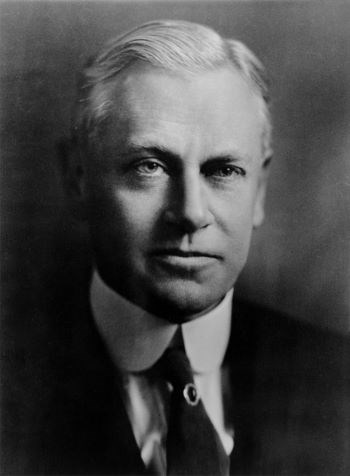
Stephen T. Mather, director of the National Park Service from 1917 to 1929. Credit: NPS History Collection.
The promoter
Born in San Francisco on July 4, 1867, Mather graduated from the University of California in 1887 and became a reporter for the New York Sun, where he met Robert Sterling Yard. He co-founded the Thorkildsen-Mather Borax Company in 1904 and within a decade was a millionaire. Sworn in as Lane's assistant on January 21, 1915, he brought money, talent, drive and charm — and a love of the outdoors from time with the Sierra Club in the High Sierra. Mather, who lived with bipolar disorder throughout his adult life, often found solace in nature. He believed that a parks bureau needed popular support, and that people would come only if there were services for them in the parks.
Selling the "vanishing West"
The transcontinental railroad was finished in 1869, but for decades most travelers saw the West only through train windows on their way to resort hotels, and wealthy Americans preferred Europe. From the 1890s, railroads built scenic lines, short lines and branches to turn western scenery, and some national parks, into destinations — and advertised them with colorful posters, brochures and leaflets, many now in the NPS History Collection. Their romantic imagery played on a vanishing frontier and told Americans they were the "legitimate heirs" of a "true America," the next step of Manifest Destiny. It leaned on stereotyped images of Native Americans, even as Native people were being removed from their lands. The Great Northern Railway and the Fred Harvey Company, partner of the Atchison, Topeka and Santa Fe, paid Native Americans to live in Glacier and at the Grand Canyon to greet visitors and give cultural demonstrations.
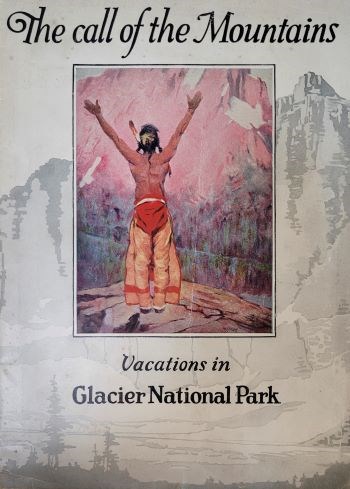
Great Northern Railway brochure for Glacier National Park, about 1927. Credit: NPS History Collection.
| Park | Railroad | Completed |
|---|---|---|
| Glacier | Great Northern | 1891 |
| Grand Canyon, South Rim | Grand Canyon Railway (Santa Fe subsidiary) | 1901 |
| Yellowstone, North Entrance | Northern Pacific | 1883 |
| Yellowstone, East Entrance | Chicago, Burlington & Quincy | 1901 |
| Yellowstone, West Entrance | Union Pacific | 1907 |
| Yellowstone, South Entrance | Chicago and North Western | 1907 |
| Yellowstone, Northwest Entrance | Chicago, Milwaukee, St. Paul and Pacific | 1927 |
| Yosemite | Yosemite Valley Railroad | 1907 |
"See America First"
The 1906 See America First Conference in Salt Lake City rallied western businesses, civic leaders and railroads to "make better citizens" of Americans ignorant of their own land: "See Europe if you must, but See America First." The Great Northern later tied its advertising to the slogan and even tried, unsuccessfully, to copyright it in 1912. World War I, which kept wealthy Americans out of Europe, gave the idea a boost.
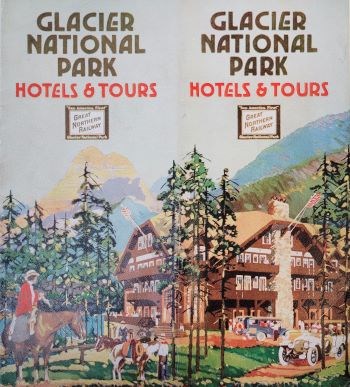
Great Northern Railway brochure promoting Glacier National Park, 1916. Credit: NPS History Collection.
"A hollow enjoyment"
Railroads also built or backed some of the parks' great lodges: the Northern Pacific funded Old Faithful Inn (1904); the Santa Fe's chief architect, Charles Whittlesey, designed El Tovar on the South Rim (1905); the Great Northern opened Many Glacier Hotel (1915). Still, lodging was scarce. "Scenery is a hollow enjoyment," Mather wrote, "to a tourist who sets out in the morning after an indigestible breakfast and a fitful sleep on an impossible bed." The railroads were reluctant hoteliers — "We do not wish to go into the hotel business," Great Northern president Louis W. Hill told the first National Parks Conference in 1911 — but Mather kept pushing. In the 1920s he persuaded Union Pacific to open the Grand Canyon's North Rim, Zion, Bryce Canyon and Cedar Breaks to rail travel, with a branch line to Cedar City, a hotel, auto stages, and the Utah Parks Company to build lodges.
The National Parks Portfolio
To win over the public and Congress, Mather commissioned his old friend Yard to write the National Parks Portfolio, nine pamphlets of romantic, patriotic text and splendid photographs. Printing 275,000 copies cost $48,000, far more than the government would pay; Mather put up the first $5,000 and 17 western railroads the rest. The first edition came out in June 1916, two months before the National Park Service was created on August 25, 1916. It went free to a handpicked elite — club members, professional societies, universities, the social register — and to every member of Congress. The railroads got a map and their ticket offices listed, though Lane's introduction, calling for more park roads, can hardly have pleased them.
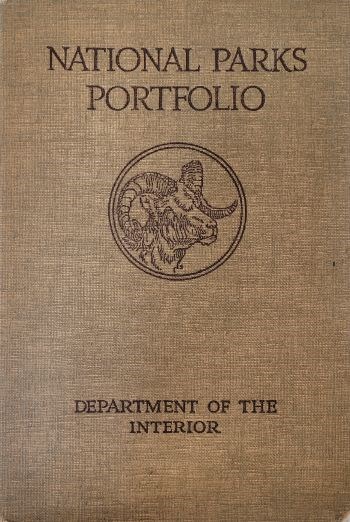
The first edition of the National Parks Portfolio, 1916. Credit: NPS History Collection.
End of a golden age
Visits rose in 1917 despite the war, as railroads promoted "park-to-park" trips and parks opened to private cars. That December the government nationalized the railroads; after the armistice, the U.S. Railroad Administration promoted the parks, distributing at least 2.5 million booklets and reaching over 115,000 people with lectures, slides and films in the first nine months of 1919. After the lines returned to private hands on March 1, 1920, Mather got them to cut fares, tighten schedules and offer "package tours."
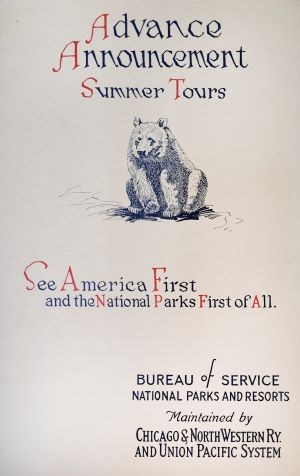
Chicago & North Western and Union Pacific brochure for 1921 summer tours. Credit: NPS History Collection.
But the car won. Private cars multiplied sixfold from 1914 to 1920, installment buying from 1919 sped that up, and free campgrounds and better roads added competition. While discrimination still limited travel for people of color, more white Americans could afford the parks from the 1920s to the 1950s. Postwar prosperity, the interstate highways and America's love of the automobile ended the golden age of railroad advertising for the national parks.
Sources
Based on "50 Nifty Finds #35: On the Same Track," National Park Service History Collection, a work of the United States government in the public domain. It cites William B. Butler, Railroads in the National Parks (2007); Cultural Resource Management 22, no. 10 (1999); the Union Pacific Railroad Museum; and TIME (2016).
I disse publikationerGrand Canyon National ParkGlacier National ParkBryce Canyon National ParkZion National ParkCedar Breaks National Monument
Licens: CC0 1.0 (offentligt eje) · Bearbejdet efter www.nps.gov
1
0
0
0

Kommentarer


