
Want to improve the page's content? Try to propose a change.
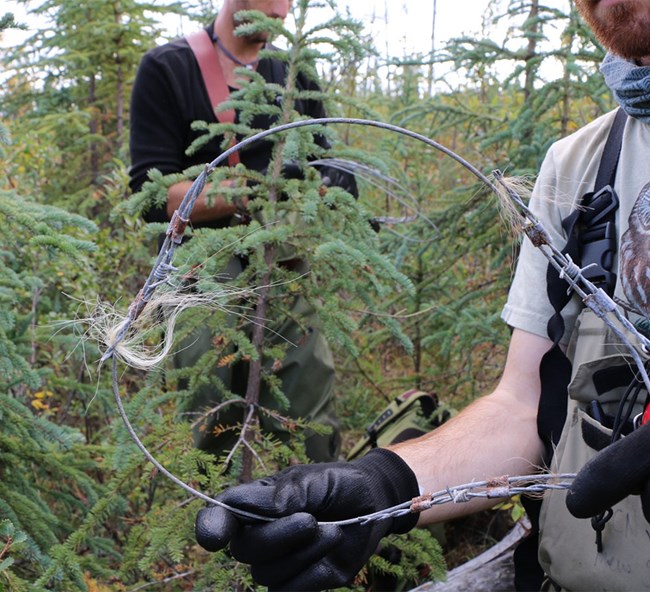
NPS biologists collect brown bear hair samples from a hair snare set along a salmon stream.
Recent studies investigating the diet of brown bears in Gates of the Arctic National Park and Preserve revealed that not only are
We sampled two 7-km sections of stream, one in the upper Kobuk watershed and the other in the upper Koyukuk watershed during a six-week period from August through early September. We returned to collect hair samples and reset hair snares every two weeks, which was no small feat considering the streams required a 225-mile flight by bush plane to access them.
Although we collected lots of hair samples (n=118) during data collection, we were still surprised that DNA analyses detected 31 individual brown bears and 5 individual black bears along the two streams. We used these data to estimate that around 24 brown bears used the Kobuk River section and about 15 brown bears used the Koyukuk River section. Surprisingly, the number of bears we estimated fishing along these streams is about the same as some coastal streams with moderate salmon runs. These Interior Alaska streams that support salmon are likely important resources for local brown bear populations, given the more nutrient-limited system in which they inhabit compared to the more coastal populations. Understanding where, when, and how many bears concentrate is vital information for conserving brown bear habitat and reducing human-bear conflicts.
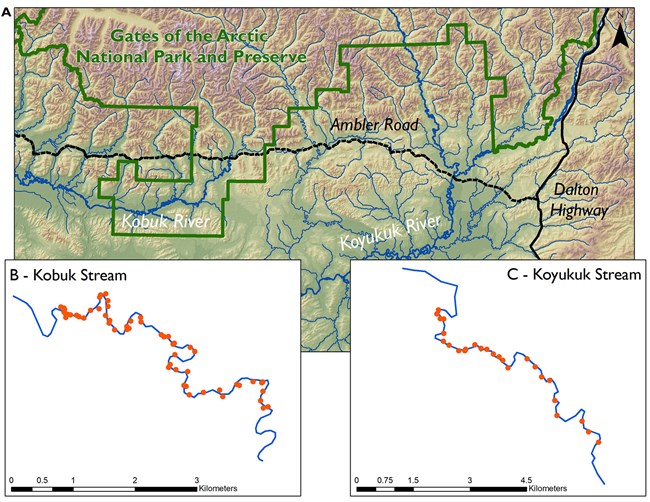
Study area (a) in the southern portion of the park (solid green line shows boundary). Hair snare locations (orange dots) along the Kobuk (b) and Koyukuk streams (c), August-September 2016-2017.
Abstract
Aggregated use along salmon-bearing (Oncorhynchus spp.) streams is common for coastal brown bears Ursus arctos; however, it is much less common in non-coastal (interior) environments, especially in the Arctic. A concurrent study of GPS-collared brown bears in the interior Brooks Range mountains, northern Alaska, revealed that salmon-bearing streams and their use by brown bears were more prevalent than previously known. Our goal was to estimate the number, gender, and species of bears (Ursus spp.) using anadromous streams while salmon were present in an area of northern, interior Alaska. We deployed single-catch breakaway hair snares on heavily-used bear trails along 7 km sections of two anadromous streams to identify individual animals through DNA genotypes. We collected 119 hair samples from August and September in 2016 and 2017 which revealed 31 unique brown bears and five American black bears Ursus americanus across both streams. Using a capture-with-replacement analysis, we estimated 24 (95% CI: 22–27) brown bears used 7 km of one stream and 15 (95% CI: 9–35) brown bears used 7 km of the other. Across both streams, we detected a higher proportion of females than males, more brown bears than black bears, and greater relatedness among bears that used the same stream. The high number of brown bears estimated along these streams belies their overall low densities in the region, while relatedness patterns suggests that bears obtain behavioral specialization through social learning. A 354 km industrial road is permitted to be constructed along the southern flanks of the Brooks Range, bisecting numerous streams and rivers, including the two sampled above. Given our findings, we identify potential mitigation measures to reduce human-bear conflicts related to aggregated brown bear use along anadromous streams.
Sorum, M. S., M. D. Cameron, A. Crupi, G. K. Sage, S. L. Talbot, G. V. Hilderbrand, and K. Joly. 2023.
Where this belongs
- Gates Of The Arctic National Park & Preserve
Where this page came from
This page was imported from National Park Service. Produced by the U.S. National Park Service and, as a work of the United States government, in the public domain.
Nobody has written it yet — it is the source material at a new address, which is why search engines are asked to skip it and why no one earns from it. It is up for grabs: take it on, and it is yours to rewrite and to earn from.
In these collectionsGates Of The Arctic National Park & Preserve
Licence: CC0 1.0 (public domain) · Adapted from www.nps.gov
1
0
0
0

Comments
Read next


