Etwas zu verbessern? Schlag eine Änderung vor.
Diese Seite ist öffentlich.
In Structural Biochemistry · Seite 178 von 952
Background Information
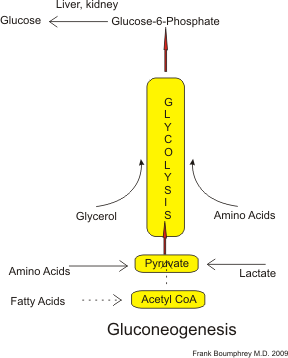
Gluconeogenesis pathway with key molecules and enzymes. Many steps are the opposite of those found in the glycolysis. (Image: Boumphreyfr, CC BY-SA 3.0)
Gluconeogenesis is a process, in which Pyruvate (a product of Glycolysis) is backward-converted into sugar, glucose in particular. Which can then be stored in the form of glycogen in animals' cells or starch and cellulose in plants' cells.
Process
There are three basis steps involved in Gluconeogenesis:
- Pyruvate to Phosphoenolpyruvate (PEP):
The enzyme pyruvate carboxylase converts pyruvate into oxaloacetate by adding the CO2 from the bicarbonate ions with the support of ATP and the coenzyme biotin. - Then oxaloacetate is converted into phosphoenolpyruvate (PEP)by the enzyme PEP carboxykinase in a process that uses GTP (guanosine triphosphate) as energy and releases CO2 as a waste product. Note that the released CO2 is actually the same CO2 molecule from the bicarbonate ion at the previous step.
- The next steps are just the reversed processes of glycolysis going from PEP back to Fructose 1,6-bisphosphate, with released products in glycolysis being reactants/cofactors in gluconeogenesis.
- Fructose 1,6-bisphosphate (Fru 1,6-P) to Fructose 6-Phosphate (Fru 6-P): This is an irreversible hydrolysis reaction catalyzed by the enzyme Fructose 1,6-bisphosphatase (FBPase-1). This reaction is heavily regulated by Fructose 2,6-bisphosphate.
- Glucose 6-Phosphate to Glucose: Fru 6-P in the previous step is converted into Glucose 6-Phosphate by reversed step of glycolysis. Glucose 6-phosphate is converted into glucose by a hydrolysis reaction.
Regulation
The main regulatory factor is the concentration of Fructose 2,6-bisphosphate (Fru 2,6-P), which controls glycolysis (catabolic pathway) and gluconeogenesis (anabolic pathway).
- First, Fru 2,6-P is the conversion of Fructose 6-Phosphate (Fru 6-P) by the enzyme Phosphofructokinase-2 (PFK-2), which uses ATP as an energy source. This is a reversible reaction, thus the reversed reaction gives back Fruc 6-P. The reversed reaction is catalyzed by the enzyme Fructose 2,6-bisphosphatase (FBPase-2) in a process releasing an inorganic phosphate.
- Second, how can Fru 2,6-P regulates glycolysis and gluconeogenesis?
In a breakdown pathway, because Fru 6-P is readily phosphorylated into Fru 1,6-P by the enzyme Phosphofructokinase-1 (PFK-1), a high concentration of Fru 2,6-P will accumulate and promotes the activity of PFK-1 and inhibits FBPase-1. Note that PFK-2 is active and FBPase-2 remains inactive to stimulate the production of Fru 2,6-P
- In the synthesis pathway, Fru 6-P concentration rises, inhibits the activity of PFK-2, and stimulates FBPase-2 to reduce the concentration of Fru 2,6-P. As the concentration of Fru 2,6-P decreases over time, the activity of PFK-1 also decreases, thus stimulating FBPase-1 to convert Fru 1,6-P into Fru 6-P,which is later ultimately converted into glucose.
Note that in the case of low glucose level in the blood: the enzyme glucagon from liver can stimulate the production of an enzyme called cAMP-dependent protein kinase, which stimulates the conversion of the PFK-2 (active)/FBPase-2 (inactive) into PFK-2 (inactive)/FBPase-2 (active). This process will inhibit glycolysis and promote gluconeogenesis to pump more glucose from liver into the blood.
Where this page came from
This page was imported from Wikibooks. From “Structural Biochemistry” on Wikibooks, by its contributors, under CC BY-SA 4.0. Changed here: set as a page; navigation and edit links left out; each image under its own licence, credited in its caption.
Nobody has written it yet — it is the source material at a new address, which is why search engines are asked to skip it and why no one earns from it. It is up for grabs: take it on, and it is yours to rewrite and to earn from.
In diesen PublikationenStructural Biochemistry
Lizenz: CC BY-SA 4.0 · Bearbeitet nach en.wikibooks.org
Kommentare