
In Lyddie - Books to Parks · page 12 of 14
In chapter 19 of Katherine Paterson's Lyddie, Lyddie finally decides to sign the petition for a ten-hour workday — and learns it is too late for this year. The organization collecting those signatures, the Lowell Female Labor Reform Association, was real, and so were the women who led it.
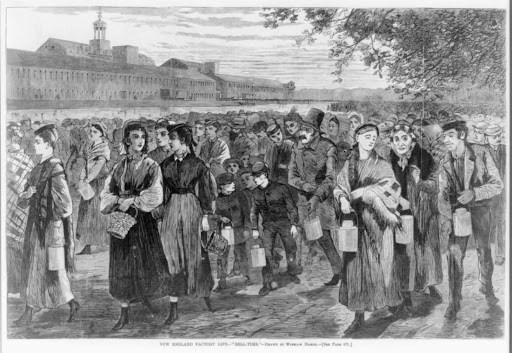
"Bell Time," New England factory workers leaving the mill: wood engraving after Winslow Homer, Harper's Weekly, July 25, 1868.
What happens in the chapter
- With her sister Rachel gone, Lyddie is lonely and throws herself into thinking about work.
- She hears that weavers at a nearby mill have signed a pledge protesting demands that they tend four looms each for less pay. She expects her friend Diana to be pleased, but Diana just looks drained.
- Lyddie finds Diana at the weekly meeting of the Female Labor Reform Association, where she is warmly welcomed. When she says she wants to sign the ten-hour petition, Diana tells her it is too late; she can try next year.
- Walking back before curfew, Diana says she is leaving Lowell. Lyddie assumes it is because of her activism, but Diana is pregnant, by a married man, and must go before anyone finds out. She thanks Lyddie for her friendship and leaves, promising to write if she can.
Was the association real?
Yes. The Lowell Female Labor Reform Association (LFLRA), the first union of working women in the United States, had Sarah Bagley as its first president and Mary Emerson as an officer. It was the main force behind Lowell's ten-hour movement: as factories demanded more work without higher wages, the "mill girls" sent petitions with thousands of signatures to the Massachusetts legislature asking for a ten-hour day in all the state's factories. The association worked with men's groups such as the New England Workingmen's Association and the New England Labor Reform League, and published a newspaper, the Voice of Industry, that pressed for better working conditions and other reforms.
The evidence
- A brother's letter, 1846. Daniel Spencer Gilman wrote that "Miss Bagley, formerly one of our factory girls & a sworn foe to the factory system," had "headed a petition of some four or five thousand names praying our legislature to reduce the hours of labor in our factories to ten per day," and that her society had bought a printing press whose paper circulated about 2,000 copies a week.
- The association's constitution, 1846. "Let the daughters of New England kindle the spark of philanthropy on every heart till its brightness shall fill the whole earth!"
- Mary Emerson, 1851, on a women's rights convention the newspapers mocked as "The Hen Convention": "hundreds stood upon their feet during each separate session … so interested in the exercises as to preserve the most perfect order."
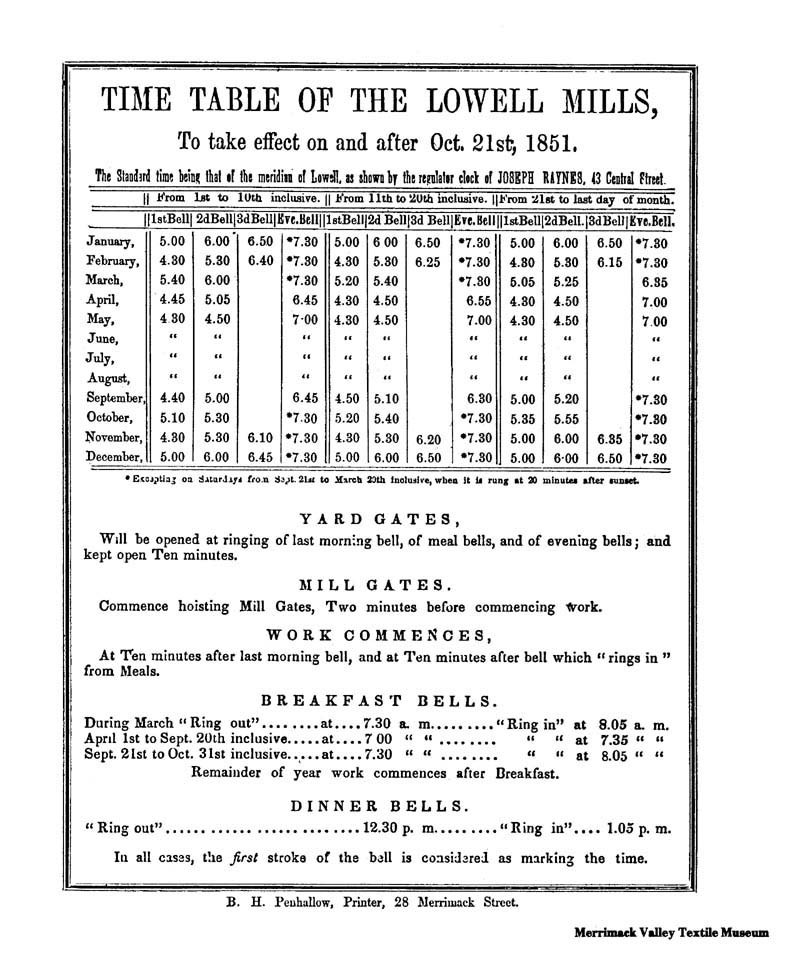
The Lowell mills' timetable, 1851. Center for Lowell History.
Questions to write about
- Opinion: Why does Diana believe she must leave Lowell? Support her point of view.
- Informative: What tactics did the LFLRA use to push for change in the factory system?
- Narrative: Lyddie is deeply lonely after Rachel leaves. Write a poem about loneliness and how to ease it.
Learn more
Lowell National Historical Park has more on the association and a short video, Time and Work in a Mill City. In the series essay "Sarah Bagley," Dr. Margot Minardi, professor of history and humanities at Reed College, looks at the union's leader.
Sources
Based on "Lyddie: Chapter 19 - Diana," from the National Park Service Books to Parks series (Lowell National Historical Park), a work of the United States government in the public domain. It quotes Daniel Spencer Gilman's letter of March 15, 1846 (Center for Lowell History), the preamble to the LFLRA constitution (Voice of Industry, 1846), and Mary Emerson's letter of October 18, 1851. Lyddie is a novel by Katherine Paterson; this page summarizes it and does not reproduce it.
In these collectionsLowell National Historical ParkLyddie - Books to Parks
Licence: CC0 1.0 (public domain) · Adapted from www.nps.gov
1
0
0
0

Comments


