
¿Quieres mejorar el contenido de la página? Propón un cambio.
En Great Smoky Mountains National Park · página 4 de 4
Feral swine threaten natural sites, cultural history, and at-risk species
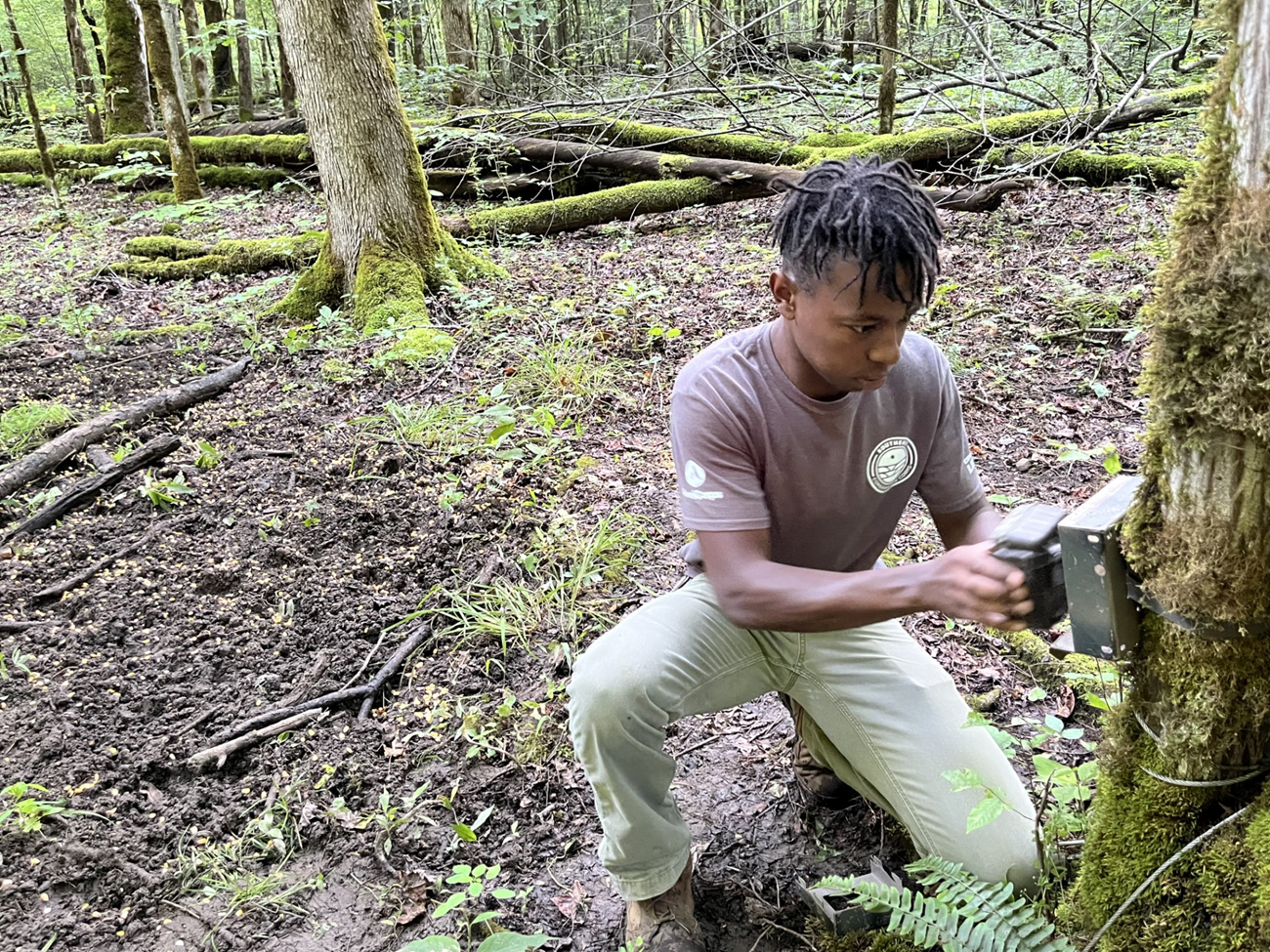
Great Smoky Mountain National Park wildlife intern, Bereket Graves, checking a game camera set to capture information on wild hogs. Necessary equipment such as this is able to be acquired thanks to Bipartisan Infrastructure Law and Inflation Reduction Act funding. NPS Photo
From sea turtle nests to cultural relics within Mississippian mound structures, feral swine are wreaking havoc on more than 40 national parks in southeastern states. While efforts are underway to address impacts across the region, at Great Smoky Mountains National Park and Canaveral National Seashore, there is help at hand, and park managers have tools, time and support to control this invasive species because of the Inflation Reduction Act and Bipartisan Infrastructure Law.
“We are trying to protect and restore natural environments, at-risk species, and cultural sites,” said Carrie Allison, wildlife biologist for the National Park Service’s Southeast Region. Feral swine threaten protected species like sea turtles at Cumberland Island National Seashore and they’re ‘rototilling’ cultural sites like the Mississippian mounds at Ocmulgee Mounds National Historic Park.

Damage from feral swine predation of sea turtle nests at Cumberland Island National Seashore. NPS / Doug Hoffman
"Large landscape restoration, also called ecosystem restoration, is key to meeting the National Park Service mission to conserve natural and cultural resources for the enjoyment, education, and inspiration of this and future generations," said Kelly Irick, the natural resources manager for the National Park Service’s Southeast Region.
Feral swine threaten healthy ecosystems and other restoration and conservation efforts by parks. Measures to control feral swine benefit people, animals, plants, and their shared environment which includes parks but also adjacent landowners facing similar impacts to agricultural lands.
Historically difficult to control
Feral swine are not native to the Americas. They were brought to North America in the 1500s by early explorers and settlers to be a food source. They established themselves easily and spread through today’s south and southeast states. In the 1900s, the Eurasian or Russian wild boar was introduced into parts of the United States for the purpose of sport hunting. Today, feral swine are a combination of escaped domestic pigs, Eurasian wild boars, and hybrids of the two.

Feral hogs navigating high waters as a result of flooding in Congaree National Park's Cooner Mound, demonstrating their adaptable nature. NPS / Dave Schuetrum
Feral swine have been reported in at least 35 states. Their population is estimated at over six million and is rapidly expanding. Range expansion over the last few decades is due to a variety of factors including their adaptability to a variety of climates and conditions, translocation by humans, and a lack of natural predators.
Jennifer Sieracki is an invasive animals ecologist for the National Park Service and sees the data on the spread of invasive animals across the Service. She says feral swine are particularly difficult to control. “A single sounder – a herd of wild swine – has the ability to eliminate entire swathes of natural areas, wipe out threatened and endangered species populations, and irreparably damage cultural sites within a park. While feral swine are usually not the only stressor affecting our park resources, they are often one of the most critical ones, and eliminating them will go a long way towards protecting and restoring the natural environments, at-risk species, and cultural sites for which we are responsible.”
Because feral swine upend natural and cultural resources, they also affect visitors’ experiences in parks. People visit Congaree National Park each spring/summer to see great numbers of fireflies at/after sunset. Park superintendent Greg Hauburger said feral swine uproot the firefly larvae which could significantly impact that annual connection of parks and people.
"Feral swine are a huge problem for Congaree," said Hauburger. "In addition to the threat to the fireflies, the hogs destroy nests of wildlife that lay eggs on or in the ground such as bobwhite quail, the Eastern wild turkey, and turtles. Their rooting causes extensive damage to our longleaf pine restoration areas and impact rare and endangered plants such as the smooth purple coneflower and Canby's dropwort. The hogs damage archaeological resources and can spread disease like pseudorabies and swine brucellosis to other wildlife and to humans."
Meanwhile, in Great Smoky Mountains National Park, efforts to control feral swine have taken place since the 1950s. Here, Supervisory Wildlife Biologist Bill Stiver is using Bipartisan Infrastructure Law funding to hire additional staff to help manage this invasive species. The park works with colleges and universities with strong wildlife management programs and veteran programs to create employment opportunities in biological sciences.
“The wild hog control program at Great Smoky Mountains National Park has a long history of engaging youth and military veterans from diverse backgrounds through internships as well as seasonal and permanent positions,” Stiver said. “The Bipartisan Infrastructure Law funding has provided the park the opportunity to hire two seasonal technicians to support wild hog control, including a recent graduate from Tuskegee University, and an active-duty veteran currently serving in the United States Marine Corps Reserves who also has a wildlife degree from The University of Tennessee.”
Since 1959, 15,000 feral swine have been removed from Great Smoky Mountain National Park.
“When you look at the map,” Allison said, “feral swine are everywhere in the southeast – on private and public lands. This is one of those projects that benefits the entire landscape.”

Feral swine damage in Ocmulgee Mounds National Historical Park. NPS / Gregory Luna Golya
Control Actions
In the case of this project, the strategy is to find and remove as many feral swine as possible. “That means trapping and euthanizing, targeted shooting by park and contract staff, and where possible, public hunting,” said Irick.
If no action is taken, feral swine have the potential to wipe out sea turtle nests on national seashores of the southeast.
“Female sea turtles come ashore to bury their eggs deep in the sand on beaches along the southeast. We’re talking feral swine locating, rooting up and eating the eggs of 90-plus percent of nests at one park in the 90’s,” Irick said.
Cumberland Island National Seashore implemented successful feral swine controls as the result of a 2000 lawsuit brought over concerns with feral swine impacts on sea turtle nesting. The control program was developed by biologist Doug Hoffman. Hoffman has been trapping, shooting and driving down the feral swine population from more than 1,000 animals at the start of the program to currently about 200 or fewer animals on average in the 36,000-acre park that is about half salt marsh and half upland habitat.

Great Smoky Mountains National Park Seasonal Biological Science Technician, Kai Shafer, setting a feral swine trap. NPS / Joe Yarkovich
Sea turtle nests and populations have expanded since the Cumberland Island National Seashore efforts – there are now about 1,000 nests on a 17-mile park beach. Hoffman said there is still potential for high losses. “A single hog can take out every nest in a small area,” he said. “They are opportunistic feeders and if they discover a piece of beach with sea turtle eggs, they’ll stick around until they’re all gone.”
That is the exact scenario that happened several years ago at Canaveral National Seashore. The park’s modest funding for feral swine controls lapsed and, Hoffman said, the park quickly lost 300 nests in a small area. Hoffman, whose control kit includes thermal imagery equipment, headed for the park, took out just a small number of hogs and the park didn’t lose another nest on that area.
“So, we’ve seen success,” Allison said, “and the Inflation Reduction Act funding provides us the ability to share resources and provide funds across the region to support feral swine control programs in our parks. Our hope is that the funding allows parks to boost their existing programs where needed to drive down feral swine populations, while also looking for ways to ensure parks can maintain their program in the future.”
About the Inflation Reduction Act
The Inflation Reduction Act provides the National Park Service with an historic opportunity to address critical ecosystem resilience, restoration, and environmental planning needs. Projects funded in national parks represent broad-scale and impactful resource investments across every corner of our nation—from Alaska to Florida to Maine.
About the Bipartisan Infrastructure Law
The Bipartisan Infrastructure Law makes critical investments in the resilience and restoration of America’s lands, skies, and waters, and enhances conservation and recreation opportunities. Visitors will see tangible results such as repaired and upgraded trails and campgrounds, removal of invasive species, as well as healthy wetlands, grasslands, and forests.
Where this belongs
- Canaveral National Seashore
- Congaree National Park
- Cumberland Island National Seashore
- Great Smoky Mountains National Park
- Ocmulgee Mounds National Historical Park
Where this page came from
This page was imported from National Park Service. Produced by the U.S. National Park Service and, as a work of the United States government, in the public domain.
Nobody has written it yet — it is the source material at a new address, which is why search engines are asked to skip it and why no one earns from it. It is up for grabs: take it on, and it is yours to rewrite and to earn from.
En estas coleccionesCanaveral National SeashoreGreat Smoky Mountains National ParkCumberland Island National SeashoreOcmulgee Mounds National Historical Park
Licencia: CC0 1.0 (dominio público) · Adaptado de www.nps.gov
1
0
0
0

Comentarios
Sigue leyendo


