¿Ves algo que mejorar? Propón un cambio.
Esta página es pública.
En The Devonshire Manuscript · página 131 de 215
| 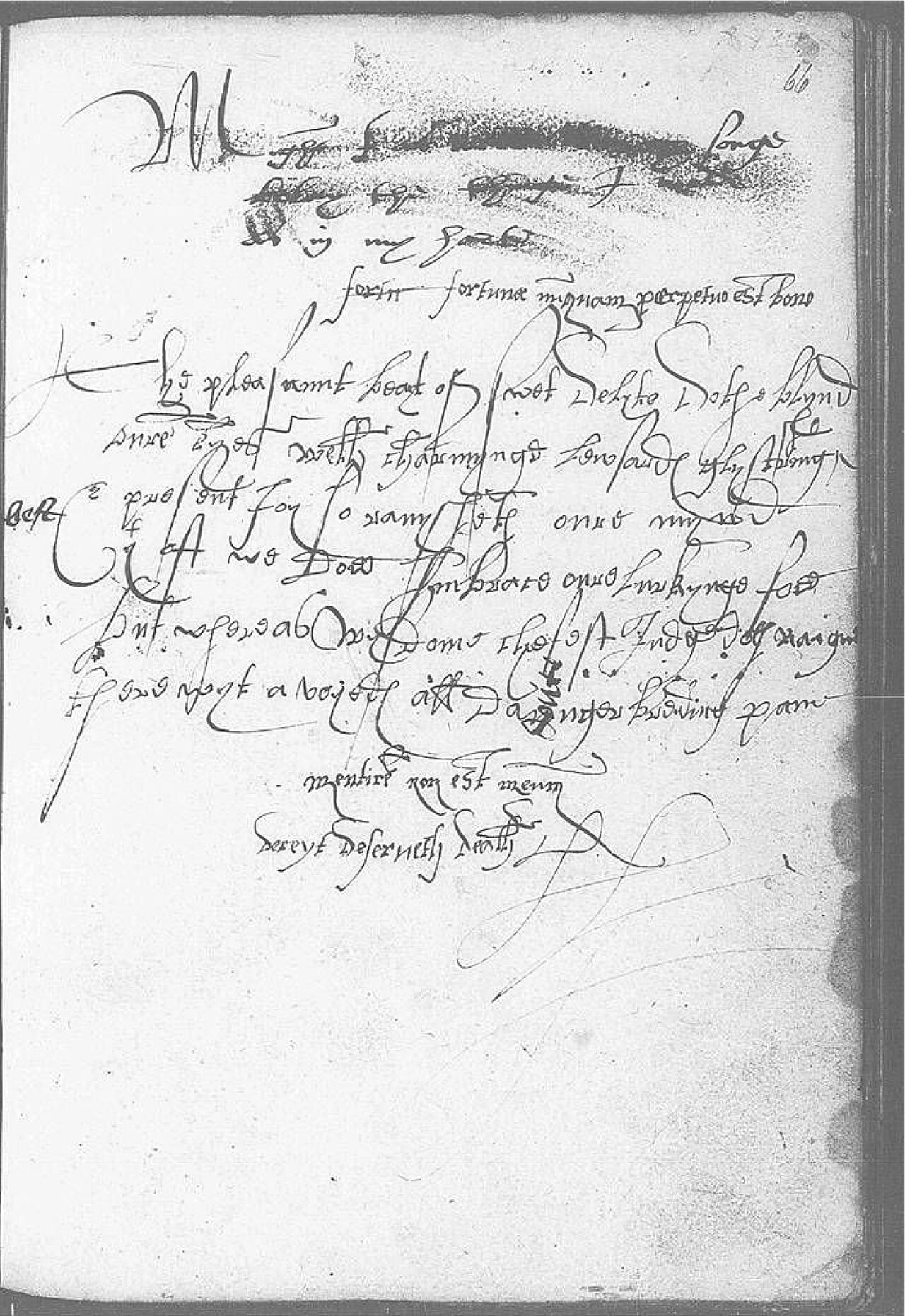
The Devonshire Manuscript facsimile 66r (Image: DMSEG, CC BY-SA 3.0) |
| --- |
|---|
f. [66r]
fortufortunee mignam pœrpetuo est bone1
1 The pleasannt beayt of swet Delyte Dothe blynd
2 oure eyes weth charmynge lewsardes{es} glystring ^sho
3 & present Ioy so ranyshekes{es} oure mynd
4 that{{th}+t+} oft we Dow Imbrace oure lurkynge foo
5 but whereas Wysdome the soft Iudge doth Raign
6 there wyt avoyedes{es} all DaDouteunger breding pain
mentire non est meum2
Deceyt Deserueth Death
Notes & Glosses
- The line reads: "fortuna mea nam perpetuo est bona," or, in English, "my luck is continuously good indeed."
- In English, the line reads: "I do not lie," literally "to lie is not mine" (to lie is not in my nature).
Commentary
Entered by H13, this poem remains unattributed. H13 also annotates the poem with two lines in Latin and one in English. The line above, “fortunee mignam poerpetuo est bone,” translates to “my fortune is continuously good indeed” and the one below, “mentire non est meum,” translates to “to lie is not in my nature.” The three annotations seem to be a personal comment on the rule of Wisdom in the speaker. The poem describes how delight blinds and makes one embrace a foe, but Wisdom makes the will avoid Danger that ultimately breeds pain (i.e. the lady’s show of reluctance and disdain). The annotations seem to indicate that the annotator aligns him/herself with the rule of Wisdom since practicing no deceit brings good fortune. Interestingly, Margaret Douglas changes the word “Daunger” for the word “Doute” in the last line. The ability of “doubt” to breed pain makes sense when a couple has confessed a reciprocal feeling. Reluctance and disdain, or “Daunger,” was frequently shown by the lady to preserve her virtue in the early stages of courtship (and was often a source of pain for the courting lover). If readers interpret this modification by Margaret Douglas in view of her relationship with Thomas Howard, then doubting one another’s feelings would be a more effective cause of pain for them than “Daunger.”
Where this page came from
This page was imported from Wikibooks. From “The Devonshire Manuscript” on Wikibooks, by its contributors, under CC BY-SA 4.0. Changed here: set as a page; navigation and edit links left out; each image under its own licence, credited in its caption.
Nobody has written it yet — it is the source material at a new address, which is why search engines are asked to skip it and why no one earns from it. It is up for grabs: take it on, and it is yours to rewrite and to earn from.
En estas publicacionesThe Devonshire Manuscript
Licencia: CC BY-SA 4.0 · Adaptado de en.wikibooks.org
Comentarios