
¿Ves algo que mejorar? Propón un cambio.
Esta página es pública.
En Principles of Economics 2e (OpenStax) · página 52 de 142
Learning Objectives
By the end of this section, you will be able to explain:
- How firms determine wages and employment when a specific labor market combines a union and a monopsony
What happens when there is market power on both sides of the labor market, in other words, when a union meets a monopsony? Economists call such a situation a bilateral monopoly.
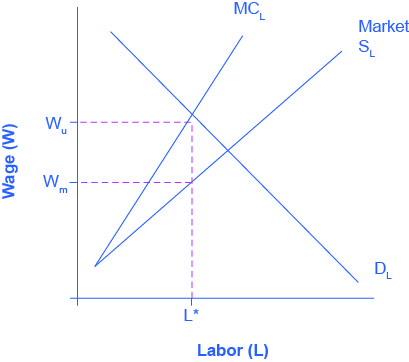
Figure 14.14. Bilateral Monopoly Employment, L*, will be lower in a bilateral monopoly than in a competitive labor market, but the equilibrium wage is indeterminate, somewhere in the range between Wu, what the union would choose, and Wm, what the monopsony would choose.
Figure 14.14 is a combination of Figure 14.6 and Figure 14.11. A monopsony wants to reduce wages as well as employment, Wm and L* in the figure. A union wants to increase wages, but at the cost of lower employment, Wu and L* in the figure. Since both sides want to reduce employment, we can be sure that the outcome will be lower employment compared to a competitive labor market. What happens to the wage, though, is based on the monopsonist’s relative bargaining power compared to the union. The actual outcome is indeterminate in the graph, but it will be closer to Wu if the union has more power and closer to Wm if the monopsonist has more power.
Where this page came from
This page was imported from OpenStax, Principles of Economics 2e. Section 14.4 of Principles of Economics 2e by Steven A. Greenlaw, David Shapiro, published by OpenStax (Rice University) under CC BY 4.0; the book is free at openstax.org. Changed here: set as a page on its own.
Nobody has written it yet — it is the source material at a new address, which is why search engines are asked to skip it and why no one earns from it. It is up for grabs: take it on, and it is yours to rewrite and to earn from.
En estas publicacionesPrinciples of Economics 2e (OpenStax)
Licencia: CC BY 4.0 · Adaptado de openstax.org
Comentarios