
¿Quieres mejorar el contenido de la página? Propón un cambio.
En National Fossil Day Logo and Artwork – Prehistoric Life Illustrated · página 2 de 3
The 2024 National Fossil Day artwork depicts a scene from the Early Jurassic at Glen Canyon National Recreation Area, drawing on some of the park's most remarkable fossil finds.
Glen Canyon: 310 million years of change
Almost 3 million people a year come to Glen Canyon for its desert views, canyons and the waters of Lake Powell, a reservoir set in canyons carved by the Colorado River and its tributaries. Established in 1972, the recreation area covers 1,254,429 acres, protected for public enjoyment and for its scientific, historic and scenic value. Its rocks tell a story that begins about 310 million years ago.
| Time | What the rocks record |
|---|---|
| Pennsylvanian–Permian (about 310–252 million years ago) | Tropical coastal seas and swamps coming and going; early sharks in the seas and reefs; early reptiles and amphibians in coastal forests (Cutler Group and later Permian marine limestones); at times, sand dunes |
| Permian–Triassic extinction, 252 million years ago | A great loss of diversity, then a slow recovery through the Triassic (Moenkopi and Chinle formations) |
| Late Triassic (Chinle Formation) | Conifer forests along rivers; large reptiles — including early dinosaurs — and amphibians ruled the land |
| Early Jurassic (Glen Canyon Group) | The park's best-known fossils, from the time dinosaurs began their true reign — the inspiration for the 2024 art |
| Cretaceous, about 100 million years ago | An interior seaway (mainly the Tropic Shale) split North America into Appalachia and Laramidia; marine reptiles, sharks, big bony fish and ammonites, plus occasional dinosaur carcasses washed in from Laramidia's coast |
| Late Cretaceous, 80–70 million years ago | Dinosaurs and other fossils in coastal deposits (Straight Cliffs and Wahweap formations) record the seaway's slow retreat |
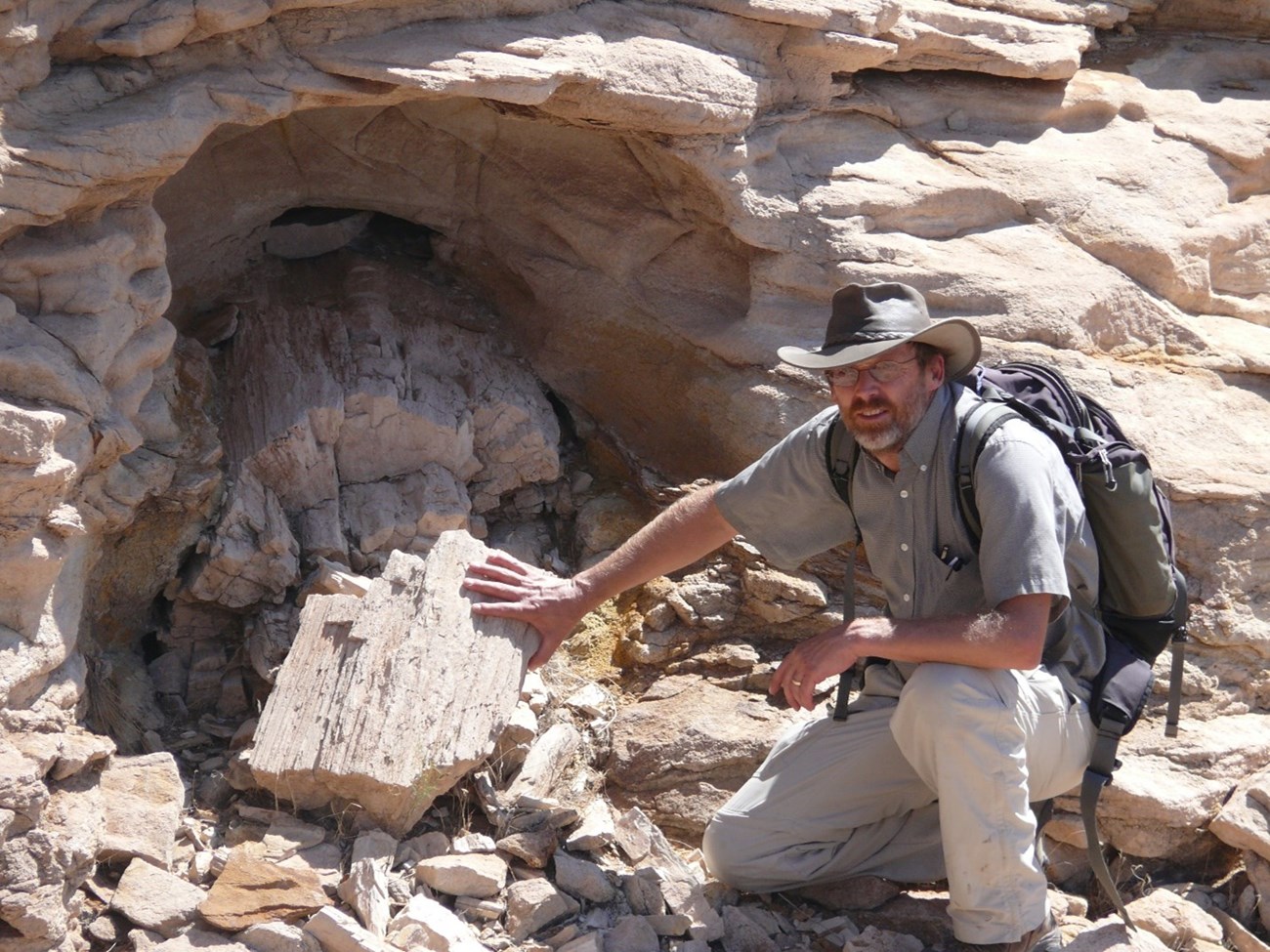
A large Late Triassic petrified log from the Chinle Formation. NPS photo.
The Glen Canyon Group
Lake Powell laps against the Glen Canyon Group, sedimentary rocks from the latest Triassic to Early Jurassic that record wind-blown sands, floodplains and desert oases — just when dinosaurs were diversifying into bigger, more complex forms.
- Wingate Sandstone (oldest, about 200 million years old): a dry sea of dunes at the very end of the Triassic and start of the Jurassic. It and the Moenave Formation are known for tracks of large reptiles, early mammal relatives and dinosaurs; nearly complete fish and some crocodiles have turned up in the Moenave west of the park, near St. George, Utah.
- Kayenta Formation: springs, ponds, lakes and rivers in a dry landscape, with a very diverse record — fish (including freshwater sharks and coelacanths), early frogs, salamanders and caecilians, early turtles, crocodiles, rhynchocephalians (early relatives of New Zealand's tuatara), pterosaurs, theropods large and small, early sauropods, armored thyreophorans, early mammal relatives, traces of worms, crustaceans, insects and swimming fish, and plants such as cycads and ferns.
- Navajo Sandstone (youngest): an erg — a dune field with little or no plant cover, though monsoon rains could fill seasonal ponds. It preserves tracks and occasional bones and teeth, including partial skeletons of the early sauropod relative Seitaad, buried by dunes; tracks of a large theropod; and the skeleton of the small theropod Segisaurus.
The scene in the art
The artwork blends the Kayenta and Navajo settings. A lone Dilophosaurus crests a dune, following the tracks of smaller plant-eaters. A group of Scutellosaurus heads over the next dune to avoid it. A family of tritylodonts forages among plants in an oasis left between the dunes by the last monsoon rains.
Dilophosaurus: the crested hunter
- First found in 1942 in the Kayenta Formation of northern Arizona by a University of California paleontologist; known from several partial skeletons.
- The top predator of its time: an estimated 23 feet long and more than 850 pounds, feeding on early sauropods, Scutellosaurus, early mammal relatives and fish.
- Its name means "two-crested lizard," for the pair of tall, thin, arched crests on its head — perhaps display structures with a horny keratin covering, like a cassowary's crest.
- Large Eubrontes tracks in the Navajo Sandstone may have been made by Dilophosaurus or something very like it. The most famous at Glen Canyon is the John Wesley Powell Track Block, a massive rock with tracks on its vertical face. Eubrontes tracks are also known from Utah, Arizona, Connecticut, Virginia and Maryland, and from France, Poland, Slovakia, the Czech Republic, Italy, Spain, Sweden, Australia, India and China.
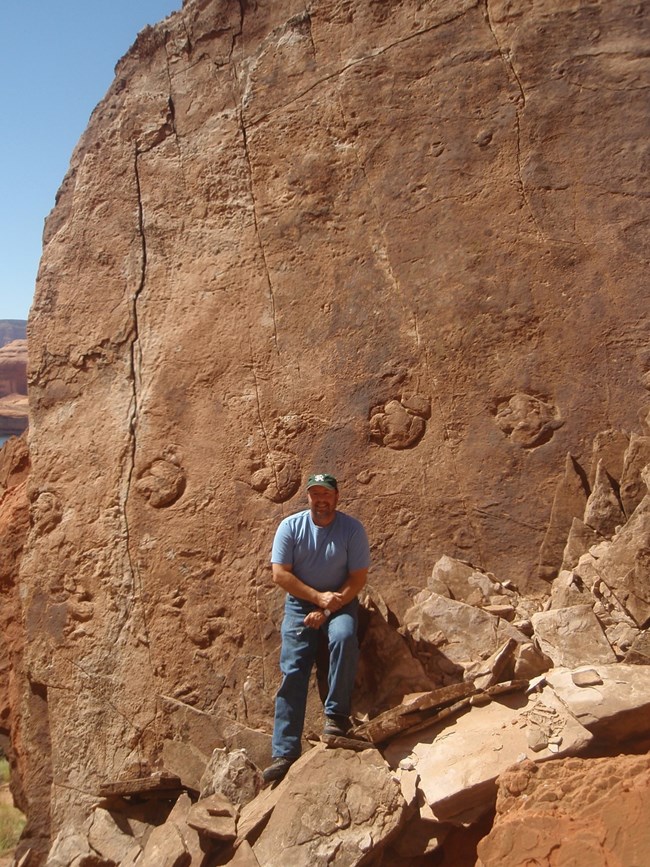
The John Wesley Powell Track Block, with large Eubrontes theropod tracks in the Navajo Sandstone. NPS photo.
Scutellosaurus: the little armored plant-eater
- Described in 1981 from partial skeletons from northern Arizona.
- An early, small member of the Thyreophora, the armored group that includes Stegosaurus and Ankylosaurus.
- Its name means "little-shielded lizard," for the several hundred osteoderms — small bones in the skin — set in rows along its neck, back, belly sides and tail.
- About 4 feet long, with a narrow, beaked skull and spade-shaped teeth for eating plants. Its limb proportions suggest it could walk on all fours and perhaps run on its hind legs to escape predators.
- Anomoepus tracks at Glen Canyon may be its footprints, showing both. Anomoepus is also known from Utah, Arizona, Connecticut, western Australia, Poland and the Czech Republic.
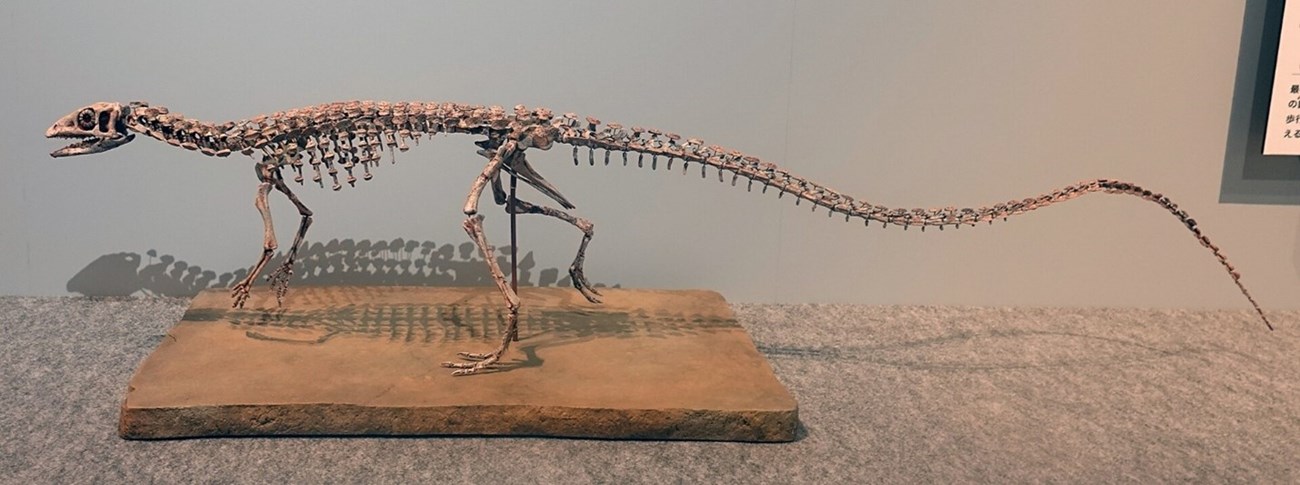
A skeletal reconstruction of Scutellosaurus lawleri. Image from the National Park Service's page.
Tritylodonts: a family underground
In early 2023, drought had dropped Lake Powell to a historic low, and the Park Service surveyed the newly exposed rock for fossils. Along with new Early Jurassic track sites, it found a rare bone bed of early mammal relatives in the Navajo Sandstone.
- Tritylodonts kept the jaw joint of their reptile-like cynodont ancestors but had hips more like today's monotremes (platypus and echidna), suggesting they laid eggs. They may be a sister group to true mammals, sharing a common ancestor.
- The bone bed held more than a dozen individuals in a small area, many still articulated — suggesting a sudden catastrophe buried them quickly. They may have lived in burrows, like some rodents such as prairie dogs today, that suddenly filled or collapsed.
- Small theropod tracks were found at the same level.
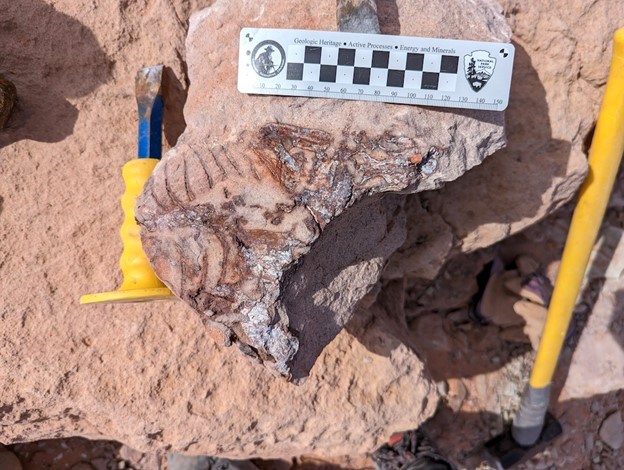
The tritylodont bone bed, discovered in early 2023. Image from the National Park Service's page.
Finds like this help reveal the diversity and evolution of the mammal family tree, let paleontologists depict Early Jurassic life more accurately, and show why careful fossil monitoring and protection on public lands matters.
Sources
Based on "Fossils of the 2024 National Fossil Day Artwork," part of the series National Fossil Day Logo and Artwork – Prehistoric Life Illustrated, National Park Service; a work of the United States government in the public domain.
En estas coleccionesGlen Canyon National Recreation AreaNational Fossil Day Logo and Artwork – Prehistoric Life Illustrated
Licencia: CC0 1.0 (dominio público) · Adaptado de www.nps.gov
1
0
0
0

Comentarios
Sigue leyendo


