
Vuoi migliorare il contenuto della pagina? Prova a proporre una modifica.
A century ago, a summer drive to Acadia National Park didn't pass fields awash in purple lupines. There are hundreds of lupine species in the world, but only one historically grew wild in Maine: the sundial lupine, Lupinus perennis. It is now considered extirpated — locally extinct — in the state. The lupine along today's roadsides is a different species, the western lupine, Lupinus polyphyllus. The two look alike but have very different stories.
At the Hulls Cove Visitor Center, the Bar Harbor Garden Club planted a native sundial lupine garden in November 2022 to tell them.
What makes a lupine
Most lupines are perennials with tall spikes of many flowers. Their leaves are whorled and palmately compound — like a sundial, with leaflets pointing out from the center like the hands of a clock. As members of the legume family (Fabaceae), they make seed pods but also spread quickly by root shoots, and they host bacteria that turn nitrogen from the air into a form plants can use. (That is why gardeners plant beans as companions — and why the notorious invader kudzu was once introduced to stop erosion.) Lupines thrive in poor, gravelly soil in fields, meadows, roadsides and cleared rights-of-way.
| Sundial lupine | Western lupine | |
|---|---|---|
| Scientific name | Lupinus perennis | Lupinus polyphyllus |
| Native range | Eastern North America, including Maine | Pacific Northwest |
| Status in Maine | Extirpated | Widespread; on Maine's advisory list for invasive potential |
| Value to local wildlife | Essential food for the endangered Karner blue butterfly; also used by clouded sulphur, eastern tailed blue and gray hairstreak butterflies, hummingbirds and native bees | Leaves toxic to Karner blue caterpillars; not a host for Acadia's native pollinators |
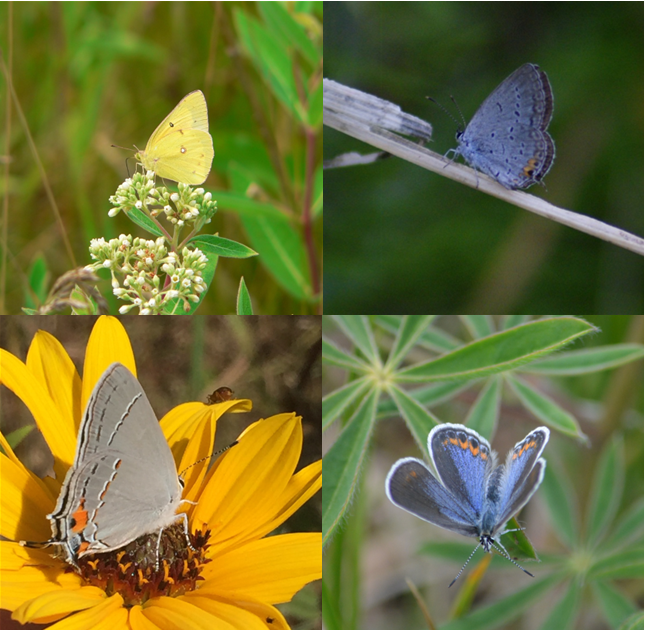
Butterflies of the sundial lupine. The clouded sulphur, eastern tailed blue and gray hairstreak live in Acadia; the endangered Karner blue (bottom right) has not been documented there. Credit: National Park Service / Jim Kaftan, National Park Service, National Park Service / Brendan Morgan, U.S. Fish and Wildlife Service / Katie Goodwin.
Plants and animals coevolve over millions of years — the monarch butterfly and milkweed are the famous example. Western lupine has partners like that in its native Northwest. Moved across a continent in a few decades, it arrives without them, and the relationships local species depended on are lost.
How the western lupine arrived
Acadia's plant life has been unusually well documented.
- The 1894 Flora of Mount Desert Island lists neither lupine. It noted that the island had only eighteen species in the legume family, only four of them native, and predicted that "when northern species of this family are introduced on the Island they flourish as well there as elsewhere."
- Updates in 1921 and 1929 still didn't include western lupine.
- In July 1934, an entomologist's notes on beetles collected on "meadow rue, lupin, and the like" mention it.
- Western lupine is estimated to have reached the Northeast by the 1950s.
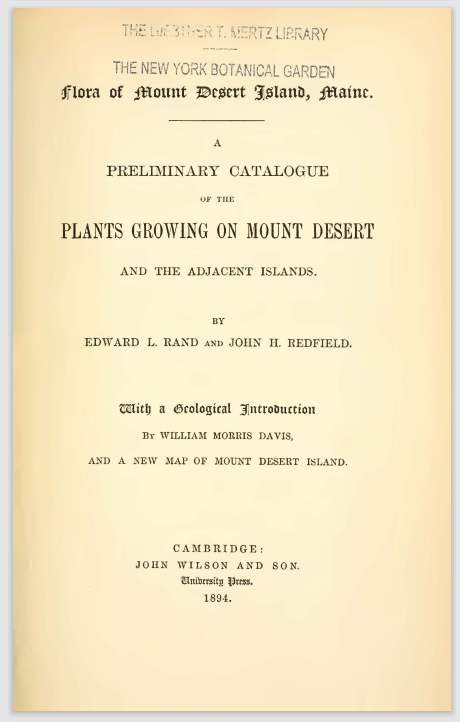
The 1894 Flora of Mount Desert Island. Image from the National Park Service's article "A Tale of Two Lupines."
Showy lupine hybrids and cultivars flourished in the elaborate gardens of the island's early-1900s villages, and escaped over the garden walls. Planted along roadsides and spreading on its own, western lupine gradually displaced the sundial lupine across the Northeast. On Mount Desert Island, it spread in a time of rapid development, road building, rising visitation and disturbances such as the Fire of 1947. Compacted, degraded soils stressed native plants, and the larger, tougher western lupine crowded them out — a common origin story for invasive plants.
In parts of the Midwest and Northeast, western lupine is now considered invasive. Its abundance and nitrogen-fixing can raise soil nitrogen beyond what native plants tolerate. Its sale isn't restricted in Maine, but it is on the state's advisory list of plants with invasive potential.
What Acadia does about it
Acadia began managing invasive plants in the late 1980s with purple loosestrife in its wetlands; its Invasive Plant Management Team now focuses on 25 species. Because lupines are a beloved part of the roadside landscape, the park doesn't currently manage them unless they threaten an at-risk species or invade important habitats such as wet meadows or mountain summits. The team has removed lupines encroaching on a large patch of milkweed to protect monarch butterfly habitat.
Whether sundial lupines and their rare pollinators ever lived on Mount Desert Island remains a natural history mystery. By planting them near their historical range, the garden club hopes to build appreciation for the flower, encourage native plants in home gardens, and bring the wider benefits of native plants back to Maine's landscapes.
Sources
Based on "A Tale of Two Lupines," Acadia National Park, National Park Service; a work of the United States government in the public domain.
In queste raccolteAcadia National Park
Licenza: CC0 1.0 (pubblico dominio) · Tratto da www.nps.gov
1
0
0
0

Commenti


