Vedi qualcosa da migliorare? Proponi una modifica.
Questa pagina è pubblica.
In The Devonshire Manuscript · pagina 123 di 215
| 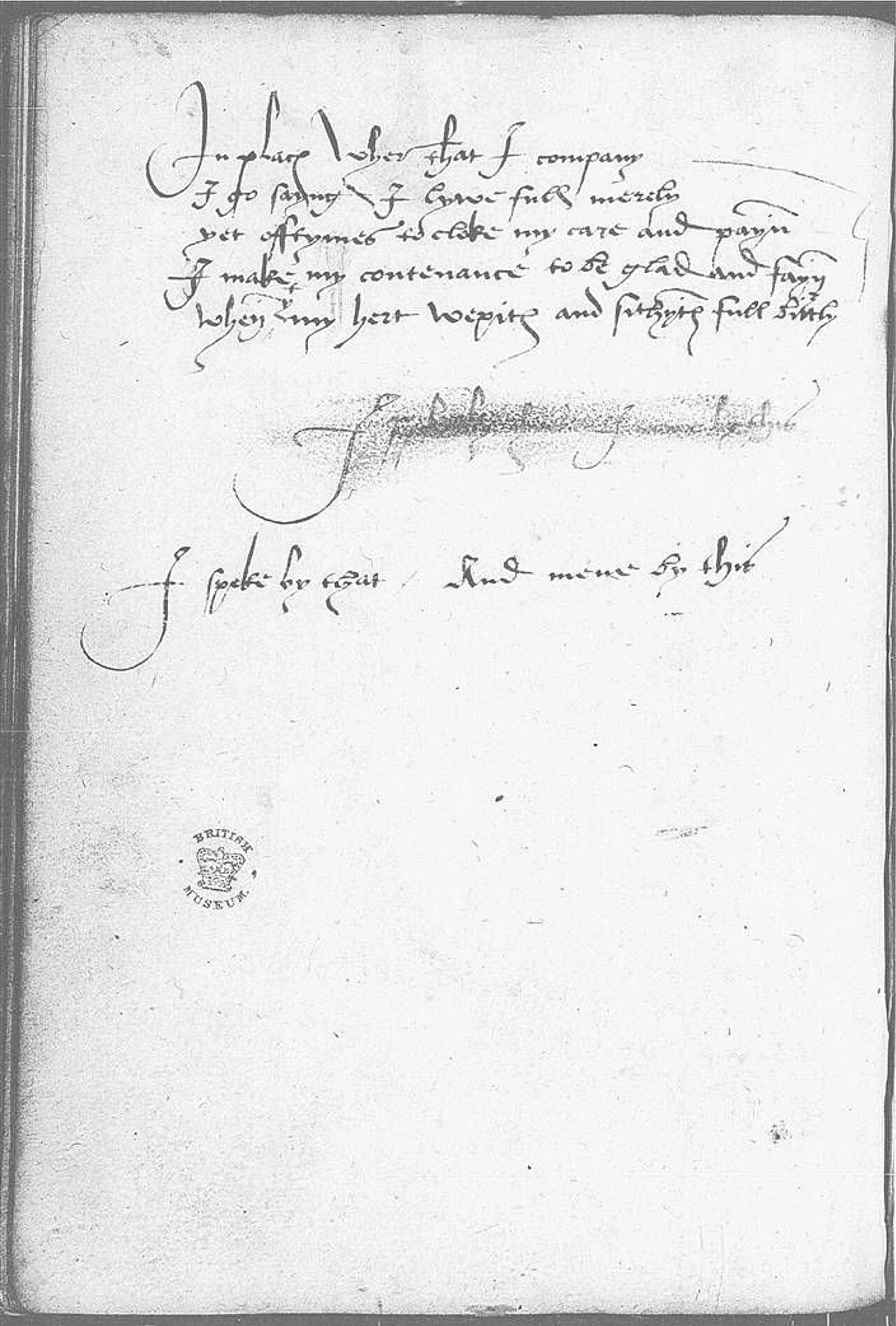
The Devonshire Manuscript facsimile 62v (Image: DMSEG, CC BY-SA 3.0) |
| --- |
|---|
f. [62v]
1 In places{es} Wher that I company
2 I go sayng I lywe full merely
3 yet offtymes to cloke my care and payn
4 I make my contenance to be glad and fayn
5 {t+r+}{{th}+t+} when that my hert wepith and sithyth full bitterly 1
[I speke by that I mene by this]
I speke by that / And mene by this
Notes & Glosses
- A superscript r following a t indicates an omitted "er" or "ur."[1]
Commentary
Entered by H7, this poem remains unattributed. This poem is one of a several entries in the manuscript that speaks of counterfeiting feelings in public (see: “Sum summ say I love sum say I moke” (58v); “I am not she be prowess off syt” (65r); “Myght I as well within my song be lay” (65v); “To cowntarffete a mery mode” (65v); “Ceaser whan the traytor of egipte” (70r); and “Whan that I call vnto my mynde” (82v-83r)). In this instance, the speaker explains how they change countenance in public to appear glad when they are not.
Works Cited
Where this page came from
This page was imported from Wikibooks. From “The Devonshire Manuscript” on Wikibooks, by its contributors, under CC BY-SA 4.0. Changed here: set as a page; navigation and edit links left out; each image under its own licence, credited in its caption.
Nobody has written it yet — it is the source material at a new address, which is why search engines are asked to skip it and why no one earns from it. It is up for grabs: take it on, and it is yours to rewrite and to earn from.
In queste pubblicazioniThe Devonshire Manuscript
Licenza: CC BY-SA 4.0 · Tratto da en.wikibooks.org
Commenti