
매거진 Help Me Understand Genetics · 95개 중 2번째 페이지
DNA, or deoxyribonucleic acid, is the hereditary material in humans and almost all other organisms. Nearly every cell in a person’s body has the same DNA. Most DNA is located in the cell nucleus (where it is called nuclear DNA), but a small amount of DNA can also be found in the mitochondria (where it is called mitochondrial DNA or mtDNA). Mitochondria are structures within cells that convert the energy from food into a form that cells can use.
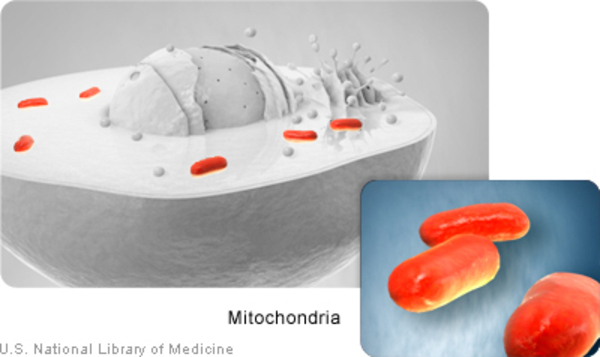
Mitochondria. Credit: U.S. National Library of Medicine.
The information in DNA is stored as a code made up of four chemical bases: adenine (A), guanine (G), cytosine (C), and thymine (T). Human DNA consists of about 3 billion bases, and more than 99 percent of those bases are the same in all people. The order, or sequence, of these bases determines the information available for building and maintaining an organism, similar to the way in which letters of the alphabet appear in a certain order to form words and sentences.
DNA bases pair up with each other, A with T and C with G, to form units called base pairs. Each base is also attached to a sugar molecule and a phosphate molecule. Together, a base, sugar, and phosphate are called a nucleotide. Nucleotides are arranged in two long strands that form a spiral called a double helix. The structure of the double helix is somewhat like a ladder, with the base pairs forming the ladder’s rungs and the sugar and phosphate molecules forming the vertical sidepieces of the ladder.
An important property of DNA is that it can replicate, or make copies of itself. Each strand of DNA in the double helix can serve as a pattern for duplicating the sequence of bases. This is critical when cells divide because each new cell needs to have an exact copy of the DNA present in the old cell.

DNA is a double helix formed by base pairs attached to a sugar-phosphate backbone. Credit: U.S. National Library of Medicine.
Where this page came from
This page was imported from MedlinePlus Genetics, National Library of Medicine. Courtesy of MedlinePlus from the National Library of Medicine; its genetics summaries and the illustrations credited to the library are in the public domain. Pictures credited to others are not copied.
Nobody has written it yet — it is the source material at a new address, which is why search engines are asked to skip it and why no one earns from it. It is up for grabs: take it on, and it is yours to rewrite and to earn from.
이 페이지가 속한 매거진Help Me Understand Genetics
이용 허락: CC0 1.0 (퍼블릭 도메인) · 출처 medlineplus.gov
1
0
0
0

코멘트


