
In Help Me Understand Genetics · page 7 of 95
Proteins are large, complex molecules that play many critical roles in the body. They do most of the work in cells and are required for the structure, function, and regulation of the body’s tissues and organs.
Proteins are made up of hundreds or thousands of smaller units called amino acids, which are attached to one another in long chains. There are 20 different types of amino acids that can be combined to make a protein. The sequence of amino acids determines each protein’s unique 3-dimensional structure and its specific function. Amino acids are coded by combinations of three DNA building blocks (nucleotides), determined by the sequence of genes.
Proteins can be described according to their large range of functions in the body, listed in alphabetical order:
| Function | Description | Example |
|---|

Immunoglobulin G (IgG). Credit: U.S. National Library of Medicine. |
| Enzyme | Enzymes carry out almost all of the thousands of chemical reactions that take place in cells. They also assist with the formation of new molecules by reading the genetic information stored in DNA. | Phenylalanine hydroxylase

Phenylalanine hydroxylase. Credit: U.S. National Library of Medicine. |
| Messenger | Messenger proteins, such as some types of hormones, transmit signals to coordinate biological processes between different cells, tissues, and organs. | Growth hormone

Growth hormone. Credit: U.S. National Library of Medicine. |
| Structural component | These proteins provide structure and support for cells. On a larger scale, they also allow the body to move. | Actin
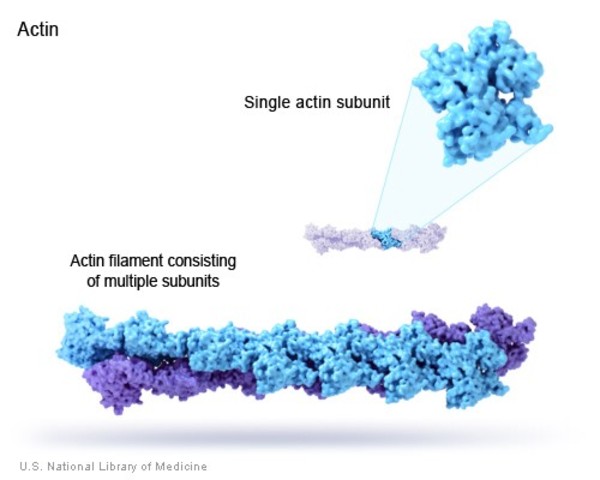
Structure of actin. Credit: U.S. National Library of Medicine. |
| Transport/storage | These proteins bind and carry atoms and small molecules within cells and throughout the body. | Ferritin

Ferritin. Credit: U.S. National Library of Medicine. |
Where this page came from
This page was imported from MedlinePlus Genetics, National Library of Medicine. Courtesy of MedlinePlus from the National Library of Medicine; its genetics summaries and the illustrations credited to the library are in the public domain. Pictures credited to others are not copied.
Nobody has written it yet — it is the source material at a new address, which is why search engines are asked to skip it and why no one earns from it. It is up for grabs: take it on, and it is yours to rewrite and to earn from.
In these publicationsHelp Me Understand Genetics
Licence: CC0 1.0 (public domain) · Adapted from medlineplus.gov
1
0
0
0

Comments


