
Viu algo para melhorar? Proponha uma alteração.
Em Help Me Understand Genetics · página 4 de 95
In the nucleus of each cell, the DNA molecule is packaged into thread-like structures called chromosomes. Each chromosome is made up of DNA tightly coiled many times around proteins called histones that support its structure.
Chromosomes are not visible in the cell’s nucleus—not even under a microscope—when the cell is not dividing. However, the DNA that makes up chromosomes becomes more tightly packed during cell division and is then visible under a microscope. Most of what researchers know about chromosomes was learned by observing chromosomes during cell division.
Each chromosome has a constriction point called the centromere, which divides the chromosome into two sections, or “arms.” The short arm of the chromosome is labeled the “p arm.” The long arm of the chromosome is labeled the “q arm.” The location of the centromere on each chromosome gives the chromosome its characteristic shape, and can be used to help describe the location of specific genes.
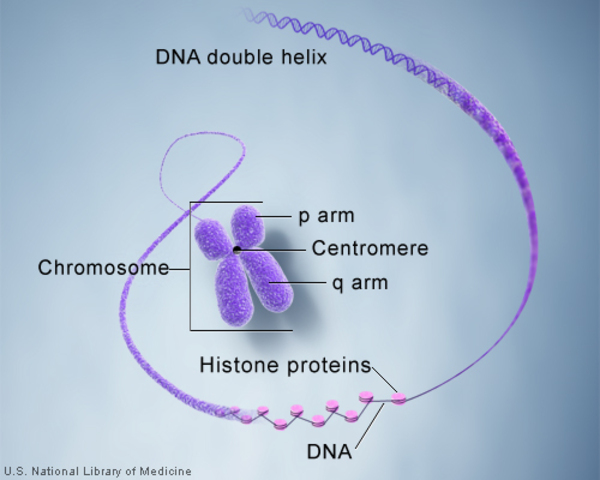
DNA and histone proteins are packaged into structures called chromosomes. Credit: U.S. National Library of Medicine.
Where this page came from
This page was imported from MedlinePlus Genetics, National Library of Medicine. Courtesy of MedlinePlus from the National Library of Medicine; its genetics summaries and the illustrations credited to the library are in the public domain. Pictures credited to others are not copied.
Nobody has written it yet — it is the source material at a new address, which is why search engines are asked to skip it and why no one earns from it. It is up for grabs: take it on, and it is yours to rewrite and to earn from.
Nestas publicaçõesHelp Me Understand Genetics
Licença: CC0 1.0 (domínio público) · Adaptado de medlineplus.gov
1
0
0
0

Comentários


