Есть что улучшить? Предложите правку.
Эта страница общедоступна.
В издании Biology (OpenStax) · страница 123 из 205
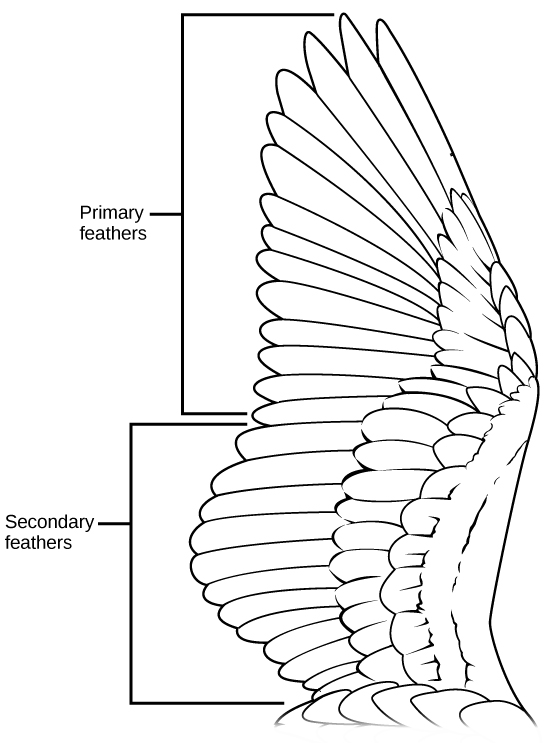
Primary feathers at the wing tip provide thrust; secondary feathers nearer the body provide lift. Illustration: OpenStax, CC BY 4.0.
What most obviously sets birds apart from other living vertebrates is feathers, which are modified scales. Bats fly without them, but birds depend on feathers and wings, along with many other changes to body and physiology, to fly.
Built for flight
Warmth. Birds are endothermic — they make their own body heat — and flying takes a great deal of energy, so their metabolism runs fast. Feathers, like mammals' fur, keep the heat in. Down feathers are the best insulators, trapping air between them; newly hatched birds are covered in down, and many other feathers have a downy base.
Lift and thrust. Wing feathers are flexible and separate as air passes through, reducing drag. Flight feathers are asymmetrical, which shapes the airflow and helps provide lift and thrust. Primary feathers, at the wing tip, provide thrust; secondary feathers, attached to the forearm, provide lift; and contour feathers smooth the body's surface so that air flows cleanly over it.
Muscle. The wings are flapped mainly by two chest muscles, the pectoralis and the supracoracoideus, which make up a larger share of body mass than in most mammals. They attach to a keel, a blade on the breastbone shaped like a boat's, and birds' breastbones are larger than other vertebrates'. The two collarbones are fused into the flexible furcula, or wishbone, which bends to support the shoulder during flapping.
Light as possible
The heavier the body, the more muscle power flight takes; the ostrich, the largest living bird, cannot fly. Flying birds save weight in several ways:
- Hollow bones. Many birds have pneumatic bones, hollow rather than filled with tissue, reinforced by internal struts and sometimes connected to air sacs. They are more extensive in large birds than small ones, and the skulls of almost all birds are pneumatic.
- No bladder. Birds have a cloaca, which reabsorbs water from waste back into the blood. Uric acid is concentrated into urate salts and expelled with the faeces, so no heavy load of urine is carried.
- One ovary. Most bird species have only one ovary instead of two.
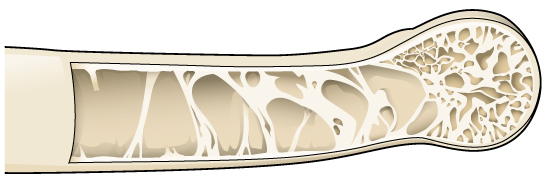
Many birds have hollow, pneumatic bones, which make flight easier. Illustration: OpenStax, CC BY 4.0.
Breathing in one direction
The air sacs that reach into the bones also connect to the lungs. In mammals, air moves in and out of the lungs along the same path. In birds it flows one way through the lungs: on the in-breath, air goes from the windpipe into air sacs behind the lungs and then through the lungs to air sacs in front; on the out-breath, air from the sacs passes through the lungs and out. Blood flows across that one-way stream, making gas exchange very efficient.
Descended from dinosaurs
Bird bones are fragile and fossilize poorly, so birds' history is still partly unclear. Birds are diapsids, with two openings in the skull, and belong to the archosaurs, with crocodiles and dinosaurs. It is commonly accepted that birds evolved from dinosaurs.
Oddly, not from the "bird-hipped" Ornithischia but from the "lizard-hipped" Saurischia, one branch of which led to long-necked plant-eaters such as Apatosaurus, the other to the bipedal predators called theropods, which include birds. Theropod fossils share with birds the structure of the hip and wrist and a wishbone.
Archaeopteryx, from the late Jurassic around 150 million years ago, sits between the two. It had a dinosaur's skeleton and teeth, but also flight feathers, a trait found among living animals only in birds; some scientists call it a bird, others a dinosaur. Older feathered dinosaurs are known, but their feathers were not built for flight.
How flight began is still debated. The arboreal hypothesis says tree-dwelling ancestors glided from branch to branch before they could flap; the terrestrial hypothesis says wings first helped running animals, then took over flight. How endothermy evolved is also open: feathers help only if the body makes heat, and making heat pays only if feathers keep it in, so one may have evolved first for some other reason.
In the Cretaceous, the dominant birds were the Enantiornithes, "opposite birds", whose foot bones joined differently from modern birds'; they died out with the Cretaceous. Alongside them lived the Ornithurae, the line of modern birds, which spread widely in the Cenozoic. Today's birds, the Neornithes, fall into two groups: the flightless ratites (Paleognathae), such as ostriches, emus, rheas and kiwis, and the Neognathae, all the rest.
Sources
- Connie Rye, Robert Wise, Vladimir Jurukovski, Jean DeSaix, Jung Choi and Yael Avissar, Biology, section 29.5, "Birds", OpenStax (Rice University), licensed under CC BY 4.0. Changed: rewritten in hubnx's own words and shortened, the career feature left out, and figures adapted from other people's work not reproduced; the illustrations are the book's. This page is shared under the same licence.
В изданияхBiology (OpenStax)
Лицензия: CC BY 4.0 · По материалам openstax.org
Комментарии

Читать дальше