此页面是公开的。
来自专栏 Lentis · 第 63 篇,共 351 篇
From torches to lightbulbs, artificial light has helped illuminate the world. Cheaper, brighter, and longer-lasting lights have improved human's ability to navigate, work, and feel comfortable in darkness. However, the increased accessibility and effectiveness of lighting can be excessive and wasteful. Known as light pollution, this man-made phenomenon has adverse effects on both the natural environment and human society.
Types of Light Pollution
- Light trespass: Poorly directed sources spilling unwanted light over to neighboring areas.[1]
- Glare: Intensely bright light sources can be hazardous, blinding and distracting people from potential dangers.
- Skyglow: Light-concentrated urban areas propagate light upward, blocking vision of the night sky.
Astronomical Impact
Skyglow reduces contrast between astronomical objects and the sky, and has become problematic to observatories. Filters can reduce the effects of light pollution, but come with several drawbacks. [2]
An example of poor outdoor lighting that allows light to escape sideways and upwards. (Image: CC BY-SA 2.0)
Palomar Observatory was selected as the site of the Hale Telescope in the 1930s, as Palomar Mountain was largely free of interference from city lights. The development of cities in Southern California since then has greatly hampered the ability of Palomar Observatory to conduct research. In response, the observatory has worked with city, county, and state governments to pass local ordinances. These ordinances require outdoor light to be directed and shielded properly, limit the correlated color temperature (CCT) to warmer color temperatures, and restrict the hours outdoor lights can be on. [3]
The International Dark-Sky Association (IDA) is a non-profit organization founded by astronomers in 1988. Its mission statement is "to preserve and protect the night time environment and our heritage of dark skies through quality outdoor lighting." Today, the IDA has 64 chapters in 18 countries. The IDA raises awareness about the dangers of light pollution, and promotes solutions for responsible outdoor lighting. [4] Its Fixture Seal of Approval program certifies outdoor lighting that minimize light pollution. In order to be certified, lighting must be fully shielded, emit no light above the horizontal plane, and emit 3000K or lower light, among other criteria. The page also links to retailers that sell attachable light shields. [5] The IDA also designates Dark Sky Reserves, land specifically protected for its exceptional night skies or environments. Restrictions on light pollution in these reserves promote astronomy, and limit disruption of wildlife at night. [6]
Environmental Impact
Light pollution at night is a significant driver in the decline of insect populations. Insects are lured to lights, where they are killed on contact, or by exhaustion. Light also makes insects more vulnerable to predators, and can disrupt mating signals. [7]
Light pollution also disrupts birds migrating at night. Artificial light at night not only disrupts the circadian rhythm of birds, it disorients their navigation. [8] Migrating song birds are more likely to collide with buildings than other species. When song birds are disoriented by light, they can call out to others, increasing flock size and leading to more collisions. [9] Fatal Light Awareness Program (FLAP) Canada is a Canadian charity which is dedicated to "safeguarding migratory birds in the built environment through education, policy development, research, rescue and rehabilitation." FLAP keeps track of bird collision statistics, and provides solutions to keep birds safe. [10]
Experiments show that under artificial light, tadpoles have slower growth, with metamorphosis greatly reduced. Ponds where frogs breed can be temporary, and dry up, so this slower growth is dangerous to newly hatched tadpoles. Frogs are also being forced from breeding grounds, as they tend to avoid breeding in lit areas. [11]
Plants rely on light not only for energy, but also information. The timing, intensity, and spectral composition of natural cycles of light are all important for plants. Trees under streetlights can retain leaves longer than usual, delaying dormancy, disrupting their ability to survive the winter. [12]
Unlike the IDA for astronomical impact, there is not a significant organization solely dedicated to combating the environmental impacts of light pollution.
Human Impact
LED Lighting
High pressure sodium lamps, which date back to 1964, are the most commonly used lighting throughout the developed world. However, new light installations are dominated by a more efficient technology: light-emitting diodes (LEDs), which convert electrical energy directly into light as opposed to heat.[13] LEDs are up to 50 percent more energy efficient than traditional sodium bulbs and can last 15 to 20 years.[14]
Health & Safety
New land development offers the easiest way to opt for LED lighting, but scheduled upkeep and retrofitting projects also present opportunities. In Detroit, a growing number of dark streets have been symbolic of the city’s decline in recent decades. In 2014, nearly half of Detroit’s 88,000 streetlights were defunct. The impact was palpable for the community: restaurants and small businesses saw significantly reduced foot traffic, especially in the winter months, as many residents avoided going out after dark. Detroit has since replaced all 88,000 sodium lamps with 65,000 LED streetlights, and communities have rebounded. Energy efficiency gains from the LEDs have yielded $3 million in annual electricity savings and cut 40,000 tons worth of carbon emissions a year.[15]
LED streetlights have also taken hold in New York City. Similar to Detroit, LEDs are expected to save the city a chunk of change: $14 million a year between energy bills and less frequent maintenance. In the Queens neighborhoods of Corona, residents have welcomed LEDs as a crime deterrent and improvement to the accessibility of public spaces after dark. Not all New Yorkers share the same sentiment, however. Since the inception of LED retrofitting projects, hundreds of grievances citing light trespass have been filed. Residents in Windsor Terrace, Brooklyn say the lights are so piercing that ordinary curtains are inadequate and make it difficult to sleep.[16]
Science legitimizes concerns around the suitability of LEDs as the go-to choice of lighting in urban areas. According to the American Medical Association, blue-rich light from LED streetlights can suppress melatonin levels. The wavelength of this light is disruptive to circadian rhythms, the impact of which is estimated to be five times greater than conventional sodium lamps.[17] Excessive nighttime light exposure has also been linked with higher rates of breast cancer.[18]
Light Pollution in Hong Kong
Hong Kong boasts some of the world's worst light pollution. A research study found that areas like Tsim Sha Tsui were 1200 times brighter than a normal night sky [19]
. Despite acknowledgement of light pollution as an issue, the Hong Kong government has avoided regulatory legislation. In 2011, the government created the Task Force on External Lighting to look into the feasibility of a “lights-off” mandate from 11 pm to 7 am.[20]
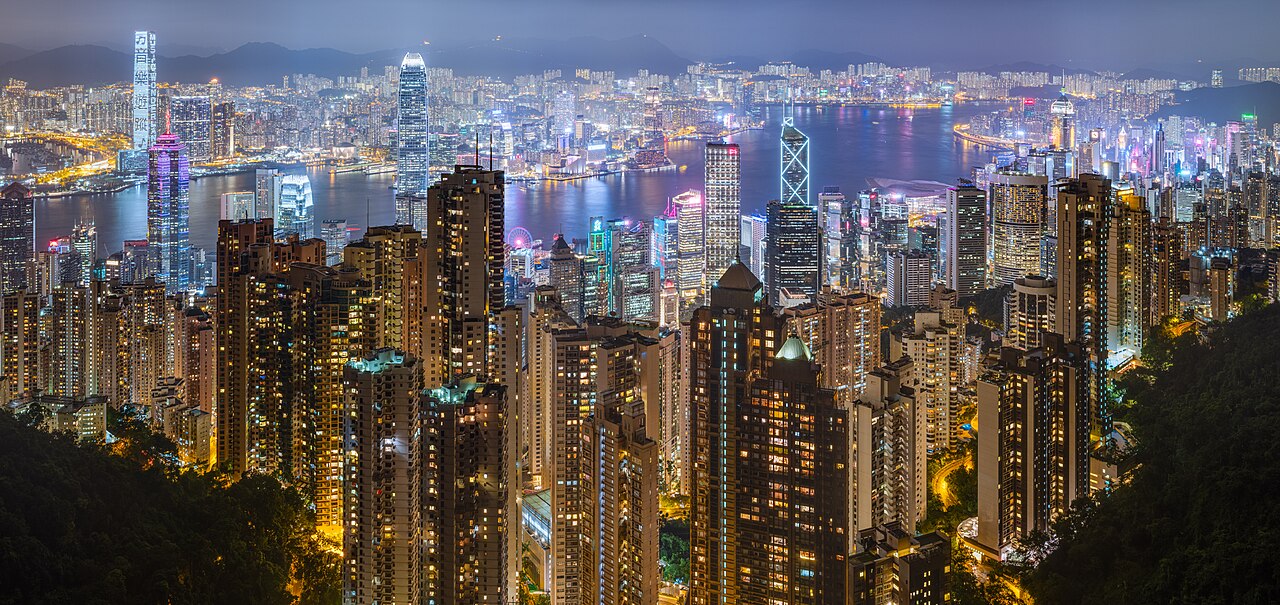
"The Pearl of the Orient's" vibrant, luminous skyline at night. (Image: Benh LIEU SONG ( Flickr ), CC BY-SA 4.0)
Groups favoring strict restrictions are residents who live near brightly-lit commercial areas. Advocacy groups like Friends of the Earth HK (FOE HK) and Green Sense raise awareness.[21] [22] A FOE HK-sponsored survey showed that 70 percent of residents wanted a reduction in light intensity. An equal percentage felt that excessive night lighting contributed to anxiety, weariness, and sleep loss.[23] FOE HK director Edwin Lau criticizes current guidelines for being too general, believing the only way to tackle light pollution is for unambiguous government legislation on brightness and illumination time: “the government has the noise control ordinance… I see no reason why it shouldn’t be the same with lighting”.[24] These critics have pointed to advertising boards and business signs as biggest offenders of light pollution, disturbing people with light trespass and glare.
Opposition to “lights-off” mandates comprise businesses who rely on brightly-lit advertising to attract customers. Hong Kong has commercialized excessive lighting for tourism, such as the world’s largest permanent light show, A Symphony of Lights. Chief Executive Donald Tsang opposed an event to briefly turn off lights across the city, saying that it would impact the daily light show: “the campaign would give negative publicity to Hong Kong as an international metropolis and a major tourist attraction”.[25] Residents less impacted by light pollution agree, fearing “lights-off” would harm Hong Kong’s cultural status as “The Pearl of the Orient”. [26]
After the 2011 Task Force delivered inconclusive results, the government issued a voluntary charter in 2016 for businesses who agree to “lights-off”. The efficacy of the charter remains unknown, as light pollution complaints have continued to rise.[27] Light pollution in Hong Kong is an environmental issue: groups who raise awareness to a seemingly invisible foe compete against groups who see regulation as an economic detriment. Other cities like Toronto have implemented legislation, but the Hong Kong government seems to side with the businesses. It may have to reconsider priorities as the same excessive lighting that proudly showcases the city’s affluence increasingly disgruntles its residents.
Conclusion
Artificial light, the answer to challenges humans face in darkness, has adverse side effects. Lighting of public spaces offers utility to some groups at the expense of others. Man-made light also has consequences for the environment. Among factors degrading biodiversity, light pollution is often underestimated. Light pollution solutions do not require productivity sacrifices. While light pollution is not a priority for many policymakers, future extensions to this casebook may examine governments like Toronto who have successfully implemented efforts to curtail light pollution.
References
- ↑ Globe at Night (2013). What is Light Pollution?. https://www.globeatnight.org
- ↑ Patat, F. (2010). The Effects of Improper Lighting on Professional Astronomical Observations. arXiv: Instrumentation and Methods for Astrophysics.
- ↑ Palomar Observatory (2017). Light Pollution. https://sites.astro.caltech.edu/palomar/community/lightpollution.html
- ↑ International Dark-Sky Association (n.d.). Our Work. https://www.darksky.org/our-work/
- ↑ International Dark-Sky Association (n.d.). Fixture Seal of Approval. https://www.darksky.org/our-work/lighting/lighting-for-industry/fsa/
- ↑ International Dark-Sky Association (n.d.). International Dark Sky Places. https://www.darksky.org/our-work/conservation/idsp/
- ↑ Rydell, J (1992). "Exploitation of Insects around Streetlamps by Bats in Sweden". Functional Ecology. 6 (6): 744–750. doi:10.2307/2389972. JSTOR 2389972.
- ↑ Loss SR, Lao S, Eckles JW, Anderson AW, Blair RB, Turner RJ (2019). Factors influencing bird-building collisions in the downtown area of a major North American city. PLoS ONE 14(11): e0224164. https://doi.org/10.1371/journal.pone.0224164
- ↑ Winger, B. M., Weeks, B. C., Farnsworth, A., Jones, A. W., Hennen, M., & Willard, D. E. (2019). Nocturnal flight-calling behaviour predicts vulnerability to artificial light in migratory birds. Proceedings. Biological sciences, 286(1900), 20190364. https://doi.org/10.1098/rspb.2019.0364
- ↑ FLAP Canada (2020). Fatal Light Awareness Program Canada. Our Impact. https://flap.org/our-impact/
- ↑ Dananay, K. L., & Benard, M. F. (2018). Artificial light at night decreases metamorphic duration and juvenile growth in a widespread amphibian. Proc. R. Soc. B, 285(1882), 20180367.
- ↑ Gaston KJ, Bennie J, Davies TW, Hopkins J. The ecological impacts of nighttime light pollution: a mechanistic appraisal. Biol Rev Camb Philos Soc. 2013 Nov;88(4):912-27. doi: 10.1111/brv.12036. Epub 2013 Apr 8. PMID: 23565807.
- ↑ Harris, T., Pollette, C., & Fenlon, W. (2020, July 27). How Light Emitting Diodes (LEDs) Work. HowStuffWorks. https://electronics.howstuffworks.com/led.htm https://electronics.howstuffworks.com/led.htm
- ↑ Kramer, J. (2019, February 25). Can LED streetlights save cities money without negative health consequences? Mobility Lab. https://mobilitylab.org/2019/02/25/can-led-streetlights-save-money-without-negative-health-consequences/ https://mobilitylab.org/2019/02/25/can-led-streetlights-save-money-without-negative-health-consequences/
- ↑ Kimmelman, M. (2017, January 10). The Lights Are On in Detroit. The New York Times. https://www.nytimes.com/2017/01/10/arts/the-lights-are-on-in-detroit.html
- ↑ Chaban, M. (2016, July 13). New York’s LED Streetlights: A Crime Deterrent to Some, a Nuisance to Others. The New York Times. https://www.nytimes.com/2016/07/12/nyregion/new-yorks-led-streetlights-receive-a-lukewarm-reception.html
- ↑ American Medical Association. (2016, June 14). AMA adopts guidance to reduce harm from high intensity street lights. https://www.ama-assn.org/press-center/press-releases/ama-adopts-guidance-reduce-harm-high-intensity-street-lights
- ↑ James, P., Bertrand, K. A., Hart, J. E., Schernhammer, E. S., Tamimi, R. M., & Laden, F. (2017). Outdoor Light at Night and Breast Cancer Incidence in the Nurses’ Health Study II. Environmental Health Perspectives, 125(8), 087010.
- ↑ Pun, C. S. & So, C. W. (2011). Night sky brightness monitoring in Hong Kong - a city wide light pollution assessment. Environmental Monitoring and Assessment, 184(4), 2537-2557. https://doi.org/10.1007/s10661-011-2136-1
- ↑ Chau, A. (2015). Report of the Task Force on External Lighting. Task Force Report
- ↑ Friends of the Earth (HK) (n.d.). About Us. Friends of the Earth (HK)
- ↑ Green Sense (n.d.). About Us. Green Sense
- ↑ Karol, D., Ng, M., Varlamova, M., & Walls, G. (2010). The Effects of Light Pollution in Hong Kong. WPI. Final Report
- ↑ Lau, S. Y., Ng. K. L., Tsang H. T., & Vong, Y. C. C.(2014). Light pollution in Hong Kong. CityU Institutional Repository. http://lbms03.cityu.edu.hk/oaps/ef2014-1205-lsy694.pdf
- ↑ China Sustainable Industrial Development Network (2006). H.K. lights dimmed for 3 min. to raise concern over air pollution. http://www.csid.com.cn/NewsInfo.asp?NewsId=41567
- ↑ Task Force Report
- ↑ Legislative Council Commission (n.d.). Regulation of nuisance caused by external lighting. https://www.legco.gov.hk/
Where this page came from
This page was imported from Wikibooks. From “Lentis” on Wikibooks, by its contributors, under CC BY-SA 4.0. Changed here: set as a page; navigation and edit links left out; each image under its own licence, credited in its caption.
Nobody has written it yet — it is the source material at a new address, which is why search engines are asked to skip it and why no one earns from it. It is up for grabs: take it on, and it is yours to rewrite and to earn from.
收录于这些专栏Lentis
许可协议: CC BY-SA 4.0 · 改编自 en.wikibooks.org
留言