
নোড এর বিষয়বস্তু উন্নত করতে চান? একটি সম্পাদনা অনুরোধ করার চেষ্টা করুন.
Elon Musk argues the case could set a major legal precedent, warning that allowing OpenAI’s shift would legitimize misuse of charitable organizations. He says OpenAI was originally founded as a nonprofit, open-source effort to counter companies like Google and prioritize AI safety. His core claim: transitioning to a for-profit structure violated that founding mission and risks concentrating power in ways that could be dangerous. Musk ties his concerns to early disagreements with Larry Page and past attempts to raise AI risks with Barack Obama. He warns AI could surpass human intelligence soon and poses existential risks if controlled by untrustworthy actors. He frames his companies—SpaceX, Neuralink, and xAI—as part of a broader effort to safeguard humanity. He says early agreement with Sam Altman was to keep OpenAI as a nonprofit, potentially supported by a secondary for-profit—so long as the nonprofit remained in control. Overall argument: OpenAI abandoned its original principles, and the outcome of this case could shape both AI governance and the future of charitable trust.
Here's the brief summary of Elon Musk vs OpenAI: High-Stakes Trial Begins Over Nonprofit Mission Shift - Apr 28th, 2026
- Elon Musk argues the case could set a major legal precedent, warning that allowing OpenAI’s shift would legitimize misuse of charitable organizations.
- He says OpenAI was originally founded as a nonprofit, open-source effort to counter companies like Google and prioritize AI safety.
- His core claim: transitioning to a for-profit structure violated that founding mission and risks concentrating power in ways that could be dangerous.
- Musk ties his concerns to early disagreements with Larry Page and past attempts to raise AI risks with Barack Obama.
- He warns AI could surpass human intelligence soon and poses existential risks if controlled by untrustworthy actors.
- He frames his companies—SpaceX, Neuralink, and xAI—as part of a broader effort to safeguard humanity.
- He says early agreement with Sam Altman was to keep OpenAI as a nonprofit, potentially supported by a secondary for-profit—so long as the nonprofit remained in control.
- Overall argument: OpenAI abandoned its original principles, and the outcome of this case could shape both AI governance and the future of charitable trust.
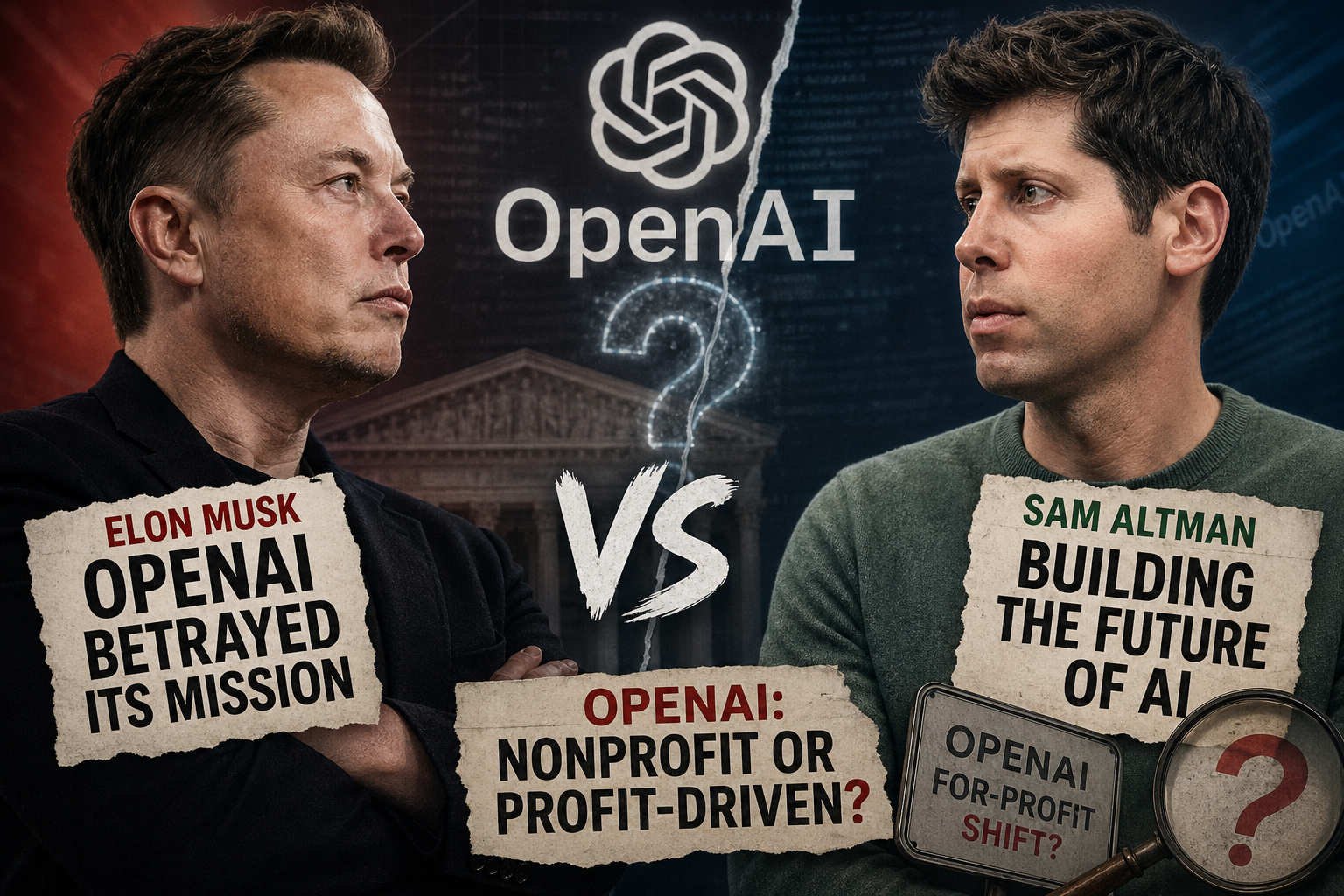
A major legal clash between Elon Musk and Sam Altman is heading to court, with potentially far-reaching implications for OpenAI and the broader AI industry. The case centers on Musk’s claim that OpenAI has strayed from its original nonprofit mission, setting up a high-stakes battle over the future direction of one of the world’s leading AI companies.
OpenAI was founded in 2015 as a nonprofit with the goal of developing artificial intelligence to benefit humanity. However, as the company grew, it became clear that remaining a nonprofit would limit its ability to raise the capital needed to compete at the highest level. This led to the creation of a for-profit arm in 2019. Musk, who was an early supporter and contributor, argues that this shift violated the organization’s founding principles and betrayed the trust of its backers.
The dispute also stems from internal disagreements during OpenAI’s early years. According to the company, Musk sought greater control over leadership decisions, while executives like Altman and Greg Brockman pushed for a structure that avoided concentrating power in any single individual. Musk eventually left OpenAI in 2018, and years later filed a lawsuit seeking financial damages, leadership changes, and a rollback of the company’s current structure.
What began as a business disagreement has since become deeply personal. Altman has described Musk as an early role model, but their relationship has deteriorated significantly. The two have publicly criticized each other, particularly on Musk’s platform X, with exchanges that go beyond the original dispute. Evidence presented in the trial, including private messages, highlights the extent to which tensions between them have escalated.
The trial is beginning with jury selection, followed by opening arguments. Several high-profile figures are expected to testify, including both Musk and Altman, as well as other OpenAI executives and Satya Nadella, whose company is also involved in the case. The proceedings are expected to offer rare insight into the inner workings of major Silicon Valley companies and the decision-making processes behind them.
The outcome of the case could have significant consequences. If Musk prevails, OpenAI may be forced to restructure, potentially disrupting its plans for a future public offering. If OpenAI wins, it could continue expanding its for-profit model and pursue additional funding. More broadly, the case may influence how AI companies are governed and increase scrutiny on the leaders shaping the future of the technology.
1
0
0
0

মন্তব্য