
পাতার বিষয়বস্তু আরও ভালো করতে চান? একটি পরিবর্তনের প্রস্তাব দিন।
An animal's annual home range is the area it uses in a year to find what it needs — food, shelter, mates. For a brown (grizzly) bear, that year runs from leaving the den in spring to entering it again in fall. Its size can depend on the bear's body size and sex, whether a female has cubs, how many bears live nearby, how productive the habitat is, how resources shift through space and time, climate, predation risk and disturbance — and on how the range is measured.
Biologists from the National Park Service and the U.S. Fish and Wildlife Service fitted GPS collars to 28 female and 8 male brown bears that denned in the Brooks Range of northcentral Alaska, and followed them from 2014 to 2017.
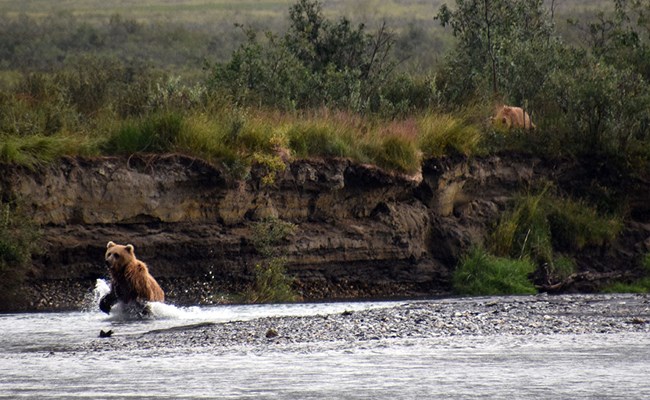
Brooks Range bears must travel a long way between their dens and a stream with salmon. NPS/Matt Cameron
The answer
The team estimated each bear's range two ways, and the choice mattered:
| Method | Males (mean, SD) | Females (mean, SD) |
|---|---|---|
| dBBMM — dynamic Brownian Bridge Movement Model, which accounts for how the bear moves | 504 km² (312) — about 124,500 acres, or 195 mi² | 135 km² (86) — about 33,400 acres, or 52 mi² |
| KDE — Kernel Density Estimator, the method most studies use | 3,886 km² (4,279) | 411 km² (738) |
Males' ranges were 3.7 to 9.4 times the size of females'. That kind of gap is found elsewhere too, but here it was among the largest ever reported.
Record-breaking — or a measuring problem?
Measured the traditional way, some bears of both sexes had the largest annual home ranges recorded for brown bears anywhere in the world. But those giant ranges belonged to bears that were not staying in one area at all: they travelled somewhere distant for the summer. That kind of movement doesn't fit the usual idea of a home range, so the team turned to dBBMM, which gave more realistic estimates. The lesson, they say, is to be careful comparing space use between studies that measured it differently.
What predicted a bigger range
- Not body size. The team expected bigger bears of the same sex to need more room to find enough food. They found no evidence of it.
- Age, a little. Age did not make the best model, but younger bears tended to have larger ranges.
- Salmon — the reverse of the coast. Bears that ate more chum salmon had larger ranges, in both sexes. On the coast, where salmon are super-abundant, brown bears can live within ranges as small as 5 mi². The likely reason for the difference: in the Brooks Range, the best denning habitat is in the mountains, relatively far from the salmon streams at lower elevations, so a bear that eats salmon has to travel between the two.
Why it matters now
Northcentral Alaska's habitat is relatively unproductive, and dens are often far from salmon streams, so its bears range widely. That makes them likely to wander beyond protected areas — and into more risk as they meet people and infrastructure. With large-scale industrial development in prospect for this roadless region, how much room the bears need, and why, has many implications for management.
The study
Joly K, Cameron MD, Sorum MS, Gustine DD, Deacy W, Hilderbrand GV (2022). Factors influencing Arctic brown bear annual home range sizes and limitations of home range analyses. Ursus 33e11: 1–12.
Sources
Based on "How much space does a brown bear in the Brooks Range use?," National Park Service, Gates of the Arctic National Park and Preserve, and the paper's abstract as the page reproduces it; the NPS summary is a work of the United States government in the public domain. The NPS summary puts the gap between males and females at "4–9 times" and the distance from dens to salmon at 50 miles, while the abstract gives 3.7–9.4 times and "up to 100 km"; the abstract's ratio is used and the distance is left out. The summary calls the industrial development "proposed" and the abstract "approved", so neither word is used. Rewritten in hubnx's own words.
যে সংগ্রহগুলোতে আছেGates Of The Arctic National Park & Preserve
লাইসেন্স: CC0 1.0 (পাবলিক ডোমেইন) · গৃহীত হয়েছে www.nps.gov
1
0
0
0

মন্তব্য


