
পাতার বিষয়বস্তু আরও ভালো করতে চান? একটি পরিবর্তনের প্রস্তাব দিন।
On February 15, 2024, at 12:01 AM, an email arrived confirming that a 771-page scientific report on the plants of Indiana Dunes National Park was finally published and available for public download. The journey to that moment had begun three years, four months, and three days earlier, when botanist Noel Pavlovic first sent a Word document to a science writer at the Great Lakes Inventory and Monitoring Network.
A Report That Refused to Stay Unfinished
In May 2020, Pavlovic — a botanist with the U.S. Geological Survey based at Indiana Dunes National Park — asked network science writer Ted Gostomski how to publish in the Natural Resource Report series. The manuscript had already been reviewed by USGS scientists, which made it seem straightforward.
It was not.
The Word file crashed Gostomski's computer. The two went back and forth on figure legends, superscripts, and the order of plant lists. By March 2021, Gostomski sent a PDF for review, noting that the report had already passed the previous record holder for largest report he had worked on — by 430 pages.
Then came the USGS policy review, which is required for all USGS publications and is separate from peer review. Results arrived in pieces: the Executive Summary in July 2021, the Introduction in September. In November, a setback: the Bureau Approving Official's computer had crashed in late August, and she had lost everything.
Co-author Gayle Tonkovich reviewed chapters in early 2023 and caught mistakes both Pavlovic and Gostomski had missed — but she was working from an older version, so some of her notes flagged things already fixed. By July 2023, Pavlovic signed off an email: "I am desperately trying to get this project completed." Around that time, Pavlovic mentioned that co-author Barbara Plampin had told him she wanted to see the report finished before she died. He paused: "She's 93 years old, Ted!"
On September 27, 2023, Gostomski submitted the manuscript to the NPS Natural Resource Report series. What followed was another round of required revisions — a list that ran four printed pages — with exchanges continuing into February 2024. When the final publication email arrived just after midnight, Gostomski forwarded it to Pavlovic at 7:55 AM. Sixteen minutes later, Pavlovic replied: "Wow! I am downloading it now. Such a big report! As if we did not know. I cannot wait to see it. ... Barbara will be so happy – I will phone her today."
The finished report — Special Flora and Vegetation of Indiana Dunes National Park — runs 771 pages, contains 34 figures, and 61 tables. As a 2015 magazine article quoted the U.K.'s chief scientific advisor saying before a gathering in London: "Science is not finished until it's communicated."
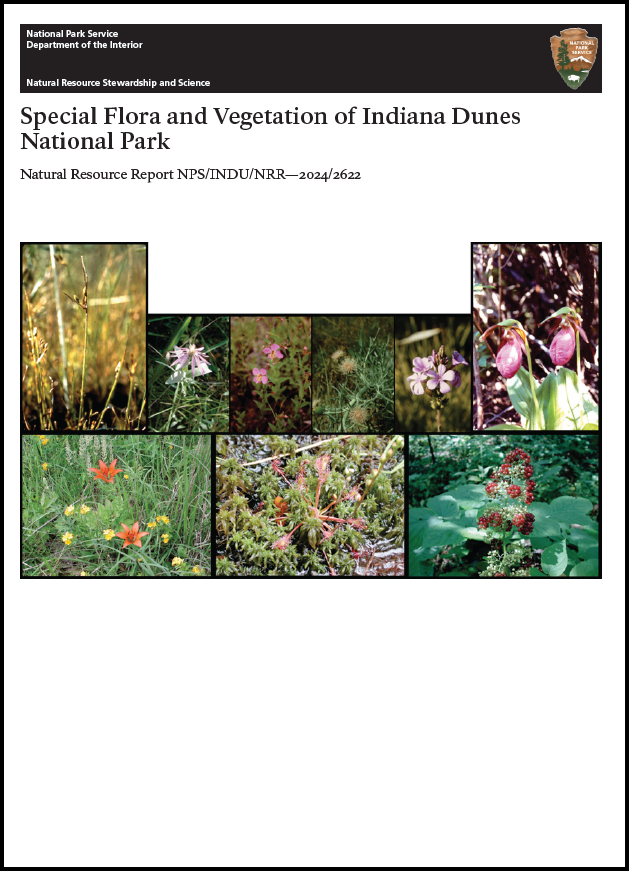
Cover of the completed Special Flora and Vegetation of Indiana Dunes National Park report. NPS
A Plant Ecologist Heads to Alaska

Plant ecologist Suzy Sanders counts ground cover plants in a sampling plot at Sleeping Bear Dunes. NPS photo
Network plant ecologist Suzanne Sanders left the Great Lakes Network in March 2024 to become the Natural Resource Program Manager for Katmai National Park and Preserve in King Salmon, Alaska.
Sanders's NPS career began in 2004 as the network's Inventory Specialist, overseeing the completion of ongoing inventories and handling contracting duties. She moved into the plant ecologist position in 2007, when the vegetation monitoring program began, though her position did not become permanent until the following year.
Over 17 years, she went through two full rounds of sampling at each park, with individual parks sampled once every nine years. Early on, she and network botanist Jessica Kirschbaum tried sampling two parks in one summer — an experiment that proved too labor-intensive and created housing headaches for seasonal crew members. They settled on one park per summer.
"We gather a lot of information and we can answer a lot of questions about things like the understory plant community and the regeneration of seedlings and saplings," Sanders said. "That is where any changes in the forest community will first appear."
After years of fieldwork, it's the unexpected sightings that stayed with her most — including a framed photo on her office wall of sundew, a tiny wetland plant she came across on Isle Royale. She's looking forward to learning the tundra plants of Alaska alongside managing the many resource management projects at Katmai.
429 Ways to Describe the Color of Water
There are many things the Great Lakes Network's water quality monitoring team records when they visit a lake or river site. One of them is water color — which sounds simple until you look at the data.
Aquatic ecologist Rick Damstra was working in NPStoret, the database that houses water quality monitoring data for all NPS Inventory and Monitoring networks, when he tried to standardize data entry by creating a drop-down list for water color. He pulled up everything that had been entered over the previous 17 years and found 429 unique ways of describing water color — and that was just within the Great Lakes Network.
The range runs alphabetically from "a little yellow" to "yellowish-green." Among the entries:
- Blacks: 7 entries
- Blues: 11 entries
- Browns: 49 entries
- Greens: 47 entries
- Yellows: 45 entries
- Clears: 107 entries
- Reds: 7 entries
- Tans: 12 entries
Modifiers include: a little, bright, cloudy, dark, deep, dim, light (the most common, with 51 entries), medium, moderate, mostly, muddy, murky, opaque, pale, semi, slight, and very. There are food and drink references — "Green – pea soup," tea, root beer, and coffee. There are tri-colored entries like "Yellowish brown with a little red tint" and "Yellowish green brown." Eleven entries describe "stained" water, referring to the brassy, tea-like color that comes from tannins leached from surrounding plants, especially cedar trees.
Some entries also noted what was in the water — algae, flecks, oily film, light foam, zooplankton. Entries mentioning "Lyngbia" or "Lyngbia-like algae" are particularly significant: Lyngbya is a blue-green algae (cyanobacteria) that can produce toxins and create harmful algal blooms (HABs) that make water unfit to drink. One entry offered a more personal assessment: "Clear/murk & floating particulates (eww)."

A word cloud created from 429 entries for "water color" in the NPStoret database. Word size corresponds to frequency of appearance. NPS

White flecks, suspended particles, algae, or little floaties? How would you describe the water? NPS/L. Isbell

Mats of Lyngbya algae float on Lake Richie at Isle Royale. M. Edlund/St. Croix Watershed Research Station
After creating a standardized drop-down list of 15 color choices, Damstra reflected: "It feels like something is being lost in the world, but we've narrowed it down to 15."
2024 Field Season at a Glance
The Great Lakes Network's 2024 monitoring season covers five programs across nine parks:
| Park | Amphibians | Contaminants (Dragonflies) | Landbirds | Vegetation | Water Quality |
|---|---|---|---|---|---|
| Apostle Islands | Mar–Aug | May–Aug | June | n/a | June–Oct |
| Grand Portage | Mar–Aug | May–Aug | June | n/a | n/a |
| Indiana Dunes | Mar–Aug | May–Aug | June | n/a | May, July, Sep |
| Isle Royale | Mar–Aug | May–Aug | June | n/a | May–Sep |
| Mississippi River | Mar–Aug | May–Aug | June | n/a | n/a |
| Pictured Rocks | Mar–Aug | May–Aug | June | n/a | June–Sep |
| St. Croix Riverway | Apr–Aug | May–Aug | June | June–Aug | Apr–Nov |
| Sleeping Bear Dunes | Mar–Aug | May–Aug | June | n/a | June–Sep |
| Voyageurs | Apr–Aug | May–Aug | June | n/a | June–Sep |
Dragonfly contaminant samples at Apostle Islands, Grand Portage, Isle Royale, and St. Croix Riverway will be collected by a Northland College field crew; park staff and volunteers will handle the other parks. Vegetation monitoring at St. Croix Riverway is led by Jessica Kirschbaum with a team of three cooperators. Amphibian monitoring at St. Croix Riverway and Voyageurs uses a U.S. Geological Survey protocol.
Sources
This article is based on "The Current: Spring 2024," published by the National Park Service at nps.gov, a work of the United States government in the public domain.
যে সংগ্রহগুলোতে আছেIndiana Dunes National ParkGrand Portage National MonumentIsle Royale National ParkApostle Islands National LakeshoreMississippi National River & Recreation AreaPictured Rocks National Lakeshore
লাইসেন্স: CC0 1.0 (পাবলিক ডোমেইন) · গৃহীত হয়েছে www.nps.gov
1
0
0
0

মন্তব্য
এরপর পড়ুন


