উন্নত করার কিছু দেখছেন? একটি পরিবর্তন প্রস্তাব করুন।
Epidemic keratoconjunctivitis (EKC) is a contagious, severe form of viral conjunctivitis that can cause pain and blurred vision for up to 4 weeks. In June 2017, it spread through the patients of a Los Angeles County optometry clinic — carried not by the staff, but by the clinic's own instruments and eye drops. The virus behind it, human adenovirus type D53 (HAdV-D53), had caused EKC outbreaks in Japan since 1980 and Germany since 2005, but had never before been reported in the United States.
How it was found
On June 22, 2017, hospital A told the county Department of Public Health about seven patients with EKC who had all been seen at its affiliated optometry clinic. The clinic had three optometrists, one ophthalmologist and three optometric assistants, three exam rooms, and about 1,300 patients a month. The investigation found 17 people with EKC: 15 linked to clinic visits, and 2 household contacts whose spouses had fallen ill first.
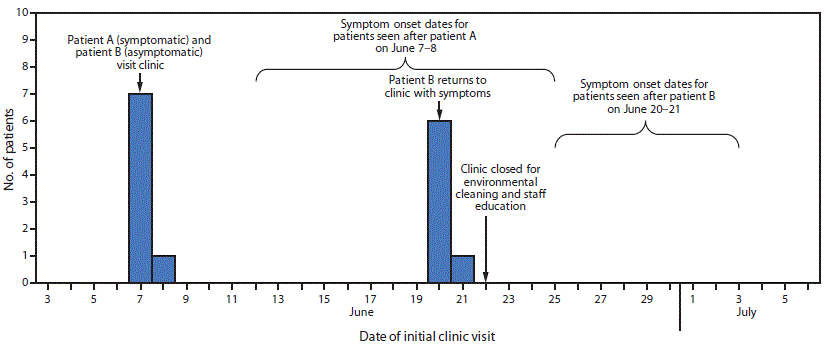
Health care–linked EKC cases by date of first eye clinic visit, Los Angeles County, June–July 2017. CDC.
| Median age | 62 (43–78) |
| Women | 12 |
| Symptoms | eye redness (14), discharge (13) |
| Incubation | mean 9 days (5–19) |
| Hospitalized | none — though 7 needed more than one visit to a clinic, emergency department or urgent care |
Two waves from one exam room
The visit dates showed two clusters:
- Patient A came in on June 7 with EKC symptoms. Seven more patients were seen on June 7 and 8, and fell ill June 12–25.
- Patient B, seen on June 7, returned on June 20 with EKC that had begun June 14. Seven patients seen after patient B on June 20–21 fell ill June 26 – July 3.
All 14 patients infected at the clinic had been examined by the same optometrist in the same exam room, after patient A or patient B. No staff member reported symptoms. Most had had slit-lamp contact (13) and tonometry (12) — the glaucoma test that measures pressure inside the eye with an instrument on the slit lamp — and 10 received dilating drops from a multidose container. Six patients in the first cluster, and none in the second, had multidose fluorescein drops; patient A received them, from a multiuse vial, and a slit-lamp exam on June 7.
What the inspection found
The clinic closed on June 22 for intensive cleaning, instrument disinfection and staff training, and reopened the next day. An inspection on June 23 found:
- eye drops from multidose vials used on several patients, with the dropper sometimes touching the eye or the skin around it;
- tonometers wiped with a 70% isopropyl alcohol pad instead of the recommended 5–10-minute soak in a chlorine or ethyl alcohol disinfectant.
The virus
Adenovirus was grown from 8 patients' swabs, and all eight were typed at the state's Viral and Rickettsial Disease Laboratory as HAdV-D53. A whole genome from one patient was nearly identical to a recent HAdV-D53 genome from Japan. The investigators concluded that a symptomatic patient brought the virus onto exam-room surfaces — where adenoviruses can survive for weeks — and lapses in infection control passed it on.
Stopping it
After staff education on giving eye drops and longer disinfection of slit lamps and tonometers, no new cases were reported after July 3, 2017. The recommended safeguards for eye care settings: disposable tonometer tips, disinfectants proven against adenovirus for tonometers and slit lamps, and single-use eye drops where available.
Sources
Based on OYong K, Killerby M, Pan CY, Huynh T, Green NM, Wadford DA, Terashita D, "Outbreak of Epidemic Keratoconjunctivitis Caused by Human Adenovirus Type D53 in an Eye Care Clinic — Los Angeles County, 2017," MMWR Morbidity and Mortality Weekly Report volume 67, number 48, Centers for Disease Control and Prevention; a work of the United States government in the public domain. The imported copy was cut short; the missing text is from the report's full text in PubMed Central (PMC6329482).
লাইসেন্স: CC0 1.0 (পাবলিক ডোমেইন) · গৃহীত হয়েছে www.cdc.gov
1
0
0
0

মন্তব্য