
উন্নত করার কিছু দেখছেন? একটি পরিবর্তন প্রস্তাব করুন।
When the Global Polio Eradication Initiative (GPEI) began in 1988, wild poliovirus was spreading in 125 countries. Cases have since fallen by more than 99.9%, and types 2 and 3 have been certified eradicated. But wild poliovirus type 1 (WPV1) has never stopped circulating in Afghanistan and Pakistan, which share a 1,600-mile (2,600-km) border crossed constantly by mobile populations. The GPEI aimed to stop all WPV1 transmission by the end of 2023.
Cases
| Year | WPV1 cases | Where |
|---|---|---|
| 2020 | 56 | |
| 2021 | 4 | Ghazni (1), Kunduz (3) |
| 2022 | 2 | Paktika, Kunar |
| 2023, January–June | 5 | all in Nangarhar, in the east |
All recent cases were along the Pakistan border. Patients were getting older: mean age at paralysis rose from 19 months (2021) to 32 (2022) to 66 months in 2023 — suggesting the virus now reaches older children missed by campaigns when they were younger. Only one patient had never received oral polio vaccine (OPV); the other six averaged 20 doses, and every 2023 patient had had at least 16 — consistent with malnutrition (affecting 54% of Afghan children) and diarrheal disease blunting the vaccine's effect.
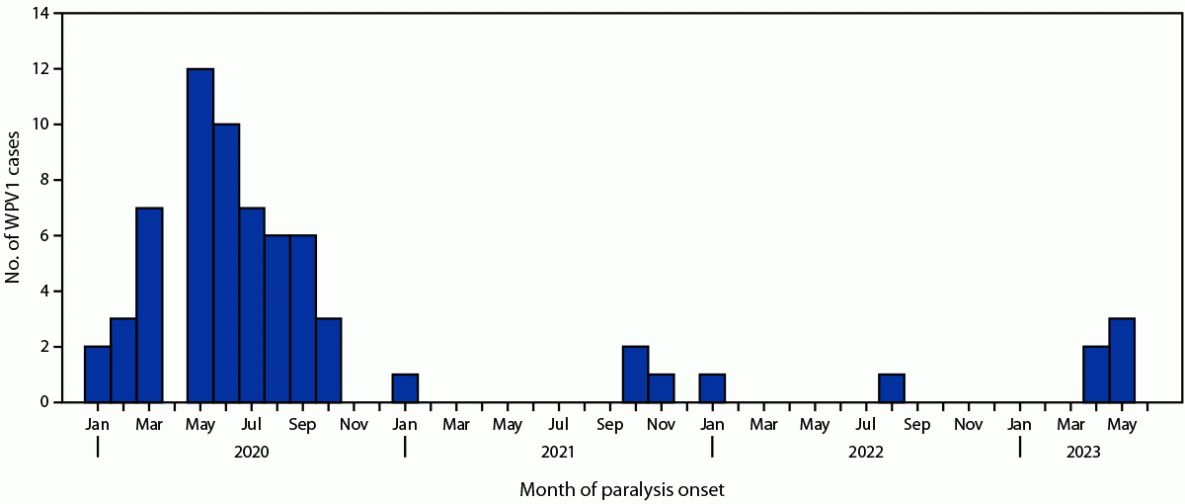
The 67 wild poliovirus type 1 cases by month of paralysis onset, January 2020–June 2023. Image from CDC's report
Sewage sampling
Environmental surveillance at 37 sites in 17 provinces found WPV1 in 22 samples in 2022, all in the east, and 32 in the first half of 2023 — including one in Kandahar (south, May) and one in Balkh (north, June), the first detections in those regions since February 2021 and March 2020.
Genome sequencing found the YB3A cluster, still endemic in eastern Afghanistan, in the east, Kandahar and Balkh — and related virus in Pakistan's Khyber Pakhtunkhwa and Punjab. A YB3C virus linked to Pakistan caused the January 2022 Paktika case. Two 2023 viruses were more than 1.1% different from their closest known relatives, pointing to surveillance gaps.
Vaccination
| 3-dose routine OPV coverage (WHO/UNICEF) | 71% (2021) → 76% (2022) |
| 1-dose IPV (inactivated vaccine) | 67% → 71% |
| Campaigns | 12 in 2022, 5 in January–June 2023, all with bivalent OPV |
| At transit points and border crossings | 14,106,879 and 1,690,497 doses |
The biggest obstacle: bans on house-to-house vaccination. Under the Taliban authorities, who took power in August 2021, house-to-house campaigns — the most effective method — remain prohibited in parts of the south and northeast, where vaccine is given only at health facilities, mosques and vaccination sites. The difference is stark:
| March 2023 national campaign | Survey lots passing |
|---|---|
| Districts without restrictions | 93% |
| Districts with restrictions | 6% |
In the south region only 16% of lots passed, and none in Kandahar. Kandahar, Uruzgan and Helmand also had the highest shares of "zero-dose" children who had never received OPV.

The seven cases by region, province and period. Image from CDC's report
Surveillance
Afghanistan's paralysis surveillance network — 1,932 active sites, 3,251 reporting sites and 49,870 community volunteers — met quality standards, with a non-polio paralysis rate of 24 per 100,000 children in 2022 and 94% of cases with adequate stool samples.
What will it take
- High-quality, unrestricted house-to-house campaigns, focused on reaching children missed before.
- Better surveillance.
- Close coordination with Pakistan — as long as WPV1 circulates in either country, both are at risk.
Limits: outdated population targets (updated in mid-2023, up 10%) may have skewed coverage figures, and dose histories rely on caregivers' memory.
Sources
Based on Adam Bjork, Irfan Elahi Akbar, Sumangala Chaudhury, Mufti Zubair Wadood, Fazal Ather, Jaume Jorba and Maureen Martinez, "Progress Toward Poliomyelitis Eradication — Afghanistan, January 2022–June 2023," MMWR, volume 72, Centers for Disease Control and Prevention; a work of the United States government in the public domain.
লাইসেন্স: CC0 1.0 (পাবলিক ডোমেইন) · গৃহীত হয়েছে www.cdc.gov
1
0
0
0

মন্তব্য


