
নোড এর বিষয়বস্তু উন্নত করতে চান? একটি সম্পাদনা অনুরোধ করার চেষ্টা করুন.
An analytical reassessment of the global technology sector reveals a structural transformation: the industry has moved past standard software product cycles into an era defined by physical infrastructure dominance. According to the newly released 2026 Future Readiness Indicator, the historical asset-light software model is receding. In its place is a capital-intensive ecosystem where market control is determined by raw computing power, energy procurement, geopolitical supply chains, and semiconductor manufacturing. Nvidia, Microsoft, Alphabet, and Apple now form a distinct tier of infrastructure leaders. These four entities dictate the global tech sector’s cost of capital, dictate computational supply limits, and shape the international regulatory agenda. Nvidia remains at the absolute apex, holding a perfect readiness score of 100.0, driven by its systemic control over the artificial intelligence hardware supply curve. While secondary giants like Meta and Amazon maintain high-performance AI integration models, they act as disciplined consumers of capital rather than pace-setters. The operational division highlights a stark reality: companies unable to fund or secure multi-billion-dollar data centers, silicon production pipelines, and specialized power grids are being decoupled from the core layers of tech industry growth. Concurrently, this infrastructure mandate is transforming consumer-facing software. Apple’s preparation for its 2026 Worldwide Developers Conference (WWDC) and its deep technical alignment with Google’s Gemini ecosystem highlight how even the world's largest consumer device company must anchor its local software—Apple Intelligence—into massive external cloud infrastructure networks to remain competitive. This shift represents the final end of standalone, localized application frameworks, replacing them with a continuous hardware-to-cloud continuum.
The Era of Asset-Light Tech is Officially Over
For nearly three decades, the technology sector operated on the premise that value creation was inversely proportional to physical asset ownership. The internet boom, the SaaS revolution, and the mobile application ecosystem were built on asset-light business models. Software could be written once, replicated infinitely at near-zero marginal cost, and distributed via third-party infrastructure. Success was determined by rapid development iterations, user acquisition velocities, and capital efficiency.
Data from the 2026 tech sector reordering confirms that this economic model has broken down. The technology sector has transitioned into an infrastructure-driven, capital-intensive, and geopolitically bounded industry. The shift is not a temporary phase in a standard technology cycle; it is a permanent structural baseline.
The core driver of this transformation is the computational demand of frontier artificial intelligence models and large-scale agentic decision networks. The software layers that interface with users are now entirely dependent on the physical layers beneath them. This dependency has inverted the value chain.
The strategic center of gravity has shifted from code optimization to physical assembly:
- The procurement of specialized silicon accelerators.
- The provisioning of gigawatt-scale electrical grids.
- The construction of hyperscale data centers.
- The security of semiconductor supply chains stretching across politically sensitive corridors.
In this new paradigm, companies can no longer scale via code alone. The strategic decisions made by the few organizations capable of funding this infrastructure now determine the cost of capital and the boundaries of computational capability for the entire global economy.
+-----------------------------------------------------------------+
|               THE NEW TECH INFRASTRUCTURE PYRAMID               |
+-----------------------------------------------------------------+
| Level 4: Consumer App Layer (Apple Intelligence, SaaS, etc.)    |
+-----------------------------------------------------------------+
| Level 3: Hyperscale Cloud & Foundational Models (Google, MSFT)  |
+-----------------------------------------------------------------+
| Level 2: Advanced Hardware & Fabrication (Nvidia, TSMC, ASML)   |
+-----------------------------------------------------------------+
| Level 1: Resource Layer (Gigawatt Power Grids, Geopolitics)     |
+-----------------------------------------------------------------+
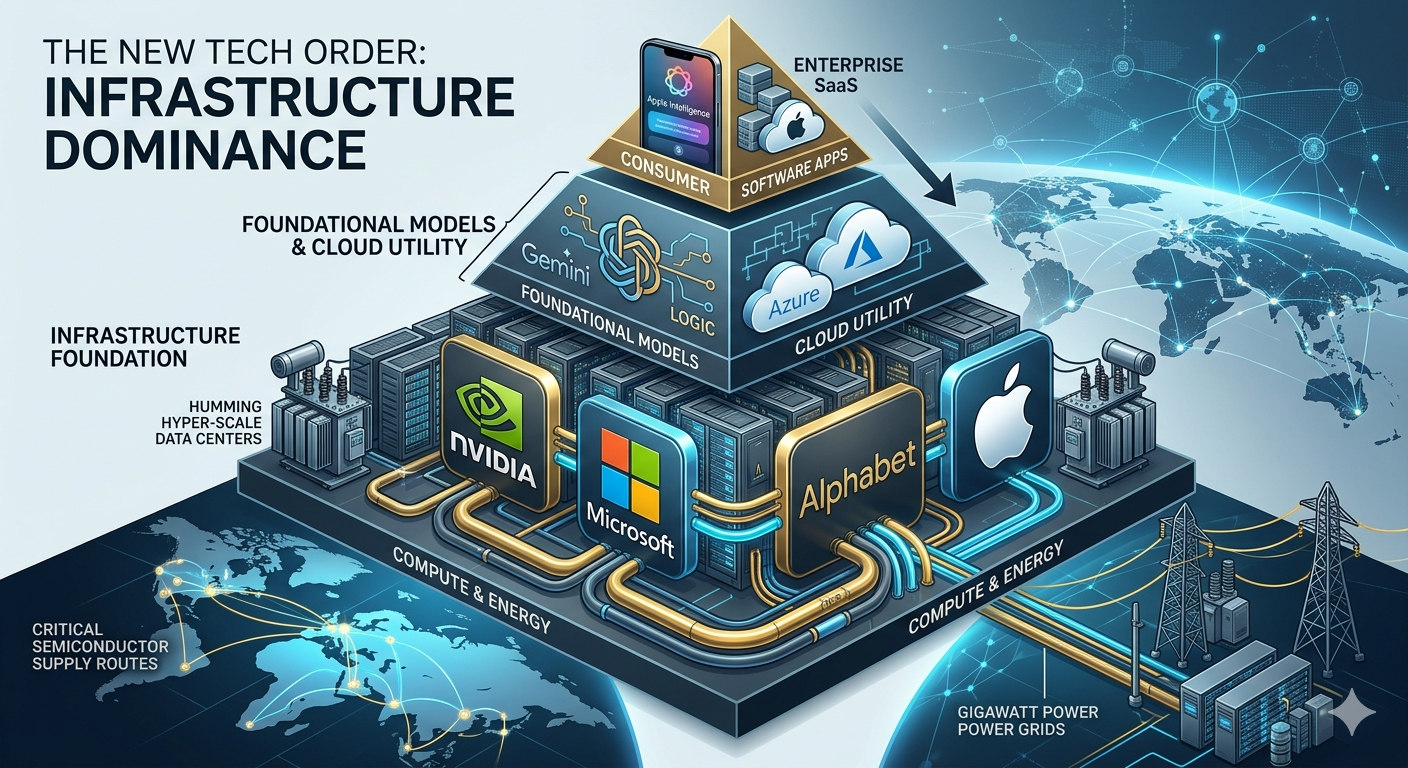
The Four Pillars of Sovereign Infrastructure
The market has consolidated into a tier of four hyper-scale infrastructure leaders: Nvidia, Microsoft, Alphabet, and Apple. These entities are no longer mere participants in the market; they define the operational limits of the technology sector.
Nvidia: The Supply Curve Dictator
Holding the absolute baseline position with a score of 100.0 on the 2026 Future Readiness Indicator, Nvidia commands the global compute supply curve. Nvidia’s dominance does not rest solely on designing superior graphics processing units (GPUs) or specialized tensor-core accelerators. Instead, it stems from its total integration of proprietary hardware architectures, interconnect fabrics (such as NVLink), and the deeply entrenched CUDA software ecosystem.
Nvidia has effectively established a monopoly on the foundational compute stack required for sovereign AI development. By managing the supply curve, Nvidia determines which enterprises, cloud providers, and nation-states receive the allocation necessary to train and execute next-generation software models.
Microsoft: The Enterprise Fabric and Compute Aggregator
Securing the second-highest position, Microsoft has leveraged its legacy enterprise software footprint to build a massive infrastructure engine. Through its multi-billion-dollar investments in data center expansions and exclusive partnerships with leading foundational model developers, Microsoft has secured its position as an infrastructure provider.
Its business model has shifted from selling software licenses to acting as an industrial utility provider for enterprise-grade intelligence. The company’s capital expenditure is directed toward secure, geographically distributed server farms capable of running autonomous operations for global enterprises.
Alphabet: The Vertically Integrated Pioneer
Alphabet occupies the third critical position due to its unique vertical integration. Unlike competitors that rely exclusively on merchant silicon, Alphabet has spent more than a decade developing its proprietary Tensor Processing Units (TPUs) alongside its massive global fiber-optic networks and consumer-facing data applications.
Alphabet’s structural advantage lies in its self-reliance: it owns the data pipelines, the internal chip designs, the hyperscale cloud footprint, and the primary consumer interfaces (Search, Android, YouTube). This loop isolates Alphabet from external supply shocks that affect asset-light or semi-integrated firms.
Apple: The Demand-Side Nexus
Apple occupies the fourth position, representing a distinct structural archetype. While Apple lags behind Nvidia on the compute supply side, it commands the world’s most lucrative consumer demand interface.
With over two billion active devices globally, Apple controls the endpoints where computational infrastructure meets human behavior. However, the 2026 market dynamics demonstrate that managing consumer endpoints is no longer sufficient on its own. To sustain its position, Apple has been forced to shift from a closed ecosystem focused strictly on local hardware to a hybrid model that connects its devices directly into massive external cloud networks.
+-----------------------------------------------------------------------+
|                FOUR PILLARS OF INFRASTRUCTURE POWER                   |
+-----------------------------------------------------------------------+
| Nvidia    | Dictates global compute supply, hardware stacks, and CUDA |
+-----------+-----------------------------------------------------------+
| Microsoft | Aggregates enterprise workloads into global cloud engines |
+-----------+-----------------------------------------------------------+
| Alphabet  | Operates fully integrated TPUs, cloud networks, and data  |
+-----------+-----------------------------------------------------------+
| Apple     | Orchestrates consumer demand, edge devices, and endpoints |
+-----------------------------------------------------------------------+
The Capital Expenditure Divide: Meta, Amazon, and the Second Tier
A clear divide has emerged between the tier-one infrastructure pace-setters and the tier-two disciplined capital deployers, most notably Meta and Amazon.
| Company | Tier | Strategic Focus | Infrastructure Role | Primary Revenue Engine |
|---|---|---|---|---|
| Nvidia | Tier 1 | Supply & Hardware Stack | Pace-Setter / Dictator | Compute Silicon & Systems |
| Microsoft | Tier 1 | Enterprise Cloud Systems | Pace-Setter / Aggregator | Cloud Infrastructure & SaaS |
| Alphabet | Tier 1 | Fully Integrated Stack | Pace-Setter / Pioneer | Advertising & Cloud Utility |
| Apple | Tier 1 | Device Endpoints & UX | Demand-Side Nexus | Consumer Hardware & Services |
| Meta | Tier 2 | Algorithmic Distribution | Disciplined Consumer | Social Media Advertising |
| Amazon | Tier 2 | Cloud Hosting Utility | Disciplined Consumer | E-Commerce & AWS Hosting |
Meta and Amazon possess massive AI systems and data operations, but their structural positions differ fundamentally from the leading tier:
Meta’s Capital Conundrum
Meta’s projected capital expenditures for 2026 are on track to surpass Alphabet’s in absolute terms. The company has acquired large volumes of advanced hardware to train its open-weights Llama model architecture and optimize its ad-targeting engines.
Yet despite this massive spending, Meta remains classified in the second tier. The reason is its underlying business model: Meta remains fundamentally an advertising company, not an infrastructure provider. Its capital deployment is defensive and optimization-oriented, designed to protect and monentize user attention within its social graphs. It does not sell infrastructure, set the cost of compute for external developers, or control the physical fabrication layers of the industry.
Amazon’s Transition to Utility Hosting
Amazon’s AWS remains a foundational component of modern internet infrastructure. However, in the realm of advanced AI infrastructure, Amazon has shifted into a hosting utility rather than a frontier innovator.
AWS excels at hosting workloads and managing storage, but it relies heavily on external partnerships (such as its deep financial and operational commitments to Anthropic) to keep pace with foundational model innovation. Amazon acts as a disciplined manager of capital, expanding its capacity to match clear market demand rather than driving the frontier forward through sovereign technological breakthroughs.
The second tier also includes key semiconductor players: AMD, TSMC, and Broadcom. These organizations are essential to the physical fabrication pipeline, but they operate within the capital and regulatory constraints set by the top four infrastructure leaders. TSMC manufactures the silicon, but its fabrication queues are determined by the capital allocations of Nvidia, Apple, and Alphabet.
Client-Edge Architecture and the Apple-Google AI Continuum
The realities of the infrastructure shift are visible in consumer software strategies, specifically Apple’s approach ahead of its 2026 Worldwide Developers Conference (WWDC). Historically, Apple’s competitive edge lay in its vertically integrated, localized software-to-silicon ecosystem. It prioritized on-device processing, framing local execution as a definitive privacy and performance advantage over cloud-reliant architectures.
This local-only model has proved unsustainable for frontier-grade AI operations. The computational density required to run highly contextualized, agentic workflows surpasses what can be efficiently executed within the thermal and battery constraints of hand-held hardware. As a result, Apple has moved toward a hybrid model.
+-------------------------------------------------------------------------+
|                  THE HYBRID APP LAYER ARCHITECTURE                      |
+-------------------------------------------------------------------------+
| [User Input]                                                            |
|      |                                                                  |
|      v                                                                  |
| +---------------------------------------------------------------------+ |
| | Local Device Layer (Apple Edge Silicon)                             | |
| | - Low-latency tasks, basic classification, VoiceOver, Magnifier      | |
| +---------------------------------------------------------------------+ |
|      |                                                                  |
|      +---> (Complex/Contextual Query?) ---> [YES]                       |
|                                               |                         |
|                                               v                         |
| +---------------------------------------------------------------------+ |
| | Private Cloud Compute (Apple Proprietary Silicon)                   | |
| | - Secure processing, intermediate reasoning                         | |
| +---------------------------------------------------------------------+ |
|      |                                                                  |
|      +---> (Frontier Orchestration / Deep Reasoning Required?) ---> [YES]|
|                                                                       | |
|                                                                       v |
| +---------------------------------------------------------------------+ |
| | External Infrastructure Tier (Google Gemini Cloud Ecosystem)         | |
| | - Multi-billion parameter models, dynamic agent workflows           | |
| +---------------------------------------------------------------------+ |
The ongoing multiyear collaboration between Apple and Google illustrates this technical shift. While Apple Intelligence manages low-latency, localized tasks—such as on-device natural language parsing for accessibility features, VoiceOver audio enhancements, and local photo processing—it acts as an onboarding terminal for complex queries. When a user requests deep multi-step reasoning or complex contextual generation, the workload transitions off the device.
It routes through Apple's Private Cloud Compute infrastructure and, for broad-scale generative queries, connects directly into Google’s Gemini models and cloud ecosystem.
This model changes the definition of modern operating systems. An operating system is no longer a collection of localized files and code compiled to run on isolated hardware. It is now a dynamic client interface that orchestrates resources across local neural engines, private edge-cloud servers, and third-party hyperscale datacenters.
Apple’s Siri is evolving from an on-device utility into an orchestrator that determines where a computing task should be processed based on latency, privacy constraints, and financial cost.
Macroeconomic and Geopolitical Implications
The transition from an asset-light to an infrastructure-driven technology sector has serious macroeconomic and geopolitical consequences:
The Consolidation of Geopolitical Influence
Because AI infrastructure requires immense amounts of capital and highly specialized supply chains, only a few corporate entities and sovereign states can afford to build it. The top-tier technology companies now wield influence comparable to traditional nation-states.
They negotiate directly with sovereign governments for energy rights, control international semiconductor allocations, and set global data-governance standards. Tech regulation is no longer just about content moderation or antitrust enforcement; it is a matter of national security and industrial capacity.
The Energy Bottleneck
The limiting factor for technological growth is no longer software engineering talent or venture capital availability; it is the capacity of the electrical grid. Hyperscale data centers require gigawatts of constant, reliable power.
This requirement has turned tech giants into major players in the energy market. Companies are bypassing traditional utility frameworks to invest directly in nuclear energy, next-generation geothermal projects, and dedicated green energy infrastructure. The future readiness of a tech company is now directly tied to its energy procurement strategy.
+-----------------------------------------------------------------------+
|                    THE MODERN COMPUTE SUPPLY CHAIN                    |
+-----------------------------------------------------------------------+
| Energy Sourcing (Nuclear, Geothermal, Grid Integration)               |
|   |                                                                   |
|   v                                                                   |
| Component Fabrication (ASML Optics, TSMC Advanced Packaging)           |
|   |                                                                   |
|   v                                                                   |
| Architectural Design & Interconnects (Nvidia Silicon Stack, CUDA)     |
|   |                                                                   |
|   v                                                                   |
| Hyperscale Deployment (Microsoft Azure, Google Cloud Datacenters)      |
|   |                                                                   |
|   v                                                                   |
| Enterprise & Consumer Applications (Agentic Supply Chains, Siri UI)   |
+-----------------------------------------------------------------------+
Shift in Corporate Venture Capital
Strategic investments are shifting toward physical integration and agentic automation. This is illustrated by Accenture’s investment in Aera Technology to deploy agentic decision intelligence across global supply chains.
Enterprises are realizing that software tools must do more than just display analytics; they must be capable of executing automated, real-time decisions across complex physical supply networks—including procurement, logistics, and finance. Corporate venture capital is moving away from standalone software applications and toward technologies that bridge digital intelligence with physical operations.
Strategic Conclusions for Enterprise Leadership
For enterprise executives, technology buyers, and institutional investors, this infrastructure-driven shift requires a fundamental reassessment of corporate strategy:
- Acknowledge Compute Dependency: Organizations must evaluate their software and AI vendors based on their underlying infrastructure access. A software vendor without guaranteed, long-term compute allocations from tier-one providers represents a structural supply chain risk.
- Prepare for Hybrid Client-Cloud Topologies: The architecture demonstrated by the Apple-Google collaboration will become the standard for enterprise apps. Leaders should design applications to split workloads efficiently between local edge devices, private enterprise clouds, and public hyperscale backends.
- Prioritize Integration Over Novelty: As standalone software applications lose their value, strategic returns will come from deep systems integration. Value lies in linking foundational AI infrastructure directly to core operational workflows, automated supply chains, and consumer interfaces.
The technology market has matured past the era of easy software creation. The future belongs to the organizations that own, control, or have direct access to the physical foundations of computing.
1
0
0
0

মন্তব্য