
পাতার বিষয়বস্তু আরও ভালো করতে চান? একটি পরিবর্তনের প্রস্তাব দিন।
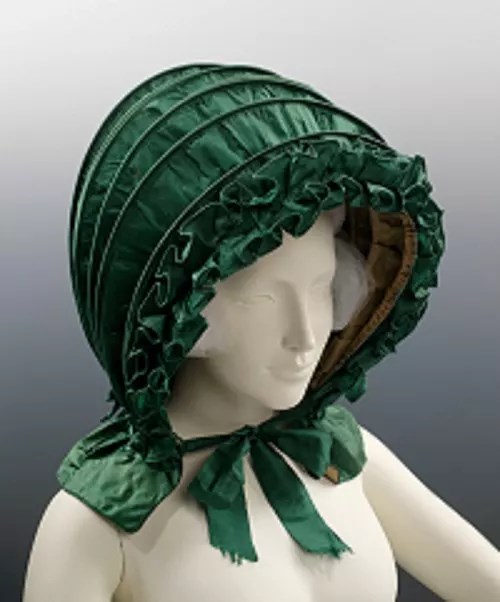
When Julia Wilson was fired from the Tremont Mills, she waved a calash like this one to signal the women on her floor to strike. It has become a symbol of resistance. Public domain.
In the years when young women — the "mill girls" — made up most of the workforce in the textile mills of Lowell, Massachusetts, they twice "turned out" on strike. One failed; the next did better. Here's why.
1834: new territory
In February 1834, Lowell's mill agents faced hard times: textile prices were falling, the market was slow and cloth sat unsold in warehouses. They answered with a 12.5% wage cut across the city.
The workers refused to accept it. Women met in the mills after work to plan, circulated petitions around the city and debated how to win the money back — methods suffragists would later use nationwide. Before they were ready, the managers fired their leader, Julia Wilson, hoping to break the resistance. Instead she gave the signal to walk out. About 800 women — roughly a sixth of the working population — left the mills, paraded through the city and visited other mills to draw more workers out.
They didn't win: strikers either left Lowell or went back to work. The walkout was rushed and unorganized, triggered by the firing, and the owners handled it efficiently. But the women learned from it.
It wasn't only about money. Echoing the language of the Revolution, the women protested as "daughters of freemen." The cut threatened the economic independence they prized — rare for single women at the time, since under coverture a married woman's money legally became her husband's, and she couldn't vote. Owners saw the strikers as ungrateful and their conduct as "unwomanly"; William Austin, chief agent of the Lawrence Mills, repeatedly called them "amazons," after the fierce women warriors of Greek myth — and didn't mean it kindly.
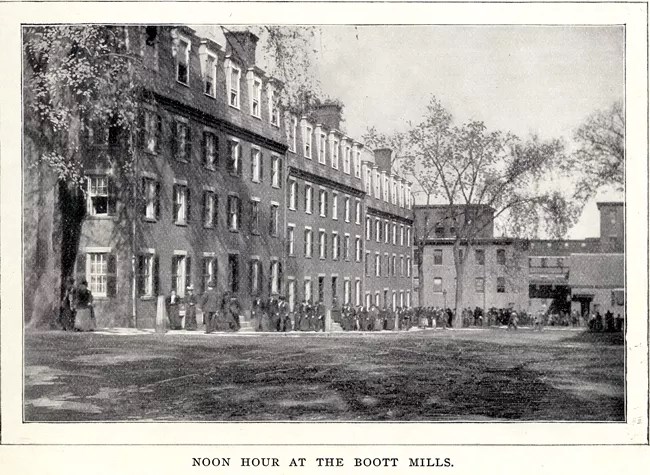
About a third of a mill girl's pay went to room and board in a company boardinghouse, so raising board charges cut her pay. Lowell NPS.
1836: take two
In October 1836, with prices rising, the boardinghouse keepers — the women who cooked, cleaned and cared for workers living on mill grounds — told management they could no longer make ends meet. Management raised the amount deducted from workers' pay for board.
With no raise to match, workers saw it as a pay cut. But unlike 1834, business was booming and the mills needed more hands, so a strike would be costly — and the women used that leverage.
- This time 1,500 to 2,000 workers turned out.
- Better organized, they kept the strike going for months, not days.
- They formed the Factory Girls' Association to help strikers pay for board while not earning wages, and the mills ran below capacity for a long time.
- Many women learned to organize and rally support — skills they later used for antislavery and women's rights.
One striker was Harriet Hanson (1825–1911), just 11 at the time, who was deeply moved by the protest; it shaped her later views on woman suffrage and labor.
Many companies gave in at least partly. The Hamilton Company dropped the increase for daily-paid workers, and the Boott and Merrimack corporations dropped it entirely.
Sources
Based on "Early Strikes in Lowell," part of the series Women's Activism in Lowell, Lowell National Historical Park, National Park Service; a work of the United States government in the public domain.
যে সংগ্রহগুলোতে আছেLowell National Historical ParkWomen's Activism in Lowell
লাইসেন্স: CC0 1.0 (পাবলিক ডোমেইন) · গৃহীত হয়েছে www.nps.gov
1
0
0
0

মন্তব্য


