
উন্নত করার কিছু দেখছেন? একটি পরিবর্তন প্রস্তাব করুন।
From the trees above Antietam National Battlefield to those along the George Washington Memorial Parkway, the park forests of the National Capital Area are varied — and "urban forest" takes in everything from woodland to landscaped boulevards. The National Park Service's Urban Ecology Research Learning Alliance (UERLA) used the i-Tree software to study several of these park forests and the benefits their trees provide to the parks and the areas around them: air pollution removal, carbon storage, avoided runoff, structural value and more.
How much forest, and which trees
Every park measured has forest, but which trees grow there and how much of the park lies under branches and leaves strongly affect the benefits its forest provides.
| Park | Area (km²) | Forested | Top three trees |
|---|---|---|---|
| Antietam National Battlefield | 13.2 | 22.3% | boxelder, northern hackberry, black cherry |
| Catoctin Mountain Park | 23.3 | 96.0% | — |
| Chesapeake & Ohio Canal NHP | 84.4 | 71.6% | boxelder, silver maple, American elm |
| George Washington Memorial Parkway | 21.5 | 60.2% | red maple, tulip tree, pumpkin ash |
| Harpers Ferry NHP | 15 | 69.7% | red maple, chestnut oak, black tupelo |
| Manassas National Battlefield Park | 20.6 | 51.6% | American elm, eastern red cedar, white ash |
| Monocacy National Battlefield | 6.75 | 34.0% | — |
| National Capital Parks–East | 46 | 63.0% | red maple, black tupelo, sweetgum |
| Prince William Forest Park | 50.8 | see note | tulip tree, American beech, Virginia pine |
| Rock Creek Park | 7.1 | 83.0% | red maple, sugar maple, chestnut oak |
| Wolf Trap National Park for the Performing Arts | 0.5 | 58.2% | chestnut oak, tulip tree, Virginia pine |
Prince William Forest Park appears as 89.5% forested in the page's table and 70% in its chart.
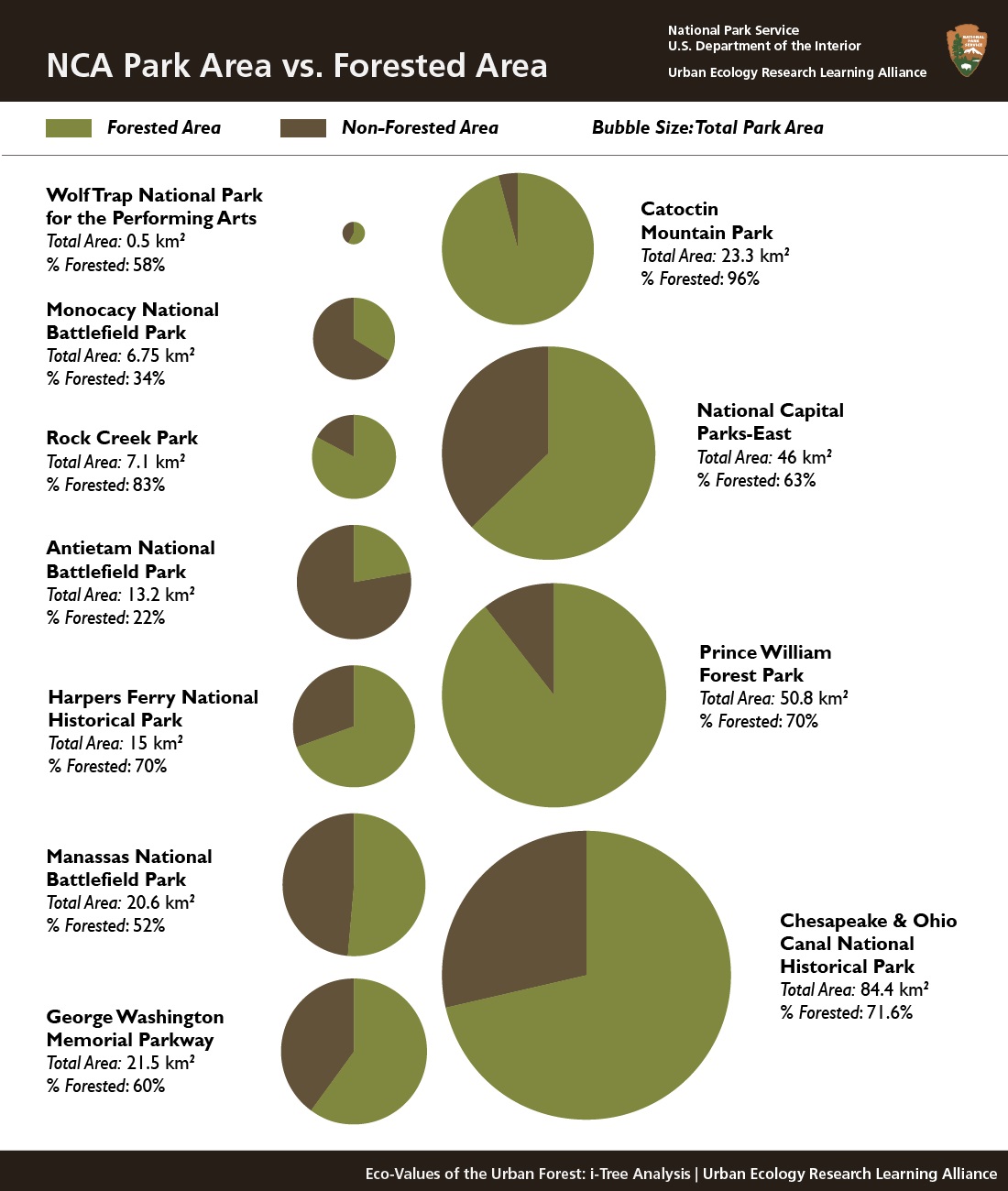
Total area and forested share of each park. NPS, Urban Ecology Research Learning Alliance.
What makes an urban forest
- Density. How crowded a forest is shapes which species succeed and how healthy it is; a denser forest means more competition for water, sunlight and nutrients.
- Size. The share of small trees is one gauge of forest health. Larger trees store and take up more carbon and are less vulnerable than small ones.
- Variety. Urban forests often hold more tree species than nearby native landscapes, because they mix native and exotic trees. Different species give different benefits, depending on how they grow and how much care they need.
About i-Tree
i-Tree, developed by the USDA Forest Service and partners, is a peer-reviewed software suite for measuring what trees and forests do for the environment and for communities. Using local hourly air-pollution and weather data, it reports on:
- forest structure — species, tree health, leaf area and more;
- pollution removed each hour, and the resulting improvement in air quality over a year;
- total carbon stored and net carbon taken up each year;
- how trees change buildings' energy use, and the resulting carbon dioxide emissions from power plants;
- the forest's structural value, and the value of its pollution removal and carbon storage;
- the potential damage from pests such as the Asian longhorned beetle, emerald ash borer, gypsy moth and Dutch elm disease.
Sources
- National Park Service, Urban Ecology Research Learning Alliance, "Overview of the Urban Forests," in Eco-Values of the Urban Forest: i-Tree Analysis. https://www.nps.gov/articles/000/uerla-trees-overview.htm
- Urban Ecology Research Learning Alliance, i-Tree Ecosystem Analysis: Urban Forest Effects and Values, 2018. https://irma.nps.gov/DataStore/Reference/Profile/2290090
- Corrected: the page's table calls two parks "National Battlefield Park" (Antietam, Monocacy); both are National Battlefields. It also spells black tupelo "Black Tulepo."
যে প্রকাশনাগুলোতে আছেAntietam National BattlefieldChesapeake & Ohio Canal National Historical ParkManassas National Battlefield ParkGeorge Washington Memorial ParkwayHarpers Ferry National Historical ParkNational Capital Parks-East
লাইসেন্স: CC0 1.0 (পাবলিক ডোমেইন) · গৃহীত হয়েছে www.nps.gov
1
0
0
0

মন্তব্য


