
Vil du gøre sidens indhold bedre? Foreslå en ændring.
During the Siege of 1777 at Fort Schuyler — today's Fort Stanwix — a baby girl was born to the wife of Private Dennis McCarty of the 3rd New York Regiment. Her birth was ordinary in every way but where and when it happened. And for more than two hundred years, nobody knew the family's name.
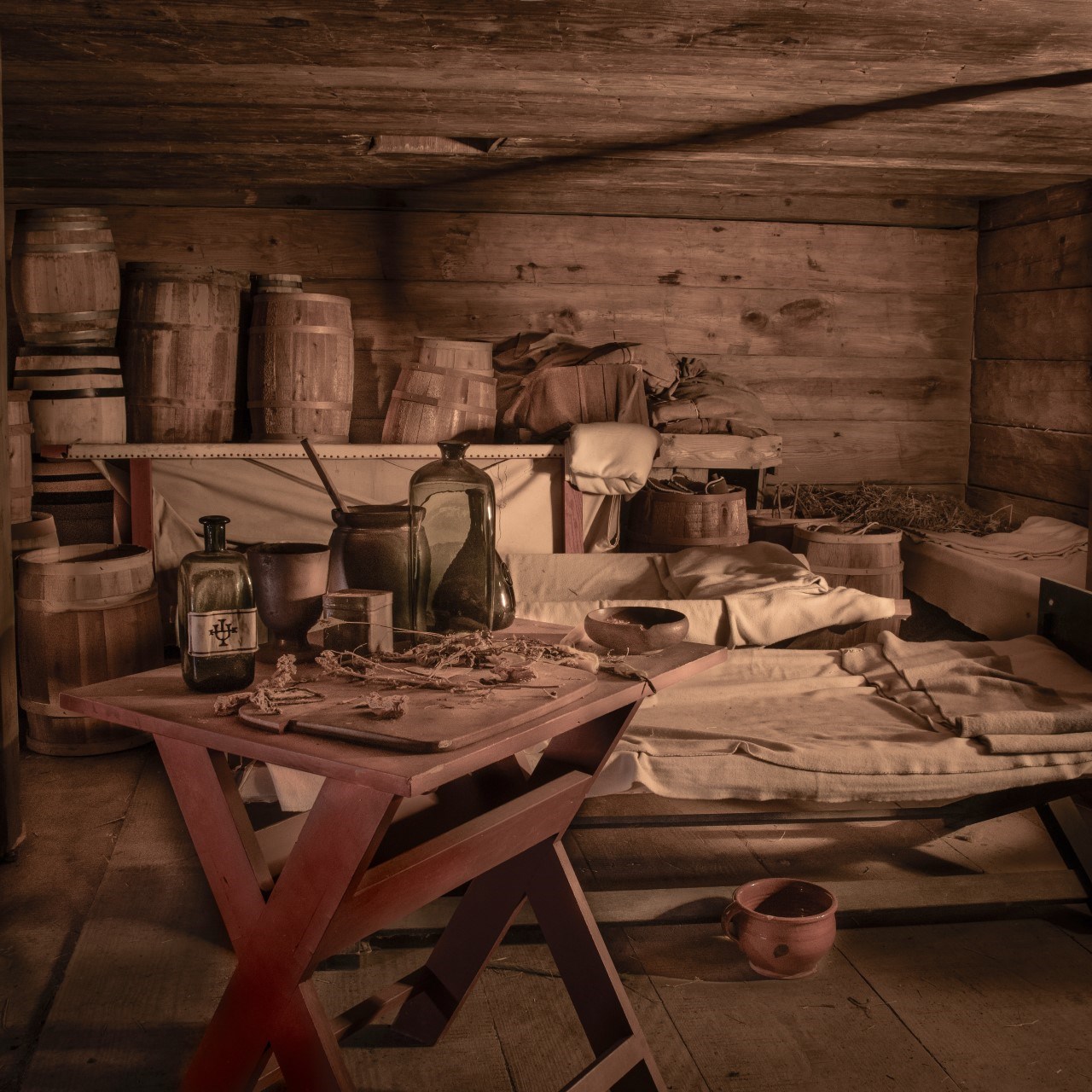
Inside a "bombproof" at the fort — the kind of room turned into a hospital during the siege, where Mrs. McCarty gave birth. National Park Service/Dan U.
Giving birth in the 1700s
Childbirth was then the leading cause of death among women. Getting through the expected forty weeks without the tests and treatments pregnancy brings today was itself remarkable, and delivery carried its own dangers. The main killers were:
- seizures (eclampsia, linked to high blood pressure in pregnancy);
- blood loss, from many causes;
- childbed fever, most likely from infection.
The risk applied to every birth, so it grew with each pregnancy.
Birth was women's business. A mother would be surrounded by grandmothers, sisters and close friends — many of whom had been through it themselves — and by the midwife, whom everyone in a community knew and who eased pain and labor with herbs and tinctures. They gathered in the mother's home until the baby came, then prepared for the "lying-in," the weeks of recovery. Doctors were only beginning to attend births in the 1700s, and then among Europe's aristocracy — not at a frontier fort beyond the edge of settled New York.
What the fort's journal recorded
From 1975 until 2014, researchers knew of the birth only from Ensign William Colbrath's journal — which never names the family, let alone the baby.
On July 28, with British forces closing in, Colonel Gansevoort sent women with children, along with the sick and wounded, to safety at Fort Dayton, near today's Herkimer, New York:
"The Colonel sent off those Women which belonged to the Garrison which have Children…"
No woman appears in the journal again until the siege is twelve days old:
Aug. 15: "In the Evening they threw their Shells at us as usual and Slightly wounded a woman…"
Aug. 21: "…a heavy and continual firing was kept up for near two Hours during which their Cannon & Mortars were playing on us very briskly, in which interim we had a man of the Artillery wounded & a Woman big with Child wounded in the Thigh."
Aug. 22: "…the woman that was wounded with a Shell last Night was brought to bed in our S.W. Bomb proof of a Daughter. She and the child are like to do well with the Blessing of God."
Who the other woman was is lost. She may have been one of several women without children who stayed to help Dr. Wodruff and Mr. Eliot in the makeshift hospital in the southwest bombproof — or she may have been kept back as a midwife for the expectant mother.
Think of what Mrs. McCarty went through: three weeks of siege in August, heavily pregnant, with no end in sight; then a mortar fragment tore flesh from her buttock — an injury that could have killed her through blood loss or infection. It most likely brought on labor instead, in a cramped bombproof probably already crowded with wounded soldiers, with no doctor to deliver her. The hope is that the other woman was there to help. And the baby arrived the day before the siege ended.
Names, at last
2014 — the surname. A pension deposition by Private Adam Happal named her:
"The effect of the explosion of a Shell, upon Mrs. McCarty wife of one of my Soldiers. Taking out of her Buttock a piece of flesh as large as a Man's fist and her being safely delivered of a Child the night after."
Only one McCarty served in the 3rd New York: Dennis McCarty, of Captain Leonard Bleeker's company.
| Dennis McCarty | |
|---|---|
| Enlisted | December 18, 1776, for the duration of the war — he served until 1783, the whole Revolution |
| From | Dublin, Ireland |
| Trade | currier — someone who dresses, colors and finishes tanned hides |
| Age in 1777 | about 20 |
| Described (1782 muster roll) | sandy hair and complexion |
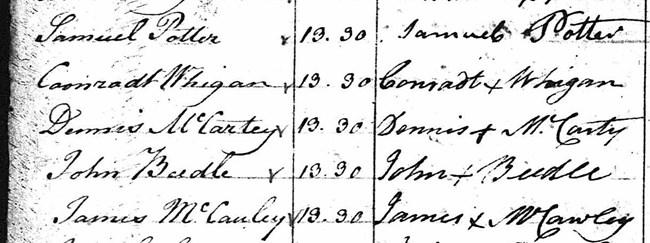
A 1783 record showing Dennis McCarty paid in full for his service. The regiment's paymaster wrote his name on the left, and his company sergeant or corporal probably signed on the right — but the "X" between his first and last names is his own mark.
2022 — perhaps a first name. In newly digitized records, researchers found the February 1781 marriage of "Dennis McCarty" and "Nency Homes" at the Dutch Reformed Church in Albany. The same day, the same church baptized a daughter of Dennis and Nancy McCarty: Rachel. Unusually, the record gives no birth date for Rachel, though it does for the other children baptized that month, most of them under a year old. Was she older than they were? Was her date simply missed? Or was she another child of the same parents as the siege baby?
Why don't the dates match? The Revolution may explain it. Many couples of the time wed in informal civil ceremonies — a Twelfth Night or "jump the broom" ceremony — and waited to marry in church until they could. The McCartys were always moving with the regiment:
| Year | Where |
|---|---|
| 1777–1778 | Fort Schuyler |
| 1779 | Dennis on Sullivan's Campaign against the Haudenosaunee |
| 1780 | West Point, New York, with the regiment |
| Early 1781 | Dennis sick "in hospital at Albany" |
His illness would have kept the family in one safer, more urban place for a while. With life and death on their minds again, perhaps they took the chance to make things official.
The trail seems to end around 1790 in Hoosick, New York, where census and land records show a Dennis McCarty with a small family. What became of Dennis, Nancy, Rachel or any other children is unknown.
Who they were
Apart from Dennis, nobody can say for certain that the siege family were Dennis, Nancy and Rachel McCarty. But whoever they were, they were a family whose lives were larger than the records show — who faced danger, lived through history, and keep a place in the story of Fort Stanwix.
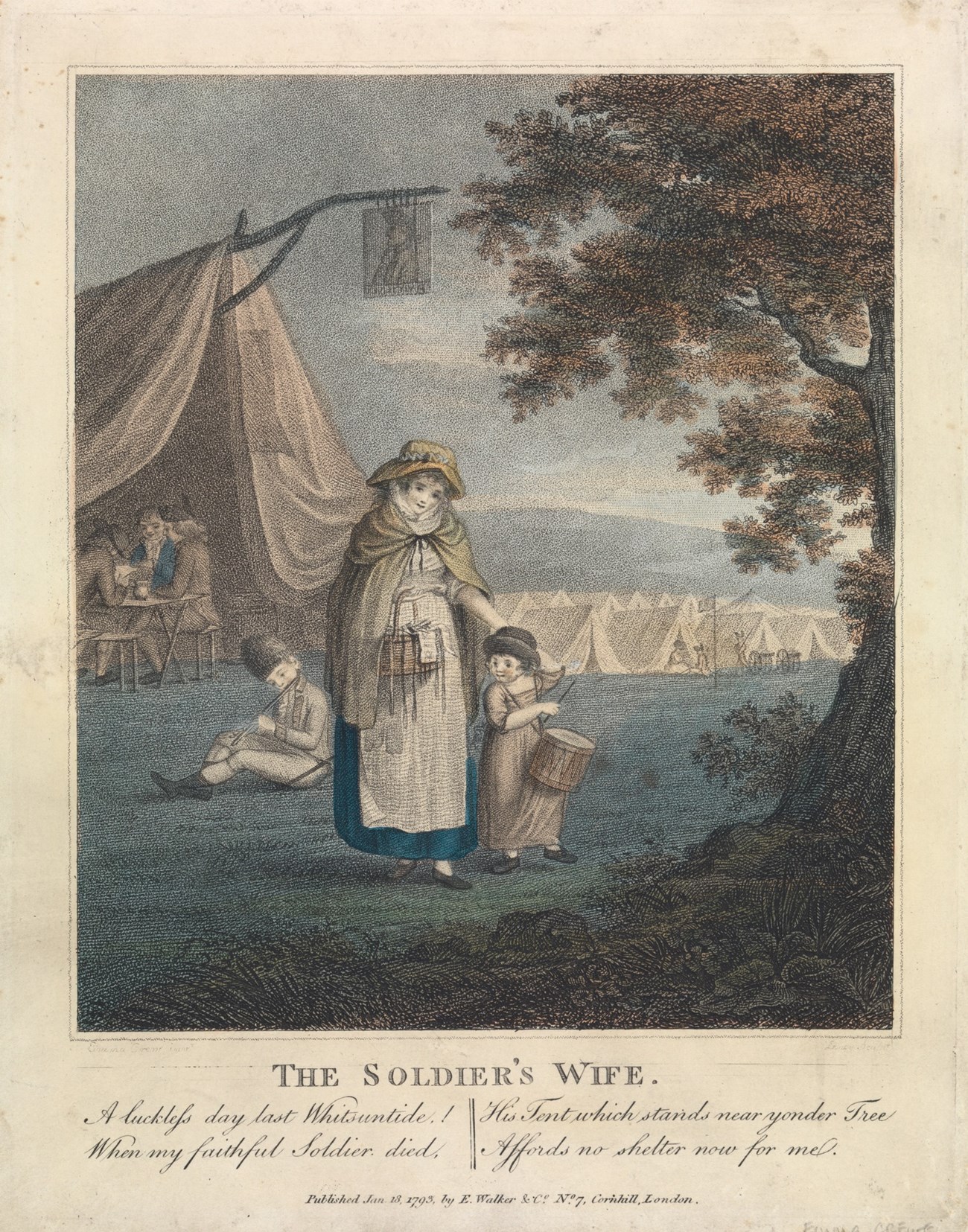
A camp follower and her child beside an army camp: William S. Leney (1769–1831), "The Soldier's Wife," 1793. Yale Center for British Art, Paul Mellon Collection.
Sources
Based on "The McCarty Family & the Siege of 1777," National Park Service, Fort Stanwix National Monument; a work of the United States government in the public domain. Ensign Colbrath's 1777 journal and Private Happal's pension deposition are quoted as the article gives them. The article's comparison of maternal death rates then and now is garbled in the source ("1/1.5%") and is left out. A museum photograph of a 1777 pincushion is left out; rewritten in hubnx's own words.
I disse samlingerFort Stanwix National Monument
Licens: CC0 1.0 (offentligt eje) · Bearbejdet efter www.nps.gov
1
0
0
0

Kommentarer


