
Ser du noget at forbedre? Foreslå en ændring.
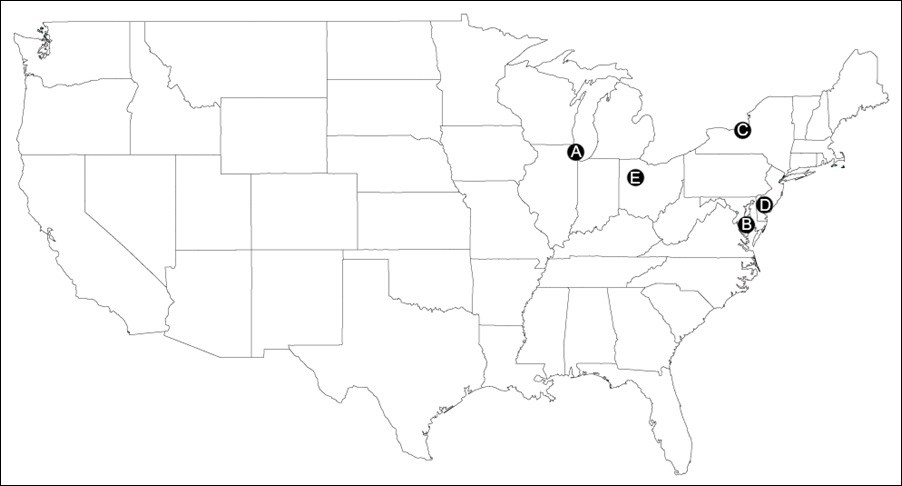
The largest Union prisoner-of-war camps for Confederates. National Cemetery Administration.
Behind a stone wall on Sullivant Avenue in Columbus, Ohio, some 2,200 marble headstones stand so close together they nearly touch. This small cemetery, under two acres, is all that is left of Camp Chase, one of the largest Union prison camps for captured Confederate soldiers. It is also where the long argument over whether — and how — the United States should mark the graves of the men who fought against it was won.
Prisoners in the Civil War
More than 400,000 soldiers were held prisoner during the war. The Union held 214,865 Confederates in 78 principal prisons; 25,976 of them died. The Confederacy held 194,743 Union soldiers, of whom 30,218 died.
Camp Chase
| Dedicated | June 20, 1861, as a training camp for Union recruits, named for Salmon P. Chase — Ohio's former governor, Lincoln's Treasury secretary, later Chief Justice |
| Early prisoners | political prisoners from Kentucky and Virginia — judges, legislators, mayors accused of Confederate sympathies — then briefly Confederate officers, then enlisted men once officers were sent to Johnson's Island |
| 1862–63 | a way station for prisoner exchanges, until the exchange agreement broke down in July 1863 and the camp filled |
| Peak | 9,423 prisoners on January 31, 1865, in a camp enlarged in 1864 to hold 8,000 |
| By the war's end | 26,000 of the 36,000 Confederates held in Ohio had passed through |
| Deaths | 2,229, from smallpox, typhoid, pneumonia and exposure, worsened by rations cut in retaliation for conditions in Southern camps and by the bitter winter of 1865 |
| Closed | July 5, 1865; every building was taken down and reused |
In February 1862, 800 prisoners arrived with about 75 Black men among them — roughly half enslaved, half servants to Confederate officers — who went on serving their masters inside the prison. Columbus residents were appalled; a legislative committee protested to Washington, and the men were released in April and May 1862. Some joined the Union army.
The camp itself grew from a half-acre stockade of three frame barracks behind a 12-foot plank wall to three prisons, the last a grid of plank huts later replaced by seventeen long barracks built by prisoners.
Marking the graves
The Army marked each grave with a thin wooden headboard carrying only a number and a name — not as a soldier's grave.
| Year | Step |
|---|---|
| 1866 | an Ohio official reports 2,307 Confederates buried in the state, 1,977 at Camp Chase, their headboards already rotting — "a simple matter of humanity", he writes, for the federal government or the state to fix |
| 1876 | a Senate committee first says the government has a duty to secure Confederate prisoners' graves |
| 1879 | the United States takes title to the cemetery; its care stays poor, the fence falling and the ground overgrown |
| late 1880s | Governor Joseph B. Foraker secures money for a stone wall and a 16-ton boulder inscribed to the 2,260 dead |
| 1895 | Col. W. H. Knauss, a Union veteran in Columbus, starts annual memorial services |
| 1902 | an arch topped by a bronze Confederate soldier, raised by Knauss's fundraising, is unveiled; its keystone reads "AMERICANS" |
| 1906 | after Foraker, now a senator, introduces his bill in three successive Congresses, the law to mark the graves of Confederates who died in Northern prisons passes; marble headstones follow |
| 1921 | the present stone wall and a speakers' platform |
Ohio men carried the cause. William McKinley — who passed through Camp Chase as a young Union soldier, argued as a congressman that caring for these graves was a "sacred trust", and pressed the case as governor and president — and Rutherford B. Hayes both lobbied for it. Foraker, who wrote with no sympathy for what the men had fought for, still insisted their graves deserved respect.
Today
Many headstones carry, instead of a unit, the word "citizen" — the political prisoners. The cemetery is one of 33 Confederate cemeteries and soldiers' lots kept by the Department of Veterans Affairs' National Cemetery Administration, under Dayton National Cemetery. It is open daily, 8 a.m. to 5 p.m., at 2900 Sullivant Avenue, Columbus.
Sources
Written from "Not to Be Forgotten: Camp Chase Confederate Cemetery", a Teaching with Historic Places lesson written by Paul LaRue and his students at Washington Senior High School, Ohio, and edited by the National Cemetery Administration and the National Park Service; drawing on the National Register nomination for Camp Chase and reports of 1866 and 1916 in the public domain.
Licens: CC0 1.0 (offentligt eje) · Bearbejdet efter www.nps.gov
1
0
0
0

Kommentarer


