
Vil du gøre sidens indhold bedre? Foreslå en ændring.
Cave shields are an unusual cave formation: two flat, parallel plates of calcite growing out from a crack in the rock, sometimes draped with stalactites like a fringe. Lehman Caves in Great Basin National Park has hundreds of them — possibly more than any other cave in the world. Why?
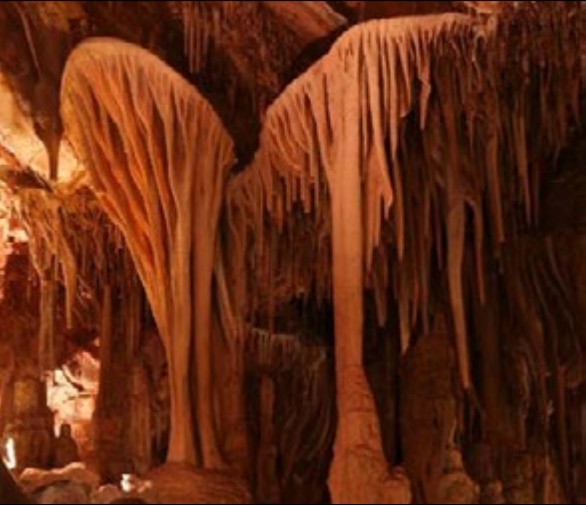
The Parachute shield (left) and others in the Grand Palace, draped with calcite formed by supersaturated water flowing from the crack between their plates. Credit: National Park Service.
Why Lehman has so many
The short answer, writes retired Park Service geologist Louise Hose: the bedrock is highly fractured, and shields grow from water seeping out of cracks. Lehman is also old — one stalagmite has been dated at 2.2 million years — so there has been plenty of time for calcite formations of all kinds, shields included, to grow.
How shields form
Exactly how shields form is still something of a puzzle, but this much is known:
- Two plates, one crack. A growing shield is two parallel plates of calcite separated by a crack so thin that water can only seep through by capillary action.
- Growth at the edge. The plates grow outward into air-filled passages, adding concentric bands around their water source — clearly visible in many half-shields along the tour route. (There's no evidence the bands are annual, like tree rings.)
- The chemistry. At the outer edge, carbon dioxide escapes into the cave air, leaving the water supersaturated so it deposits calcite — the same process that builds stalactites, stalagmites and other cave decorations.
- The fringe. When more water flows than capillary seepage can carry, it drips from the edges and builds stalactites and draperies, as on the Parachute.
- Hollowing out. In many caves, including Lehman, the gap between plates seems to widen toward the center. Undersaturated water seeping from the fracture may dissolve calcite from inside the plates and redeposit it at the edges. That may also weaken a plate's attachment — which could explain why the lower plates of many of Lehman's shields appear to have fallen away.
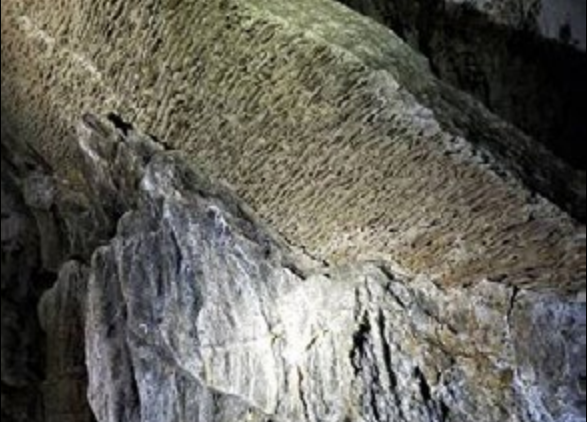
The upper plate of a shield near the Exit Tunnel, its lower plate fallen away. The corrugated inside may have been formed by stagnant water, or "strand" lines left as the shield dried while the lower plate was intact. Credit: G. Baker, National Park Service.
Sources
Based on "Lehman Caves' Shields," by Louise Hose, retired NPS geologist, The Midden (Great Basin National Park), Vol. 18, No. 1, Summer 2018, National Park Service; a work of the United States government in the public domain.
I disse samlingerGreat Basin National ParkThe Midden - Great Basin National Park: Vol. 18, No. 1, Summer 2018
Licens: CC0 1.0 (offentligt eje) · Bearbejdet efter www.nps.gov
1
0
0
0

Kommentarer


