
Vil du gøre sidens indhold bedre? Foreslå en ændring.
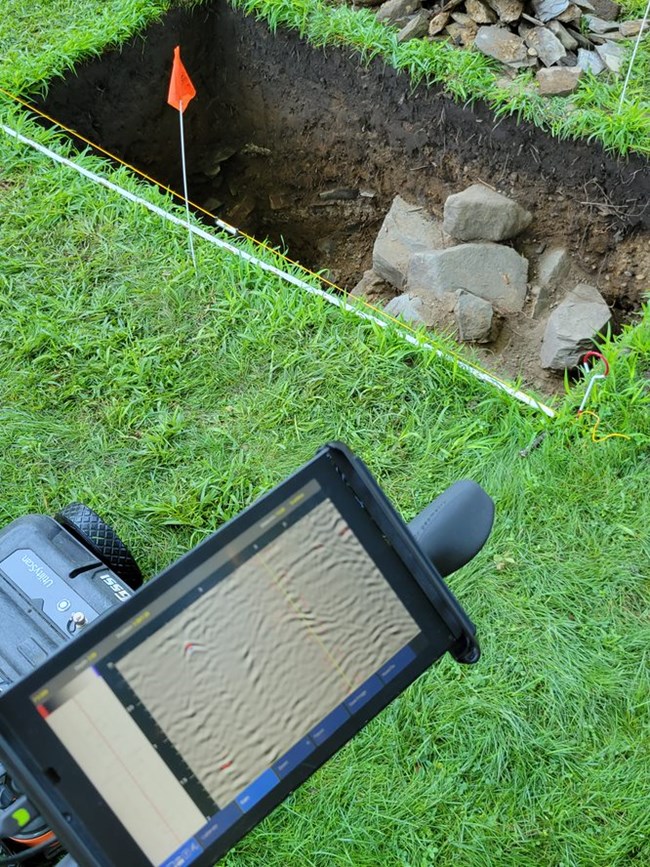
A ground-penetrating radar unit beside an excavation that has reached a stone feature.
The yellow house on Brattle Street in Cambridge, Massachusetts, was George Washington's headquarters during the siege of Boston in 1775–76, and the poet Henry Wadsworth Longfellow's home from 1837 to 1882. Before either, it belonged to a loyalist family of sugar planters — and to the people they enslaved. Park Service archaeologists have now dug to test what radar had seen beneath the lawn, hoping to find all of them.
Who lived there
| When | Who |
|---|---|
| 1747 | Col. John Vassall, a West Indies sugar planter, buys the property; his son John Vassall Jr. inherits it |
| 1750s | the present house is built (the project asks whether an older building stood first) |
| 1774 | the Vassalls, loyalists, leave — and leave behind seven enslaved people: Malcom, William, Cuba, Dinah, a child named James, and two unnamed "small boys". Most stay on through Washington's occupation, until evicted in 1780 |
| 1775–76 | George and Martha Washington; the house is the Continental Army's headquarters |
| 1837–1882 | Henry Wadsworth Longfellow and his family |
Radar first, then shovels
In 2011 a geophysical survey — ground-penetrating radar, electrical resistivity and conductivity, combined with laser scans of the house — found anomalies that might be foundations, garden beds, landscape features and colonial buildings, some possibly older than the house.
In June archaeologists ran a new survey with higher-resolution equipment. From July 18 to August 5 they ground-truthed it — excavating at the anomalies to find out what they really are — and ran a public pop-up programme alongside.
The questions
- Is there a basement under the anomalies, and was it built before the present house, in the 1750s?
- Do artefacts reflect the Vassalls' ties to the British Atlantic trade — and to the Washingtons' time?
- Can archaeology shed light on the enslaved people who lived, worked and died there?
- How did the roles and movements of the household change across the landscape over time?
- What do the landscape features show about how the grounds were used, and when that changed?
The findings will be used to tell visitors a fuller story of everyone who lived at the site. The project is run by the Park Service's Northeast Archeological Resources Program.
Sources
Written from "Ground Truthing at Longfellow House–Washington's Headquarters", National Park Service, a work of the United States government in the public domain.
I disse samlingerLongfellow House Washington's Headquarters National Historic Site
Licens: CC0 1.0 (offentligt eje) · Bearbejdet efter www.nps.gov
1
0
0
0

Kommentarer
Læs videre


