
Vil du gøre sidens indhold bedre? Foreslå en ændring.
Above about 64°F (18°C), salmon struggle to swim upstream and spawn; the heat stresses them and can kill them before they reproduce. In 2019, record-breaking air and water temperatures in Alaska coincided with widespread deaths of salmon returning to spawn — and climate projections suggest the water will keep warming.

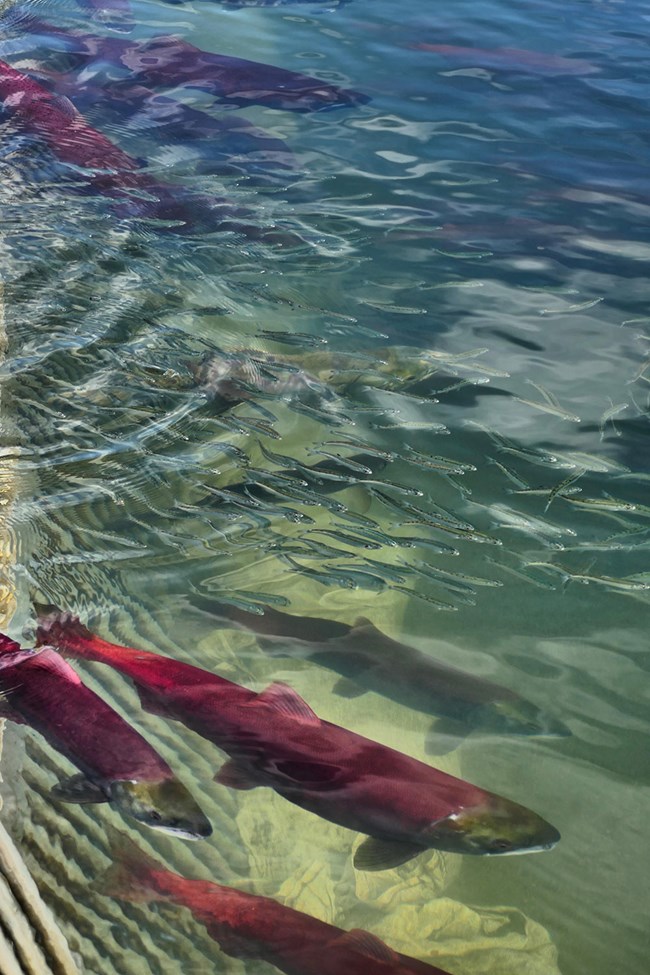
Sockeye salmon in the Telaquana River, at the headwaters of the Kuskokwim watershed, Lake Clark National Preserve. Credit: Tom Saxton, National Park Service.
Why it matters
Salmon are the lifeblood of much of Alaska, and the rivers and lakes protected in its national parks are major habitat for all five species of Pacific salmon. For millennia, the annual runs up the Yukon and Kuskokwim Rivers have been a primary food source for Indigenous communities. Those runs have declined for more than a decade, threatening the communities' traditional culture and food security, and warming water has been identified as one of the drivers.
Cold-water refuges
Fish can escape warm water in cold-water refugia: places cooled by groundwater such as springs, by colder tributaries or by shade. They give salmon and other species short-term protection. How well they work depends on where they are, how many there are, how they connect and how long they last. Mapping them is a key step in understanding how vulnerable a river is to warming — and in planning how to protect the refuges on the stretches that matter most.
Mapping cold-water areas where salmon can take refuge during migration will help the Park Service protect them. Credit: J. Mills, National Park Service.
Food, too
Large aquatic insects (macroinvertebrates) are a major food for salmon, trout, char, whitefish and other sport and subsistence fish. Knowing which are present, where and in what variety is essential to healthy waters, especially as the chance of harmful events grows. Assessments are hard because communities of living things are likely to shift over time, and wildfires, oil spills and invasive species will make those shifts worse.
The project
With Bipartisan Infrastructure Law funding, the Park Service will document fish and macroinvertebrate species and how they change, setting reference conditions and targets for recovery from climate change, wildfire, oil spills and other disturbances. That takes long-term study over large areas — especially hard in remote Alaska.
So the Park Service is turning to environmental DNA, or eDNA: the DNA that animals shed into their surroundings in skin cells, feces and secretions, which can be plentiful in water and sediment. "Using eDNA to sample is more efficient and cost-effective with greater spatial coverage because we only need to collect water or sediment samples for processing," said Dan Young, fisheries biologist for Lake Clark National Park and Preserve. The method has proved workable in aquatic ecosystems and is preferred for assessments in other remote places.
The work covers parks including Lake Clark, Gates of the Arctic and Bering Land Bridge.
Sources
Based on "Improving Salmon Resilience to a Warming Climate," National Park Service, a work of the United States government in the public domain.
I disse samlingerBering Land Bridge National PreserveGates Of The Arctic National Park & PreserveLake Clark National Park & Preserve
Licens: CC0 1.0 (offentligt eje) · Bearbejdet efter www.nps.gov
1
0
0
0

Kommentarer


