
Ser du noget at forbedre? Foreslå en ændring.
For many fish, survival depends on a journey up or down a river, and a dam can end it. Dams, culverts and waterfalls can slow or stop fish on their migrations, and these barriers are often linked to the decline of certain fish stocks. A fish ladder is the way around: a structure that lets migrating fish pass over or around an obstacle in the river.
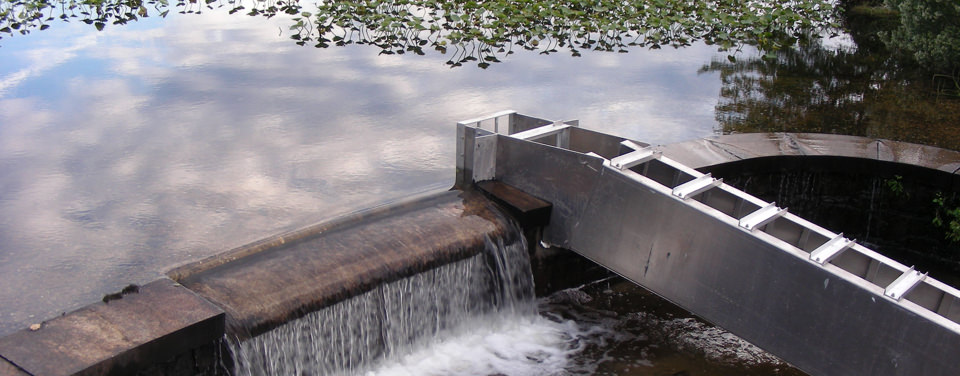
A fish ladder near the south shore of Long Island, where alewives were recorded migrating. Credit: NOAA.
Who needs to migrate
Different fish travel in different directions at different stages of life:
| Kind of fish | Examples | Downstream | Upstream |
|---|---|---|---|
| Anadromous | salmon, shad, sturgeon | as young fish | as adults |
| Catadromous | the North American eel | as adults | as young fish |
Either way, a blocked river means a blocked life cycle.
How a ladder works
A fish ladder, also called a fishway, gives migrating fish a detour past a particular obstruction. Designs vary with the obstacle, the flow of the river and the species involved, but every ladder works on the same principle: a series of ascending pools, each reached by swimming against a stream of water. A fish leaps through the rushing cascade, rests in a pool, and repeats the process until it is out of the ladder.
Sources
Based on "What is a fish ladder?" from NOAA's National Ocean Service, a work of the United States government in the public domain.
Licens: CC0 1.0 (offentligt eje) · Bearbejdet efter oceanservice.noaa.gov
1
0
0
0

Kommentarer


