
Vil du gøre sidens indhold bedre? Foreslå en ændring.
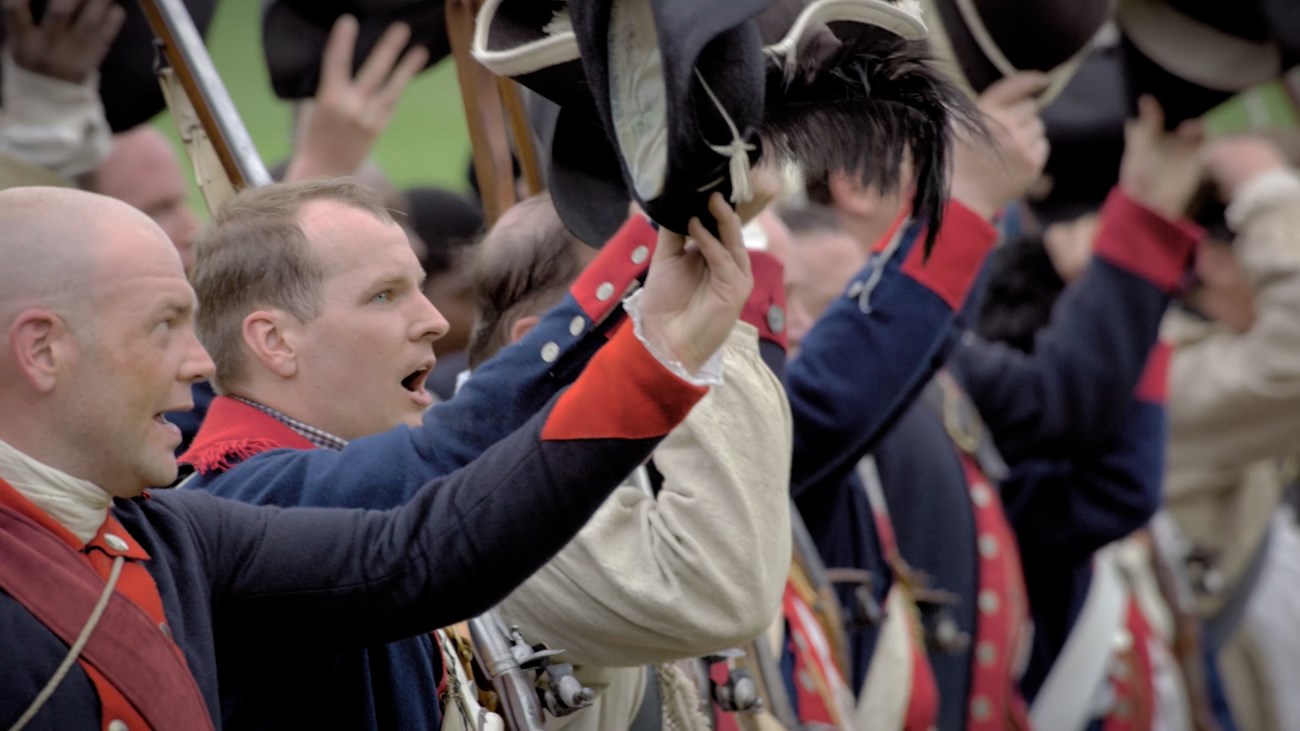
The American alliance with France was formalized during the Valley Forge encampment and celebrated by the Continental Army on May 6, 1778. NPS Image
Celebrating the Alliance
On May 5, 1778 General George Washington received news that France had formally recognized the United States and entered into a mutual defense pact with its new ally. To celebrate, the commander-in-chief freed condemned prisoners and ordered that extra rations of rum be distributed to the troops.

A musket salute known as a "fire of joy." NPS Image
If you stood on the Grand Parade at Valley Forge the next day on May 6, 1778 at half past eleven o' clock, you would have heard the rat-tat-tat of celebratory musket fire and voices raised in cheer — Huzzah! Long live the King of France!
The Continental Army conducted a feu de joie (a.k.a. fire of joy)—a musket salute with each soldier firing in succession along the ranks. They cheered for the long life of both King Louis XVI (ironic, considering what would happen during France's revolution fifteen years later) and the "friendly European powers."
A Global Conflict
As empires, France and Britain claimed territory around the world. French entry into the war meant that Britain would have to divert troops and resources from Philadelphia to defend their other possessions.
Despite the advantages of a formal French alliance, Washington worried that Patriots might relapse into a false sense of security. The struggle for independence would continue for another five years.
Learn more about America's fight for independence from Great Britain.
Sources
- “General Orders, 5 May 1778,” Founders Online, National Archives, https://founders.archives.gov/docu…/Washington/03-15-02-0039. [Original source: The Papers of George Washington, Revolutionary War Series, vol. 15, May–June 1778, ed. Edward G. Lengel. Charlottesville: University of Virginia Press, 2006, pp. 38–41.]
- “From George Washington to Major General Alexander McDougall, 5 May 1778,” Founders Online, National Archives, https://founders.archives.gov/docu…/Washington/03-15-02-0043. [Original source: The Papers of George Washington, Revolutionary War Series, vol. 15, May–June 1778, ed. Edward G. Lengel. Charlottesville: University of Virginia Press, 2006, pp. 47–48.]
Where this belongs
- Fort Stanwix National Monument
- Saratoga National Historical Park
- Valley Forge National Historical Park
- Washington-Rochambeau Revolutionary Route National Historic Trail
- Yorktown Battlefield Part of Colonial National Historical Park
Where this page came from
This page was imported from National Park Service. Produced by the U.S. National Park Service and, as a work of the United States government, in the public domain.
Nobody has written it yet — it is the source material at a new address, which is why search engines are asked to skip it and why no one earns from it. It is up for grabs: take it on, and it is yours to rewrite and to earn from.
I disse samlingerFort Stanwix National MonumentValley Forge National Historical ParkSaratoga National Historical Park
Licens: CC0 1.0 (offentligt eje) · Bearbejdet efter www.nps.gov
1
0
0
0

Kommentarer
Læs videre


