Ser du noget at forbedre? Foreslå en ændring.
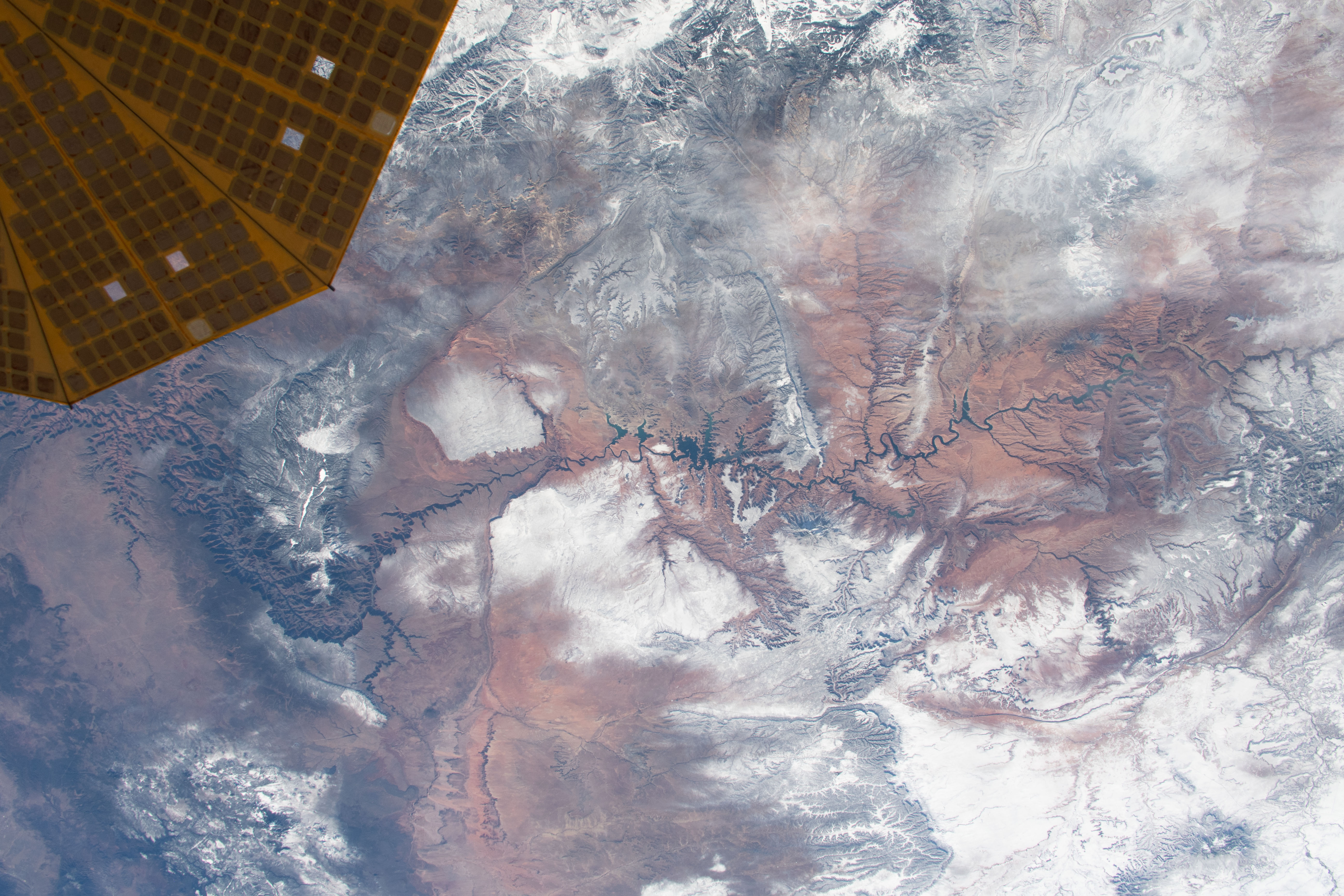
On a bright winter’s day, an astronaut aboard the International Space Station (ISS) focused a camera on the Grand Canyon and surrounding snowy landscapes in northern Arizona, many of which are federally protected lands. The Grand Canyon was declared a national park 100 years ago on February 26, 1919.
The photograph shows the ragged, steep-sided canyon walls and its numerous side canyons that contrast with the flat surrounding plains. From viewpoints on the South Rim, the thin line of the Colorado River lies more than 1525 meters (5,000 feet) below.
The Grand Canyon is one of the best-known natural wonders on Earth, but astronauts see very different patterns compared with the iconic ground-based views. Astronauts quickly learn that different land surface colors frequently indicate high and low parts of the scenery below them. In this photo, bright snow indicates high, cold plateaus, such as those within several Native American Indian reservations and the Vermillion Cliffs National Monument. Snow that fell at warmer, lower elevations—inside the Grand Canyon or in the parts of the nearby desert—melted quickly or did not reach the ground.
Dense greens are another feature that help astronauts understand the landscapes they see from space. In the desert southwest of North America, higher elevations get more rain and snow. Thus the high Kaibab Plateau is wet enough for forests to thrive, while the main colors of the low country are browns and tans of rocks and desert soils.
Astronauts also get some sense of topography from shadows and sunlight. This image was taken from an orbital vantage point over Las Vegas, nearly 400 kilometers (240 miles) to the west. The view is oblique enough to give a slightly three-dimensional view, especially from shadows like those cast by the Grand Canyon cliffs and the narrow canyons around the Colorado River.
The same snow-covered and snow-free features can be recognized in this more vertical view shot the following day. This summertime view shows the area without snow.
Where this page came from
This page was imported from NASA Science. Published by NASA and, as a work of the United States government, in the public domain; pictures credited to others are left out.
Nobody has written it yet — it is the source material at a new address, which is why search engines are asked to skip it and why no one earns from it. It is up for grabs: take it on, and it is yours to rewrite and to earn from.
Licens: CC0 1.0 (offentligt eje) · Bearbejdet efter science.nasa.gov
1
0
0
0

Kommentarer