
Ser du noget at forbedre? Foreslå en ændring.
Midway between Sacramento and Stockton, where the Sacramento and San Joaquin Rivers meet, two small towns sit along the narrow River Road. Store signs in Chinese and Japanese still advertise the Dai Loy Gambling House and the Hayashi Company Store. Walnut Grove and, a mile to the north, Locke were once bustling Chinatowns and nihonmachi — Japanese towns — built by immigrants who drained the Delta's swamps and worked its fields.
Unwelcome, and indispensable
Both Chinese and Japanese immigrants faced hostility and discrimination rooted in nativism and racial prejudice, encouraged in California by politicians and labor leaders.
| Year | Law or agreement |
|---|---|
| from the 1860s | California and many of its cities pass anti-Chinese laws |
| 1882 | The first Chinese Exclusion Act suspends immigration of Chinese laborers for 10 years and bars Chinese people from U.S. citizenship; students, teachers, merchants and officials may still enter |
| 1888 | Chinese laborers who leave the U.S. are barred from returning |
| 1904 | Chinese exclusion is made "permanent" |
| 1907 | Under the "Gentlemen's Agreement," Japan stops issuing passports to laborers bound for the U.S., and the U.S. refrains from laws formally excluding Japanese immigrants; wives and children may still join Japanese men already in America |
| 1913 | California's Alien Land Law bars aliens not born in America, including the Chinese, from owning land |
| 1924 | The Immigration Act excludes immigration from Japan and practically bars all Asians from entering the United States |
Chinese and Japanese immigrants gathered for companionship and survival in their own enclaves. Chinese benevolent societies helped laborers with passage, jobs, housing and recreation; Japanese officials in several western cities offered similar help.
Making the Delta

California in 1851. The two towns lie in the northern third of the Central Valley, east of San Francisco. Credit: Library of Congress, Geography and Map Division.
The Chinese came first, drawn by news of gold in California in 1848. Most came from Kwangtung (Guangdong) and Fukien provinces in southern China, fleeing flood, famine and upheaval capped by a revolution that lasted from 1851 to 1864. Some 300,000 made their way to the "Land of the Golden Mountain," most intending to go home once they had made their fortunes. Driven from the mines by prejudice and violence, they helped build the western section of the transcontinental railroad; when it was finished in 1869, some went to work on a vast levee project in the Delta.
Those levees turned 500,000 acres of swamp into some of California's most valuable farmland. As large farms shifted from wheat to fruit and vegetables, they needed hand labor. The Delta, home of the Bartlett pear, became the pear capital of the world in the late 19th century, and after better canning made asparagus profitable in the 1890s, it eventually grew nearly 90 percent of the world's asparagus. Chinese "bosses" found the mostly male workers their jobs, housed them and sold them supplies between jobs — keeping them in debt — and offered recreation, legal and otherwise. Gambling was especially popular: fun, and a hope of a windfall.
The Japanese replaced the Chinese in the fields after the 1882 exclusion act; most came after 1890, uprooted by the upheaval of Japan's rapid modernization. By 1904 Japanese farmers worked 50,000 acres in California, and by 1919, 450,000. They were able to start families sooner than the Chinese: some sent for wives left at home, and others married "picture brides" chosen by their families — about 20,000 Japanese women came to America as proxy brides. Some became landowners with farms of their own.

Locke, Walnut Grove and neighboring Delta towns. From the National Park Service Teaching with Historic Places program.
Walnut Grove: two Asian towns in one
John Wesley Sharp, who helped build a Sacramento River levee, founded Walnut Grove in 1851 with a boat landing and hotel, and later a lumber mill, brickyard, school, and store with a post office. After he died in 1880, Agnes Brown and her son Alex bought much of the estate. By 1890 Alex Brown ran the hotel, a cattle ranch, a store and a warehouse, farmed 4,000 acres, and was postmaster and agent for the railroad's steamers, Wells Fargo and Western Union.
Brown backed the town's Chinese and Japanese communities, lending to Asian businessmen and renting land at fair rates. A Chinatown, perhaps begun in 1875, grew in the 1880s as a commercial and social center for Chinese farm workers; Japanese businessmen settled at its northern end from about 1896, and by 1905 Japanese farmers worked about 80 percent of the land around the town.
In 1915 fire swept the Asian section. Brown sent two tugboats that sprayed water on it for two days, rented land to the Japanese for a new district north of Chinatown, and put up a 14-business building and water and sewer service. Japanese architects and carpenters from across Northern California volunteered to rebuild — so unlike most California towns, where Asians worked in buildings put up by European Americans, Walnut Grove got a Japanese business district designed and built by Japanese. By the 1920s, a barber recalled, some 1,000 men came into "Kawa Shima," as the Japanese called the town, every Sunday, and it had two movie theaters, a Japanese Association, Methodist and Buddhist churches, schools, a dentist and a surgeon. It became the only town in California with two complete Asian communities inside a European American-managed town.
Gakuen Hall, a Japanese culture and language school, is the only known one designed and built by Japanese in response to California's 1921 school segregation laws. When Japanese residents were forced into camps under Executive Order 9066 in World War II, the local landowner held it in trust until they returned; today it is a community center. The Chinese section burned again in 1937 and was rebuilt, but by the 1940s the Chinese population was aging and, under strict immigration limits, could not be replenished. Most Japanese residents returned after the war but soon left for nearby cities or Japan. The Bing Kong Tong Benevolent Society's building, put up after the 1937 fire, and the Japanese district, looking much as it did in the 1920s, still stand.
Locke: a Chinese town on leased land
After the 1915 fire, a group from the Chung Shan district of Kwangtung, bound together by their Cantonese dialect, decided to build a town of their own. Barred from owning land by the Alien Land Law, Lee Bing and six other merchants obtained a verbal lease from landowner George Locke for a site cut from a pear orchard a mile north of Walnut Grove. Three Chung Shan merchants had already opened businesses there in 1912, serving workers from the asparagus fields and from canneries the Southern Pacific Railroad built in 1909.
Locke's one- and two-story wooden buildings went up quickly, in the plain style of local working people — residents saw no reason to spend on land they could not own, and many still dreamed of going home. The town was essentially complete by 1930. Unincorporated and without police, it drew crowds during Prohibition with speakeasies, gambling, drugs and prostitution. In the 1920s its 600 residents swelled to 1,500 on weekends, supporting a theater, a hotel, nine grocery stores, six restaurants, a flour mill and gambling halls. The Depression, the end of Prohibition, the decline of asparagus and the mechanization of farming ended the boom.

Inside the Dai Loy Gambling Museum, Locke. Jet Lowe, Historic American Buildings Survey.
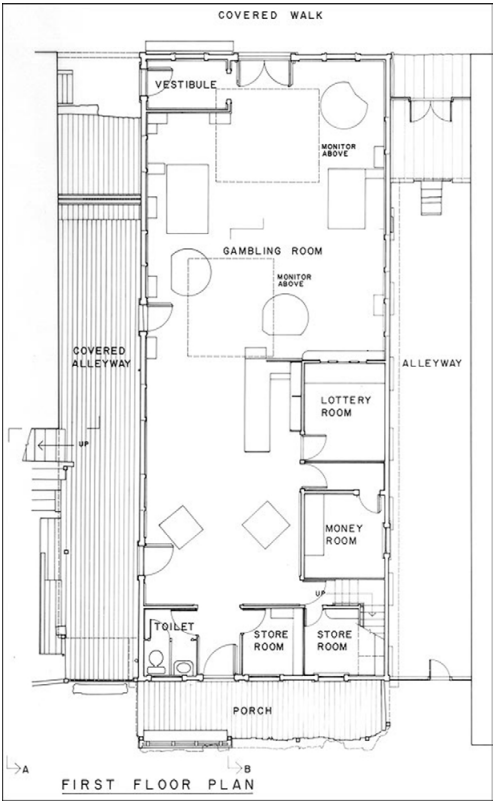
First-floor plan of the Dai Loy Gambling Museum, Locke, 1979. Credit: William F. Hand, delineator, Historic American Buildings Survey.
Locke outlasted the Delta's other rural Chinatowns. Younger Chinese Americans left for the cities, but older residents stayed. Even after the Alien Land Laws were ruled unconstitutional, the townspeople never bought their land; the few who remain still lease it. Now a National Historic Landmark — the largest, most complete example of a rural Chinese American farming community in the United States — Locke has fallen into disrepair, its wooden buildings at high risk of fire. It is a redevelopment area of the Sacramento Housing and Redevelopment Agency, and Sacramento County has been exploring ways to preserve it.
Visiting
Walnut Grove is on California Highway 160 between Sacramento and Stockton; Locke is a mile north. The historic districts can be seen on foot or by car; only businesses are open to the public.
Sources
Based on "Locke and Walnut Grove: Havens for Early Asian Immigrants in California," a Teaching with Historic Places lesson by Rita G. Koman, National Park Service, a work of the United States government in the public domain. The lesson draws on the National Register and National Historic Landmark files for the Locke and Walnut Grove historic districts and Walnut Grove Gakuen Hall; Roger Daniels, Asian America (1988) and Coming to America (1990); George Chu, "Chinatowns in the Delta," California Historical Society Quarterly (1970); and Christopher L. Yip, "A Time for Bitter Strength: The Chinese in Locke, California," Landscape (1978).
Licens: CC0 1.0 (offentligt eje) · Bearbejdet efter www.nps.gov
1
0
0
0

Kommentarer


