Ser du noget at forbedre? Foreslå en ændring.
Denne side er offentlig.
I Structural Biochemistry · side 147 af 952
Overview
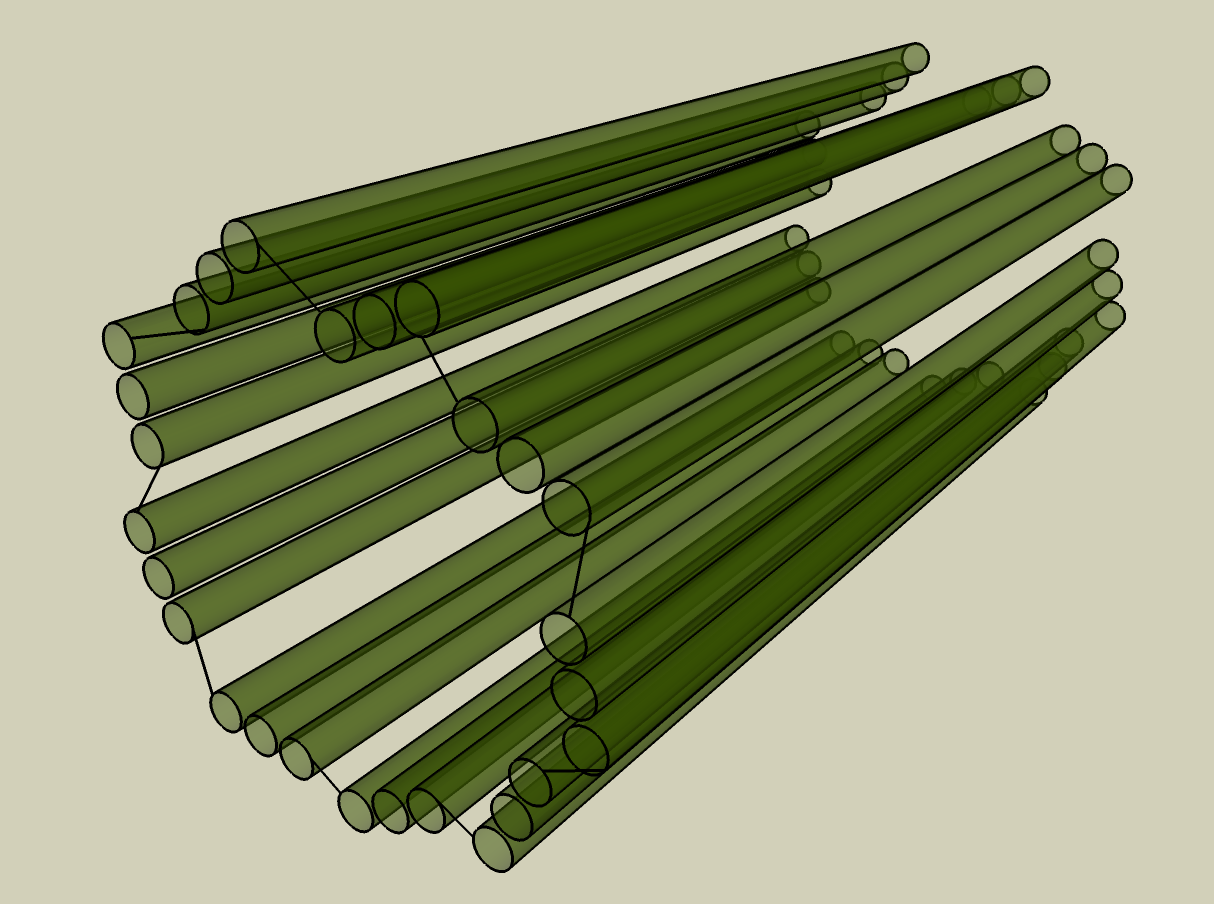
3D view of a centriole (Image: Twooars at English Wikipedia, CC BY-SA 3.0)
Every animal cell has two small organelles called centrioles. Centrioles help the cell when it comes time to divide. Mitosis and meiosis both have centrioles involved in. A centriole is a small set of microtubules arranged in a specific way. Also, there are nine groups of microtubules. The centrioles are found in pairs and move towards the poles of the nucleus when it is time for cell division. During interphase, the cell is at rest. The centrioles move to opposite ends of the nucleus and a mitotic spindle of threads begins to appear during prophase.
Centrioles are cylindrical structures that composed of groupings of microtubules arranged in 9+3 pattern. They are usually exist in pairs that form centrosomes. Centrioles are found in animal cells and play a big role in cell division. While cell division, the centrosome divides and the centrioles replicate (make new copies). The result is two centrosomes, each with its own pair of centrioles. The two centrosomes move to opposite ends of the nucleus, and from each centrosome, microtubules grow into a "spindle" which is responsible for separating replicated chromosomes into the two daughter cells.
Centrioles contain delta-tubulin, a protein which is part of the structure of tubulin.
Centrioles are barrel-shaped organelles that are found in most eukaryotic cells, with the exception of vascular plants and fungi. Centrioles consist of nine triplets of microtubules and are involved in the mitotic spindling, as well as when the cytoplasm of a eukaryotic cell split to form two daughter cells.
Where this page came from
This page was imported from Wikibooks. From “Structural Biochemistry” on Wikibooks, by its contributors, under CC BY-SA 4.0. Changed here: set as a page; navigation and edit links left out; each image under its own licence, credited in its caption.
Nobody has written it yet — it is the source material at a new address, which is why search engines are asked to skip it and why no one earns from it. It is up for grabs: take it on, and it is yours to rewrite and to earn from.
I disse publikationerStructural Biochemistry
Licens: CC BY-SA 4.0 · Bearbejdet efter en.wikibooks.org
Kommentarer