
Vil du forbedre nodens indhold? Prøv at lave en redigeringsanmodning.
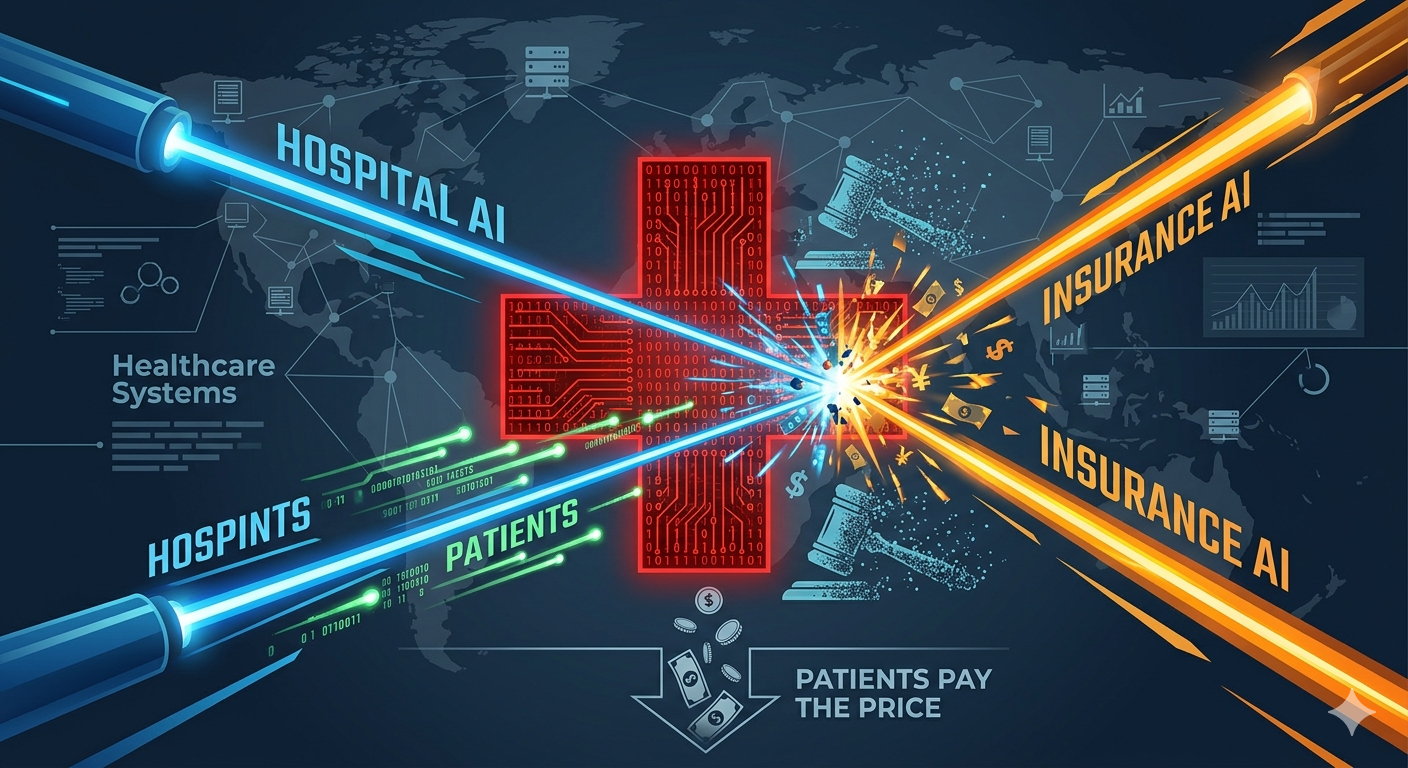
The United States healthcare system has devolved into a multi-sided algorithmic arms race, a digital "coding war" where hospitals, insurance companies, and patients deploy specialized artificial intelligence models to fight over medical billing and claims. Prompted by the widespread integration of Large Language Models (LLMs) and predictive analytics, healthcare providers have adopted ambient AI and automated revenue cycle management systems to maximize reimbursements. By analyzing patient-physician dialogue and medical charts in real time, these clinical algorithms identify, bundle, and suggest highly complex billing codes—a phenomenon known as AI-assisted upcoding. In response, private health insurers have launched counter-offensive algorithms. Using automated utilization review and predictive denial engines, payers systematically reject, delay, or downcode claims at scale, citing systemic billing inflation. This robotic tug-of-war has caught patients in the crossfire. Confronted with skyrocketing premiums, high out-of-pocket costs, and an unprecedented surge in administrative denials for historically covered procedures, consumers and advocacy groups are now arming themselves with consumer-facing AI bots to parse medical jargon, detect billing redundancies, and draft sophisticated legal appeals. While the technology promises workflow optimization, its current deployment exploits a deeply fragmented fee-for-service infrastructure. Hospitals use AI to drive up the perceived intensity of care, while insurers use AI to minimize payouts, yet neither side changes the actual volume or quality of medicine delivered. Consequently, the financial burden of this administrative friction is transferred directly to the consumer through elevated premiums and denied coverage. This deep dive analyzes the mechanics of the AI medical coding conflict, the operational strategies of the three opposing factions, the regulatory intervention efforts, and the long-term socioeconomic ramifications of an automated healthcare ecosystem.
The Architecture of the Algorithmic Escalation
To comprehend the ongoing technological conflict within the American healthcare sector, one must understand the underlying structural friction of its billing infrastructure. The United States operates predominantly on a fee-for-service and complex managed care framework, heavily reliant on standard nomenclatures: the International Classification of Diseases (ICD-10) for diagnoses and Current Procedural Terminology (CPT) codes for services rendered. Because these alphanumeric codes dictate the exact monetary reimbursement a healthcare provider receives from an insurance payer, the system has historically incentivized providers to code as comprehensively as possible, while prompting payers to audit these submissions to prevent overpayment.
For decades, this friction was managed manually by human clinical coders and insurance claims adjusters. It was a slow, labor-intensive process bounded by human constraints. However, the introduction of enterprise-grade generative AI and advanced natural language processing (NLP) has completely removed these operational bottlenecks. What was once a series of manual administrative disagreements has transformed into an automated, high-velocity algorithmic escalation.
Hospitals, insurers, and patients now deploy distinct, specialized AI models trained to execute conflicting financial objectives. This is not a collaborative integration of technology designed to improve clinical outcomes; it is a transactional battlefield where machine learning models exploit technicalities in the healthcare system to claim or protect capital.
The Provider Offensive: Ambient Intelligence and AI-Assisted Upcoding
Healthcare providers and hospital networks operate on increasingly tight margins, strained by labor shortages and escalating operational costs. To optimize the revenue cycle, health systems have aggressively integrated ambient AI assistant tools and generative AI clinical documentation software into the examination room.
The Mechanics of Automated Capture
During a patient visit, ambient AI applications run continuously in the background, capturing real-time audio of the physician-patient interaction. Using highly specialized clinical LLMs, the software transcribes the conversation, translates the unstructured dialogue into structured medical documentation (such as SOAP notes), and immediately queries internal electronic health record (EHR) databases to cross-reference the patient’s clinical history.
The primary financial value of these tools lies in "revenue cycle optimization." As the AI synthesizes clinical data, it automatically identifies documentation gaps and flags secondary or tertiary conditions that a human physician might neglect to record during a brief consultation. Crucially, the algorithm suggests the highest legally defensible billing codes, mapping complex combinations of CPT and ICD-10 codes to maximize the acuity rating of the encounter.
The Reality of Upcoding at Scale
While vendors market these platforms as administrative relief tools that mitigate physician burnout, data reveals a systemic shift toward higher-paying, maximum-severity billing categories. For example, a hospital visit that a human coder would traditionally categorize as a moderate-severity encounter is systematically re-evaluated by an AI agent that scans for underlying systemic factors—such as historical mentions of chronic hypertension or minor lab fluctuations—to reclassify the visit as a high-complexity admission.
| Metric / Clinical Indicator | Baseline Era (Pre-AI / 2022) | High-Adoption AI Era (Present / 2026) | Real-World Impact & Clinical Context |
|---|---|---|---|
| Inpatient Admissions Coded as "Complex" | 47% | 60% | Massive shift toward maximum-severity billing categories across top AI-adopting hospital networks. |
| Postpartum Anemia Diagnosis Frequency | Baseline Normal | +37% Increase | Sharp rise in diagnosis codes without any corresponding clinical increase in iron-infusion or blood-transfusion therapies. |
| Hospital Upcoding Index Change | Stable Historical Mean | +28% Aggressive Coding | Represents systemic inflation of billing complexity over a three-year adoption window without changes in treatment. |
| Estimated National Outpatient AI Inflation | $0 | $1.67 Billion | Estimated cumulative financial inflation driven exclusively by outpatient algorithm optimization. |
This systematic upcoding presents a profound ethical and legal paradox. The care delivered to the patient remains entirely unchanged; the clinical protocols, medications, and contact hours are identical. The only element that alters is the digital footprint generated by the AI, which translates the same physical encounter into a significantly more expensive corporate invoice.
The Insurer Defensive: Predictive Denials and Algorithmic Downcoding
Faced with an unprecedented surge in high-acuity, AI-generated claims from hospital networks, private health insurance payers have launched automated counter-offensives. To protect profit margins from AI-driven billing inflation, insurers have deployed predictive analytics, machine learning classifiers, and automated utilization review platforms designed to systematically filter, downcode, or deny claims at scale.
+-----------------------------------------------------------------------+
|                       THE ALGORITHMIC TUG-OF-WAR                      |
+-----------------------------------------------------------------------+
|                                                                       |
|   [ HOSPITAL AI ]  ================================>  [ INSURER AI ]  |
|   - Ambient Listening & Transcription                 - Batch Claim Processing|
|   - Real-time Clinical Synthesis                      - Cross-checks Criteria |
|   - Maximized ICD-10/CPT Selection                    - Automated Downcoding  |
|   - Acuity Upcoding Optimization                      - Batch Denial Generation|
|                                                                       |
|   Impact: Maximizes Claim Value                       Impact: Minimizes Payout|
+-----------------------------------------------------------------------+
                                    ||
                                    || (Costs & Denials Cascaded Down)
                                    \/
                   +----------------------------------+
                   |           [ PATIENT ]            |
                   |   - Higher Insurance Premiums    |
                   |   - Massive Out-of-Pocket Cost   |
                   |   - Left to Fight Denied Claims  |
                   +----------------------------------+
Batch Processing and Mechanical Denials
Rather than evaluating complex claims individually through human medical directors, insurance companies feed incoming hospital invoices into batch-processing AI engines. These engines parse thousands of multi-page medical claims per minute, cross-checking them against proprietary internal medical necessity criteria and historical actuarial datasets.
When a hospital’s AI submits an optimized claim featuring highly complex codes, the insurer's AI automatically detects patterns associated with billing inflation. Instead of initiating a nuanced peer-to-peer review, the system uses predictive models to issue instantaneous, automated denials or automated downcoding—arbitrarily lowering a Level 5 emergency visit code to a Level 3, for instance—frequently without human review of the patient's actual medical records.
Systematized Prior Authorization Barriers
The strategic use of AI has also transformed the prior authorization process into a highly defensive gatekeeping mechanism. Insurers utilize algorithms to predict which medical procedures, specialized drugs, or extended hospital stays are most likely to be unnecessary or profitable to contest.
By applying rigid algorithmic rules to patient profiles, these systems generate automated prior authorization rejections in fractions of a second. The objective is operational friction: by automating the denial process, insurers create an administrative bottleneck that shifts the burden of proof back onto the healthcare provider and the patient, banking on the statistical reality that a large percentage of denials are never formally appealed due to human administrative exhaustion.
The Patient Outcry: Caught in the Crossfire of Corporate Algorithms
At the bottom of this algorithmic hierarchy sits the healthcare consumer. As hospitals use AI to extract maximum revenue and insurers use AI to minimize claims payouts, the friction between these two opposing forces creates a direct financial cascade onto the patient.
The Dual Financial Burden
Patients are penalized from both sides of the corporate technological divide:
- Premium Inflation: Because hospital AI algorithms successfully inflate the overall cost of claims, insurance companies face rising aggregate expenditures. To preserve their targeted medical loss ratios and corporate margins, insurers pass these costs directly to employers and individual consumers, driving up baseline health insurance premiums by an average of 7% to 9% annually.
- The Out-of-Pocket Crisis: When an insurer's defensive AI issues a blanket denial or downcodes a procedure that has already occurred, the hospital does not absorb the financial loss. Instead, the balance is transferred directly to the patient in the form of massive, unexpected out-of-pocket medical bills, balance billing practices, and un-covered liability.
The Appeal Deficit
The systemic asymmetry of this framework is stark. A patient who has just undergone a complex surgical procedure or is managing a chronic illness does not possess the administrative stamina, time, or specialized legal vocabulary required to combat a multi-billion-dollar insurance corporation's automated denial framework. The traditional appeal process requires navigating multi-page formal disclosures, gathering clinical peer-reviewed literature, and compiling exact documentation—a reality that leaves millions of patients trapped with catastrophic medical debt for treatments that should have been covered.
The Consumer Counter-Offensive: Deploying Bots to Battle Corporate AI
In response to this systemic vulnerability, a grassroots technological movement has emerged. Realizing that human efforts cannot match the speed of corporate software, patients, consumer advocacy nonprofits, and specialized legal-tech startups are turning to consumer-facing artificial intelligence to fight back.
Forensic Bill Splitting and Redundancy Audits
When patients receive highly complex, un-itemized hospital invoices that run into tens or hundreds of thousands of dollars, they are increasingly uploading these documents into advanced consumer LLMs and platforms designed by digital health advocacy startups.
These consumer-facing AI agents function as forensic billing auditors. They read through the raw, unstructured medical jargon and cross-reference the listed CPT codes against public databases and regional standard pricing indexes.
The AI can immediately isolate instances of duplicative billing—such as a hospital charging separately for a sterile kit and an IV line that are legally required to be bundled under a single procedural code. In high-profile cases documented across consumer advocacy forums, these forensic AI interventions have successfully dissected and exposed improper coding practices, forcing hospital billing departments to slash inflated invoices by up to 80%.
Automated Appeal Engines
On the insurance denial front, startups and legal-tech organizations have developed dedicated, consumer-accessible "appeal bots." When an insurer issues an automated denial letter for a critical medication or diagnostic scan, the patient uploads the denial notice along with their medical records into the consumer application.
+--------------------------------------------------------------------------+
|                     CONSUMER AI APPEAL BOT WORKFLOW                      |
+--------------------------------------------------------------------------+
|                                                                          |
|  [ Patient Uploads ] ---> [ Consumer AI Agent ] ---> [ Automated Appeal ]|
|  - Insurer Denial Letter    - Extracts Rejection Codes  - Custom Draft   |
|  - Clinical History Notes   - Scans Policy Language     - Legal/Medical  |
|  - Doctor Recommendation    - Queries PubMed Database     Evidence Cited |
|                                                                          |
+--------------------------------------------------------------------------+
The AI executes a targeted multi-step analysis:
- Extraction: It extracts the specific internal rejection codes utilized by the insurer’s defensive algorithm.
- Policy Parsing: It parses the patient’s exact insurance policy contract to identify ambiguities or explicit clauses that mandate coverage for the disputed service.
- Evidence Synthesis: It queries open-access medical databases (such as PubMed) to automatically pull peer-reviewed clinical studies supporting the medical necessity of the treatment.
- Drafting: It drafts a highly formal, legally compliant, and medically sound appeal letter tailored to trigger a mandatory human review within the insurance company’s compliance department.
By reducing the time required to generate a sophisticated medical appeal from hours to seconds, consumer AI is attempting to democratize administrative resistance, allowing individual citizens to wage an automated war of attrition against corporate claims adjusters.
Legal, Regulatory, and Compliance Battlegrounds
The rapid escalation of this algorithmic arms race has caught the attention of federal and state regulators, triggering a wave of enforcement actions, statutory prohibitions, and significant civil litigation under existing anti-fraud frameworks.
The False Claims Act and Algorithmic Vulnerability
At the federal level, the Department of Justice (DOJ) has begun aggressively monitoring hospital networks that utilize automated revenue cycle tools to determine if their software design crosses the line into systemic fraud. Under the False Claims Act (FCA), any entity that knowingly submits, or causes to be submitted, a false claim to a federal healthcare program (such as Medicare or Medicaid) face severe treble damages and civil penalties.
Legal precedents have established that hospital systems cannot shield themselves behind a vendor's algorithm. For example, the Department of Justice’s intervention and subsequent $23 million settlement with University of Colorado Health (UCHealth) signaled a major shift in enforcement strategy.
The government alleged that the health system used an automated billing rule within its electronic health records infrastructure to systematically upcode emergency department visits to the highest-paying billing code (CPT 99285) based solely on routine, low-complexity clinical actions (such as how frequently a nurse checked a patient's vital signs), rather than actual medical necessity. As generative AI engines take over the drafting of clinical codes from raw doctor notes, the potential for these models to systemically "hallucinate" diagnoses or intentionally ignore negating statements (e.g., misinterpreting "no evidence of pneumonia" as an active diagnosis) exposes healthcare systems to profound FCA liability.
State Legislative Prohibitions and Regulatory Vetting
Simultaneously, state legislatures are moving to establish statutory guardrails to protect consumers from completely automated insurance denials.
               STATE LEGISLATIVE PROHIBITIONS (2025-2026)
               ==========================================

    +-------------------+   +-------------------+   +-------------------+
    |      TEXAS        |   |     MARYLAND      |   |      ARIZONA      |
    +-------------------+   +-------------------+   +-------------------+
    | Bans AI as sole   |   | Mandates human    |   | Prohibits automated|
    | decisionmaker in  |   | sign-off for all  |   | medical necessity |
    | medical necessity |   | adverse clinical  |   | denials without   |
    | claim rejections. |   | determinations.   |   | human review.     |
    +-------------------+   +-------------------+   +-------------------+
States including Texas, Maryland, Arizona, and Nebraska have enacted strict regulatory frameworks that explicitly ban insurance companies from utilizing artificial intelligence or automated algorithms as the sole decisionmaker when denying a claim based on medical necessity. These statutes dictate that while an AI can be used to expedite approvals for clearly valid claims, any adverse determination or coverage denial must undergo rigorous, documented review and sign-off by a licensed human medical professional who possesses relevant expertise in the specific clinical field under review.
Furthermore, state attorneys general have initiated direct deceptive trade practices investigations into health-tech vendors. The Texas Attorney General’s investigation and subsequent settlement with Pieces Technologies set a critical consumer protection precedent. The state concluded that the vendor's marketed metrics regarding its AI clinical software’s accuracy and safety rates were unverified and misleading to hospital clients, establishing that AI developers will be held directly accountable for the performance claims of their products.
The Future of the Automated Healthcare Economy
The ongoing algorithmic conflict between healthcare providers, insurance companies, and patients is a structural symptom of an infrastructure that prioritizes billing documentation over clinical efficacy. As long as the American healthcare economy remains tethered to a fragmented fee-for-service model where administrative complexity dictates profitability, the integration of artificial intelligence will inevitably be weaponized to optimize financial transactions rather than human health.
If left unchecked, this automated arms race threatens to widen the equity gap in medicine. Wealthier health systems will deploy increasingly predatory AI to maximize revenue, massive insurers will build larger algorithmic walls to insulate capital, and tech-savvy patients will use premium bots to bypass restrictions. Meanwhile, marginalized populations—who lack access to advanced digital tools, stable internet infrastructure, or the technical literacy required to manage automated appeal engines—will bear the brunt of algorithmic bias and systematic denials, finding themselves priced out of an unfeeling, hyper-automated system.
To avert a future where healthcare is governed by a network of adversarial algorithms, a structural paradigm shift is required. Federal and state regulations must transition from reactive enforcement to proactive, systemic governance. This includes mandating full algorithmic transparency, requiring open-source explainability dashboards for all billing and denial software, enforcing strict "human-in-the-loop" accountability metrics, and ultimately restructuring healthcare incentives away from volume-and-code complexity toward verifiable, value-based patient outcomes. Until these fundamental structural changes are realized, the medical coding wars will continue to escalate, transforming the pursuit of human health into a cold war of digital attrition where the machine wins and the patient pays.
1
0
0
0

Kommentarer