
Ser du noget at forbedre? Foreslå en ændring.
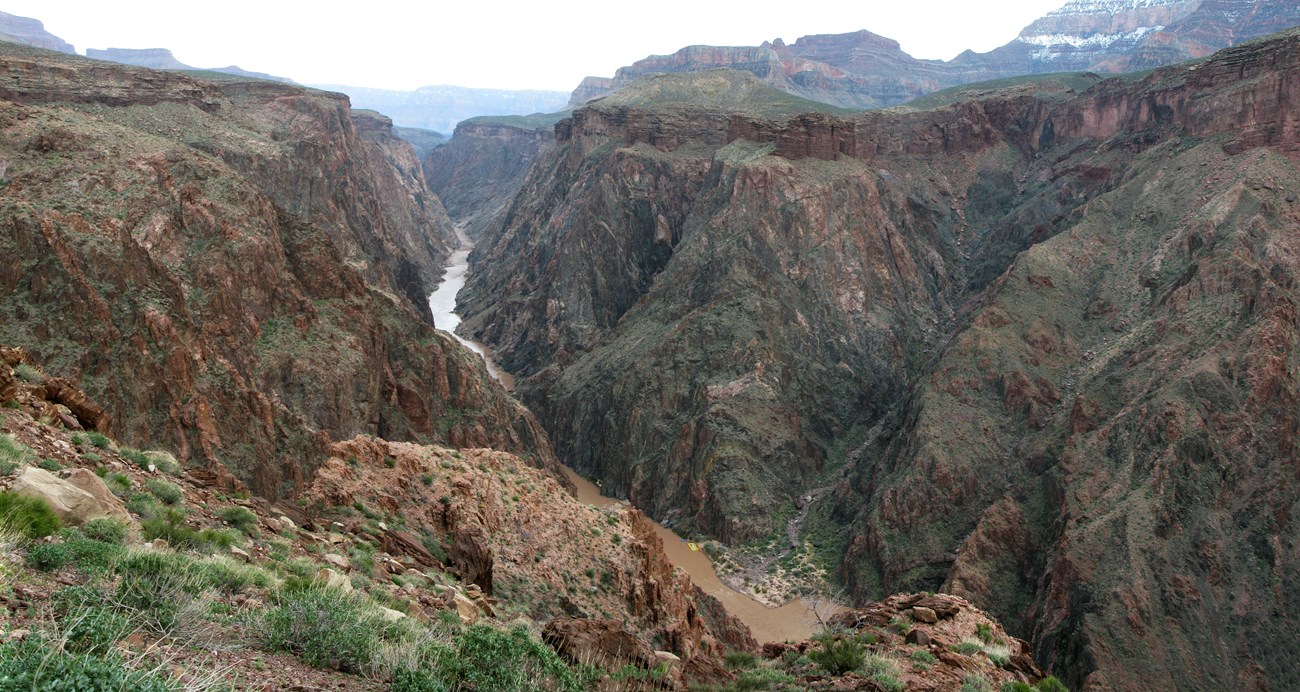
The inner gorge of the Grand Canyon and the Colorado River. NPS photo by Michael Quinn.
At the very bottom of the Grand Canyon lie its oldest rocks — the ancient crystalline rocks known together as the Vishnu Basement Rocks. This page is based on a National Park Service article series adapted from the report Telling Time at Grand Canyon: 2020 Update.
At a glance
| Rock type | metamorphic and igneous rocks with vertical folds and foliation |
| Where they formed | in volcanic island chains that collided with ancestral North America to form the southwestern United States; the rocks were metamorphosed and invaded by magma deep in the crust |
| Age | Paleoproterozoic and Mesoproterozoic eras (Precambrian), 1,840 to 1,375 million years ago (Ma) |
"Vishnu Basement Rocks" is an informal name. It is useful because the formal names don't cover all of the canyon's metamorphic units and individual igneous bodies. "Vishnu" is borrowed from the well-known Vishnu Schist; "basement" describes the kind of rock assemblage and where it sits. The rocks span 465 million years, but a general age of about 1.75 billion years (1.75 Ga) highlights the tectonic collisions that added this piece of crust to North America.
Five groups, oldest to youngest
The basement rocks fall into five informal groups, each with its own time and tectonic story. Only two — the Granite Gorge Metamorphic Suite and the Zoroaster Plutonic Complex — have been formally defined.
1. The oldest basement: Elves Chasm pluton (1,840 Ma)
The oldest basement rock yet identified in the canyon, exposed only near Elves Chasm around River Mile 115. It was once a magma chamber in one of the microcontinents that gradually joined to form North America. Its age marks when the magma crystallized; because it is intrusive, it must have pushed into still older rocks, which have not yet been found.
2. Granite Gorge Metamorphic Suite (1,750–1,751 Ma)
A gap of 90 million years — an unconformity — separates the Elves Chasm pluton from the overlying suite:
| Rock | Origin | Age (Ma) |
|---|---|---|
| Rama Schist | volcanic | 1,751 |
| Brahma Schist | volcanic | 1,750 |
| Vishnu Schist | sedimentary | 1,750 |
These rocks were laid down in volcanic island arcs and later welded onto the growing continent during the Yavapai orogeny, about 1,700 Ma. Buried as deep as 12 miles (20 km), they were metamorphosed and took on their characteristic folds and vertical foliation. The collision was similar to Italy's collision with Europe that formed the Alps, and it added new crust to what was then the southern edge of North America. Two kinds of magma later intruded these rocks at great depth: first granodiorite, then granite and pegmatite.
3. Zoroaster Plutonic Complex (1,740–1,713 Ma)
Most of the granodiorite bodies belong to this complex. They formed during the Yavapai orogeny, probably as magma chambers feeding volcanic arcs above subduction zones — similar to the chambers beneath the Cascade volcanoes of the Pacific Northwest today.
| Rock | Age (Ma) |
|---|---|
| Zoroaster granite | 1,740 |
| Diamond Creek granite | 1,736 |
| Trinity granite | 1,730 |
| Ruby gabbro | 1,716 |
| Horn Creek granite | 1,713 |
4. Later granites and dike swarms (1,698–1,662 Ma)
The last melts of the waning Yavapai orogeny formed more than 12 miles (20 km) down, as colliding plates thickened and heated the crust. They differ from the Zoroaster rocks in composition and in how they cut across them, and are slightly younger: the Cremation pegmatite (1,698 Ma) — a swarm of intrusions seen near Phantom Ranch — and the Phantom granite (1,662 Ma).
5. The youngest granite: Quartermaster pluton (1,375 Ma)
In the western Grand Canyon, this pluton is far younger than the rest. It belongs to a belt of similar-age plutons from southern California to Labrador, formed when later collisions — probably of other continental fragments, far to the south — melted the crust across the Southwest.
How the ages are known
The ages come from U-Pb dating of the mineral zircon. They are highly precise — within ±2 million years — except for the Trinity granite, whose ±93 million-year uncertainty reflects mixed zircon populations that newer methods could now resolve. The dates have changed little in two decades.
Much remains to learn. Zircon grains in the Vishnu Schist that survived metamorphism unchanged record where its sediment came from: the oldest are as old as 3.8 billion years, with many about 2.4 and 1.8 billion years old. The next step is finding the source regions outside the canyon.
Roots of vanished mountains
These igneous and metamorphic rocks formed beneath the Vishnu mountains, which have long since eroded away. By the time the Grand Canyon Supergroup was deposited on the erosion surface called the Great Nonconformity, the mountains had been worn down to sea level.
Sources
- National Park Service, Grand Canyon National Park: "Vishnu Basement Rocks," from the series Telling Time at Grand Canyon.
- Karlstrom K, Crossey L, Mathis A, Bowman C. 2021. Telling Time at Grand Canyon National Park: 2020 Update. Natural Resource Report NPS/GRCA/NRR—2021/2246. National Park Service.
I disse publikationerGrand Canyon National ParkTelling Time at Grand Canyon National Park
Licens: CC0 1.0 (offentligt eje) · Bearbejdet efter www.nps.gov
1
0
0
0

Kommentarer


