
Ser du noget at forbedre? Foreslå en ændring.
Since the Global Polio Eradication Initiative began in 1988, wild poliovirus has been pushed back sharply: types 2 and 3 were certified eradicated in 2015 and 2019, and type 1 still spreads endemically only in Afghanistan and Pakistan. In 2016 every country switched at once from trivalent oral polio vaccine (OPV), which contains weakened Sabin strains of types 1, 2 and 3, to bivalent OPV with types 1 and 3 only, to cut the risk of circulating vaccine-derived poliovirus type 2 (cVDPV2). Such viruses arise when vaccine virus circulates for a long time in under-immunized communities and regains the ability to paralyze. Since the switch, widespread cVDPV2 outbreaks have occurred where immunity is low. This MMWR report reviews Somalia's, which has been under way since 2017.
Background
Somalia has lived through decades of civil unrest since its central government fell in 1991, bringing a complex humanitarian emergency, mass displacement and the collapse of the health system, especially in the South-Central region. The country has 118 districts, 20 regions and seven federal states, including Banadir, home to the capital, Mogadishu; Somaliland in the north runs itself. As of December 2023, insurgents partly or fully controlled nearly half of the 81 South-Central districts, blocking house-to-house vaccination for 17% of targeted children. No national census has been taken in more than 40 years.
Even so, Somalia stopped its own wild poliovirus type 1 transmission in 2002, ended imported outbreaks in 2005–2007 and 2013–2014, and before the 2016 switch halted a long cVDPV2 outbreak (2008–2013). Its schedule includes 4 doses of bivalent OPV and 2 of inactivated polio vaccine (IPV), which covers all three types. But since 2017 only an estimated 47% of infants have received 3 OPV doses through routine immunization, and since 2018 only 42% have received 1 IPV dose.
In October 2017 cVDPV2 was detected in Banadir, followed 4 months later by circulating vaccine-derived poliovirus type 3 (cVDPV3).
Cases
From 2017 to March 2024, Somalia recorded 39 cVDPV2 cases in 14 of its 20 regions and in all seven states; transmission also spread to Ethiopia and Kenya. Thirty-four (87%) came from districts in the South-Central region, and the other five from Somaliland (four) and Puntland (one) in 2019–2020. Patients' average age was 36 months (range 3–108 months), 49% were girls, and 20 (51%) had received no OPV at all.
In 2018 Hirshabelle reported five cVDPV3 cases and Jubbaland two. None has been isolated since September 2018.
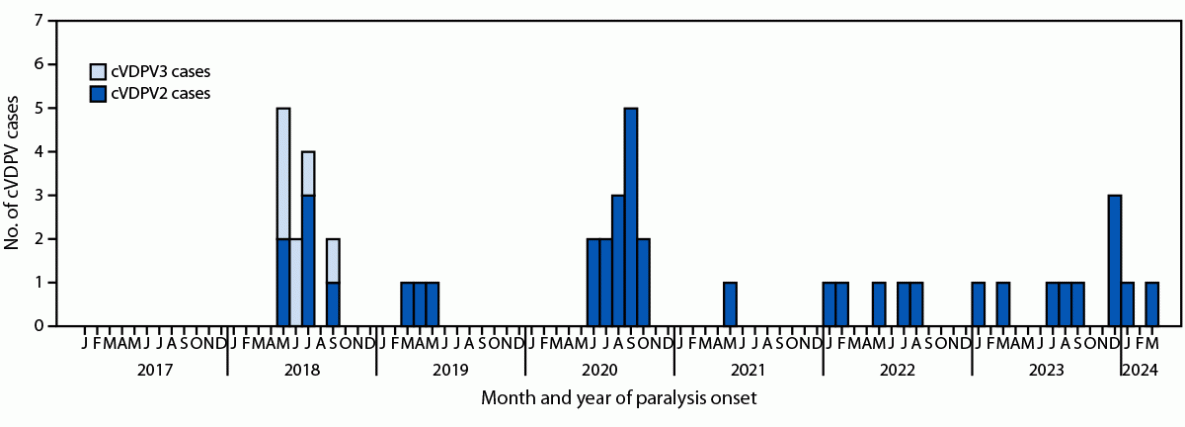
Cases of circulating vaccine-derived poliovirus types 2 and 3 by month, Somalia, January 2017–March 2024. CDC figure.
Genetics. Sequencing in 2017 showed that the main outbreak strain, SOM-BAN-1, had been circulating undetected for at least 3 years; its latest case was found in Jubbaland in March 2024. From January 2021 to March 2024, 17 of 29 isolates (59%) came from Banadir, including 10 of 16 "orphan" viruses — a sign of large gaps in surveillance. A second strain, SOM-BAY-1, emerged in southern Somalia in December 2023 and was last detected in January 2024. A sewage sample from Banadir in May 2022 carried a strain from a Yemen outbreak, YEM-TAI-1, not seen in Somalia since.
Vaccination campaigns
Since January 2021 Somalia has run 28 supplementary immunization activities (SIAs) with type 2 vaccine or IPV: seven national, 12 subnational and nine smaller targeted campaigns, using monovalent Sabin OPV2 (15), novel OPV2 (eight), trivalent OPV (three) and IPV (two). From 2017 to 2020 there were 17 bivalent OPV campaigns.
Among 1,921 children aged 6–59 months with paralysis from other causes (nonpolio acute flaccid paralysis), caretakers reported that 38% had received at least 3 routine OPV doses, 28% at least 1 IPV dose, and 71% at least 3 OPV doses in campaigns. But 231 (12%) had never received any OPV; 95% of these "zero-dose" children were from South-Central districts, and 60% of those whose district status was known lived in inaccessible areas. As of December 2023 an estimated 472,743 children — about one in six Somali children under 5 — could not be reached in the South-Central region because of insecurity.
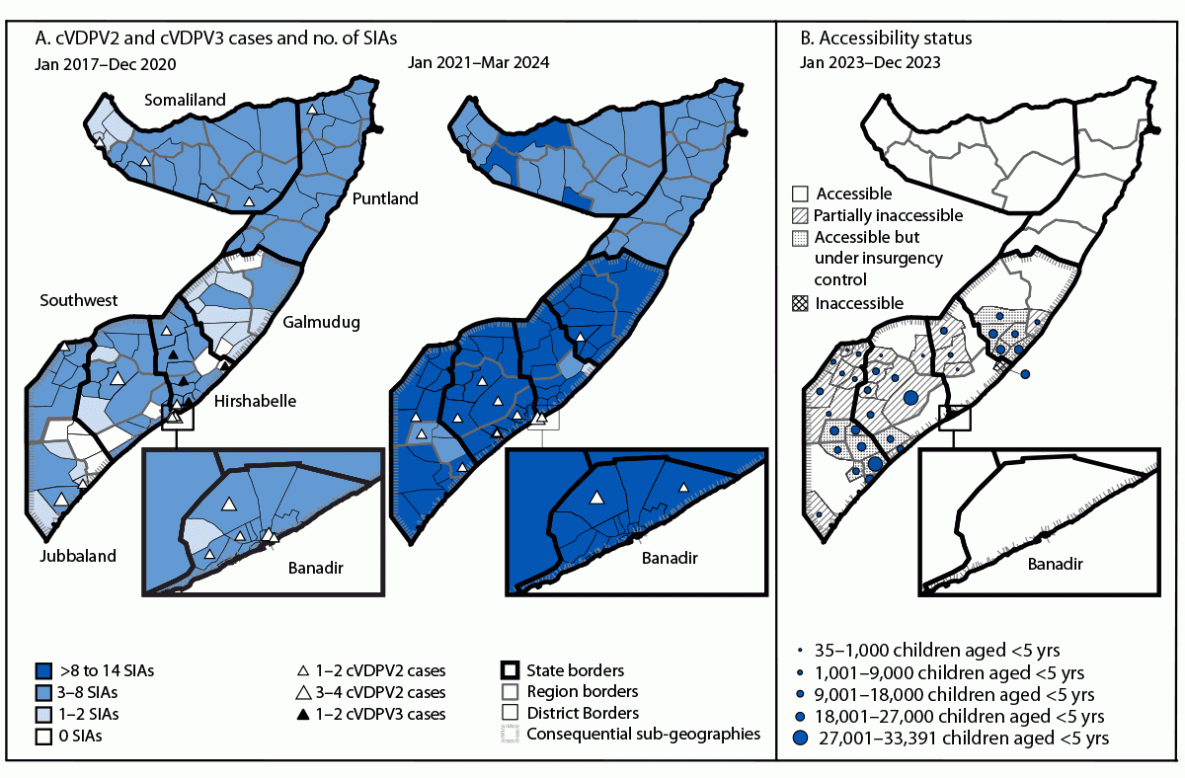
Cases, campaigns and accessibility by district, Somalia, January 2017–March 2024. CDC figure.
Surveillance
As of March 2024, surveillance for acute flaccid paralysis ran through 983 active sites and 796 village polio volunteers, 71% of them in the South-Central region. The national rate of nonpolio paralysis cases met the World Health Organization's sensitivity standard of three per 100,000 children under 15 every year (3.8–5.2 in 2021–2024), but Banadir, the state with the most cases, missed it every year (1.8–2.9). Adequate stool samples were collected from more than the target of 80% of cases each year (92.4%–99.1% in 2017–2023), though Galmudug fell to 72.2% in early 2024. Yet the share of samples reaching the accredited laboratory in Kenya within 3 days fell from 44% in 2017 to 9% in 2022 and 2023.
Sewage sampling grew from four sites in 2017 to 17 in 2023. It found 73 cVDPV2 isolates in four of the six states with sites, 66 (90%) of them in Banadir.
What is being done
Many children in the affected regions have been out of reach for more than a decade, routine coverage is chronically low, and campaign quality has suffered even where children can be reached. Under new leadership, Somalia's polio team has improved health worker training, expanded vaccination of people on the move, strengthened campaign monitoring, and worked with humanitarian negotiators to gain temporary access to insecure areas; the Prime Minister is to lead a new Task Force on Polio Eradication and Immunization. With trained third-party monitors, the share of districts passing post-campaign quality checks fell from 87% in 2021 to 55% in November 2023 — likely a more accurate picture, showing that inaccessibility is only one reason children go unvaccinated.
Stopping cVDPV2 in Somalia is critical to keeping the Horn of Africa free of polio and to ending cVDPV2 worldwide. The authors called for new ways to reach children in inaccessible areas, fixes to operational problems, and high-quality campaigns where access is possible.
Limitations: campaign data were incomplete for some years; uncertainty about which areas are accessible clouds both surveillance and immunization figures; caretakers' recall of doses may be inaccurate; campaign dose data do not separate type 2 vaccine from bivalent vaccine; and without a recent census, population estimates are uncertain.
Sources
- Mendes A, Mohamed GA, Derow M, et al. "Persistent Transmission of Circulating Vaccine-Derived Poliovirus — Somalia, January 2017–March 2024." MMWR 2024;73(25).
Licens: CC0 1.0 (offentligt eje) · Bearbejdet efter www.cdc.gov
1
0
0
0

Kommentarer


