
Vil du gøre sidens indhold bedre? Foreslå en ændring.
The bison robe trade changed both the Plains tribes and Bent's Fort, the trading post of Bent, St. Vrain & Co. on the Arkansas River.
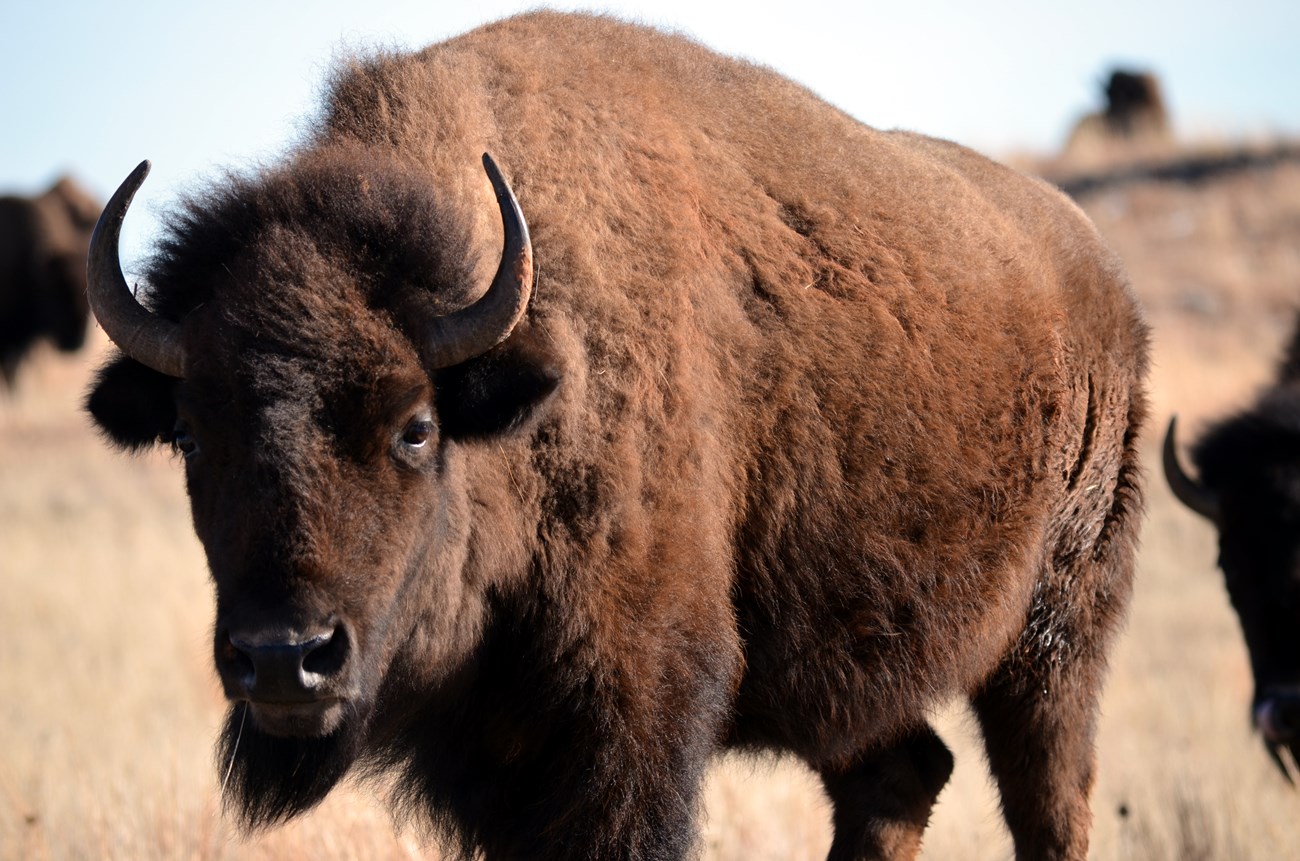
NPS/WICA
Drawn into a global market
The traders' manufactured goods proved irresistible. The tribes gave up some of their old self-sufficiency and came to depend on traders for necessities — iron for arrow points, skinning knives, fire steels, sewing awls, firearms, powder and lead.
For a few months every year, the tribes did little but hunt bison and process robes. They weren't factory workers, but they were laborers in a capitalist market — a global one, controlled by others, from European fur buyers to the robe traders on the high plains. White traders became familiar figures in the villages during robe season, and some gained real influence over particular bands.
Bent's Fort became a hub around which much of the political, economic and social life of the Southern Cheyennes and others revolved — a role no trading post had played before the 1830s.
Families, raids and horses
- More wives, more robes. Women did all the work of tanning, so a lodge with more wives could process more robes. The trade led to a noticeable rise in polygyny, and encouraged raids between tribes to capture women for this labor.
- Heavier work for women, as hunters pushed for bigger harvests to trade.
- More horses. The hunt depended on them. William Bent's son George recalled that men used "their best horses...to chase buffalo" and "old plugs" to carry the hides, riding the plugs and leading the good horses to keep them fresh; a good hunter took two or three pack horses as well as his runners. Horses also let bands range widely after the herds and travel to posts on the Arkansas and South Platte.
- Strain on the land. Big horse herds ate up grass and timber around traditional campsites — worse still in drought.
The bison vanish
The trade's biggest impact was a frightening fall in bison numbers and a shrinking of their range.
| Source | Robes a year |
|---|---|
| Josiah Gregg, 1844 — exported from the western prairies | about 100,000 |
| John F. A. Sanford, about the same time | 90,000 |
| 1850 industrial census of St. Louis — handled by Pierre Chouteau Jr. & Co. and R. & W. Campbell | 98,000 |
Thousands came into Bent's Fort each year, thousands more into posts on the North and South Platte and the Upper Missouri, plus the trade of small independents and New Mexican ciboleros. None of those figures counts bison killed by Native Americans for their own use, or by sport hunters, adventurers and emigrants on the trails.
In 1860, the St. Louis Democrat wrote that "probably not over a tenth of those [buffalo] slaughtered furnish us robes" — so a season yielding 80,000 trade robes might mean 800,000 dead bison. The paper, like most people then, assumed they would "scarcely be missed out of the immense herds."
But recent scholarship puts the number of plains bison far lower than the wild estimates of the nineteenth century. And the trade took mostly cows, and to a lesser extent calves — killing thousands of breeding females every year. Add market hunting, drought, hard winters, disease and competition with wild and tame horses for forage, and the warning signs were plain.
Those who saw it coming
- Josiah Gregg noted the high-plains bison had "sensibly decreased within the last ten years," and warned the slaughter "must ultimately effect their total annihilation from the continent."
- The Cheyenne leader Yellow Wolf told Lt. James Abert in 1846 of the "decrease of the once abundant buffalo," predicting "that in a few years they will become extinct."
- In 1845 the Southern Cheyennes were "suffering from hunger, not having seen any buffalo, except now and then a single bull." Bent's Fort took in only a third of its usual robes that year. In January 1846, the Cheyennes were still finding few buffalo as far as 140 miles east of the post.
- Alexander Barclay wrote to his brother George in 1845 that the robe business shrank every year as the animals grew so rare, even at the foot of the mountains, that "we have frequently to go one and two hundred miles to get the first sight of one" — and that the Indians following the herds believed their children would "have to raise corn for an existence."
The herds' retreat eastward weighed heavily in William Bent's decision to abandon Bent's Fort in 1849 and move his trade down the Arkansas. That the decline was already so measurable after the fort's sixteen years was an ill omen for the slaughter of the next generation.
Previous in the series The Business of Bison: Packing Bison Hides for Trade.
Sources
Based on "Impacts of the Bison Robe Trade," National Park Service, adapted from Mark L. Gardner's 2004 NPS Historic Resource Study Bent's Old Fort on the Arkansas; a work of the United States government in the public domain.
I disse samlingerBent's Old Fort National Historic SiteSanta Fe National Historic TrailThe Business of Bison
Licens: CC0 1.0 (offentligt eje) · Bearbejdet efter www.nps.gov
1
0
0
0

Kommentarer


