
Willst du den Inhalt der Seite besser machen? Schlag eine Änderung vor.
By Science Communication Assistant Jailyn Hoskins, San Francisco Bay Area Network Science Communication Team
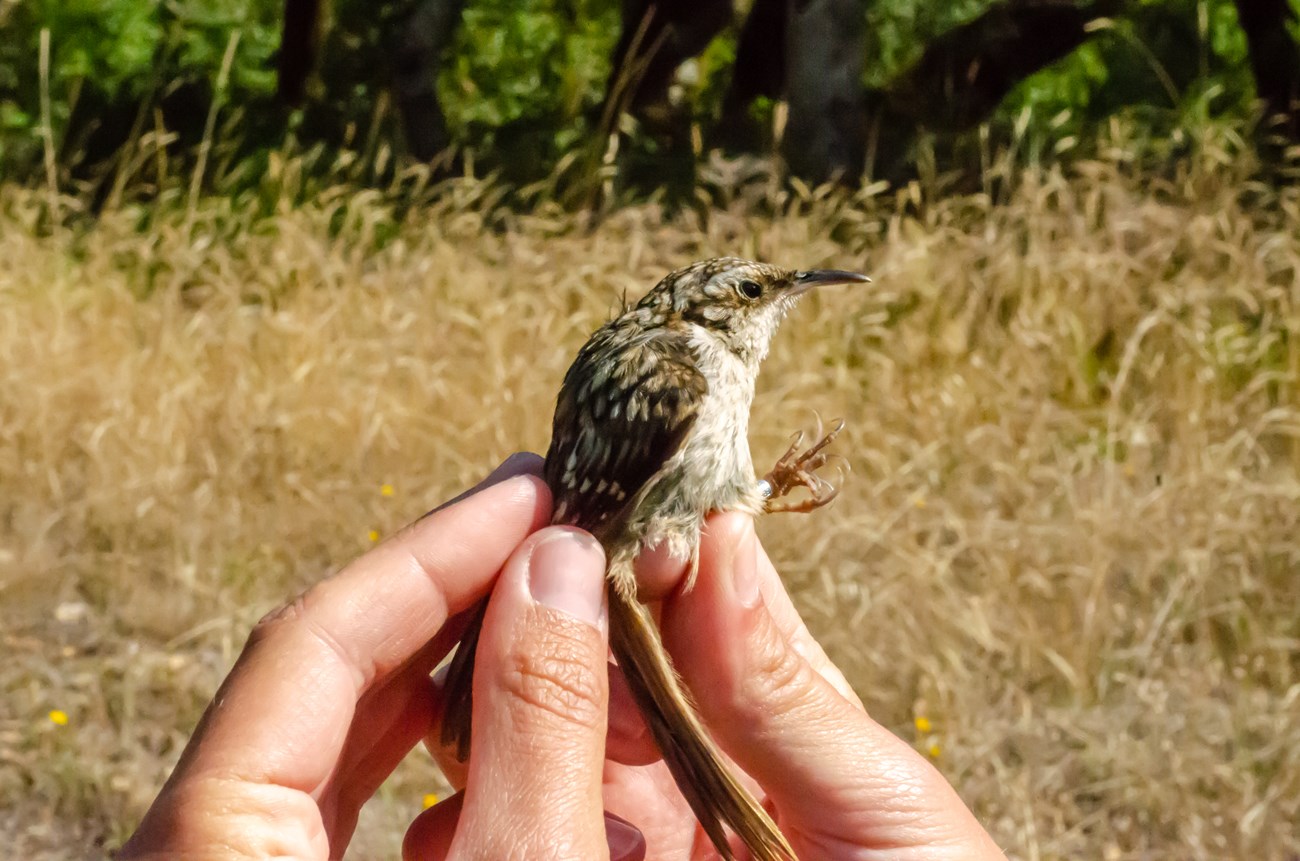
On my first day observing the mist netting, I was there from around eight in the morning until noon, and we only caught one bird, a brown creeper. NPS / Environment for the Americas / Jailyn Hoskins
October 2022 - I started birding a couple years ago and was just getting comfortable with the birds in southeast Louisiana before I moved out west. Coming to California exposed me to a wide variety of birds that I was not familiar with. That’s why I was really looking forward to joining Point Blue Conservation Science for two days to observe their mist netting, which would allow me to see the birds up close for the first time. Point Blue’s work in riparian (stream-side) areas of Golden Gate and Point Reyes in partnership with the National Park Service forms the core of the San Francisco Bay Area Network’s Landbird Monitoring Program.

I watched eagerly as the team gently gathered information about the bird. When the banders brought it to the mobile station they had set up at some much earlier hour, they checked its feathers and body, weighed it (in a film canister!), and attached a small metal band to one of its legs. NPS / Environment for the Americas / Jailyn Hoskins
The first day, I traveled up Highway 101 and arrived at Point Blue’s Palomarin Field Station in the south end of Point Reyes National Seashore. It is the longest running landbird mist-netting and banding effort West of the Mississippi and third in the continent! There were three banders (interns and apprentices who were part of an intensive early-career training program) who were going on “net runs” to check all the nets every 30 minutes to check what had flown into the thin netting. It wasn’t much. I was there from around eight in the morning until noon, and we only caught one bird, a brown creeper. But they skillfully solved the puzzle of removing it from the net by determining which direction it had flown in and using different techniques to safely remove it. Just from watching I could see the level of expertise required.
Then I watched eagerly as the team gently gathered information about the bird. When the banders brought it to the mobile station they had set up at some much earlier hour, they checked its feathers and body to determine age and other aspects of its condition, then weighed it (in a film canister!). I was told that this day in particular was really slow, but I had nothing to compare it to, and I was happy to help release the bird once the banders were done examining it.
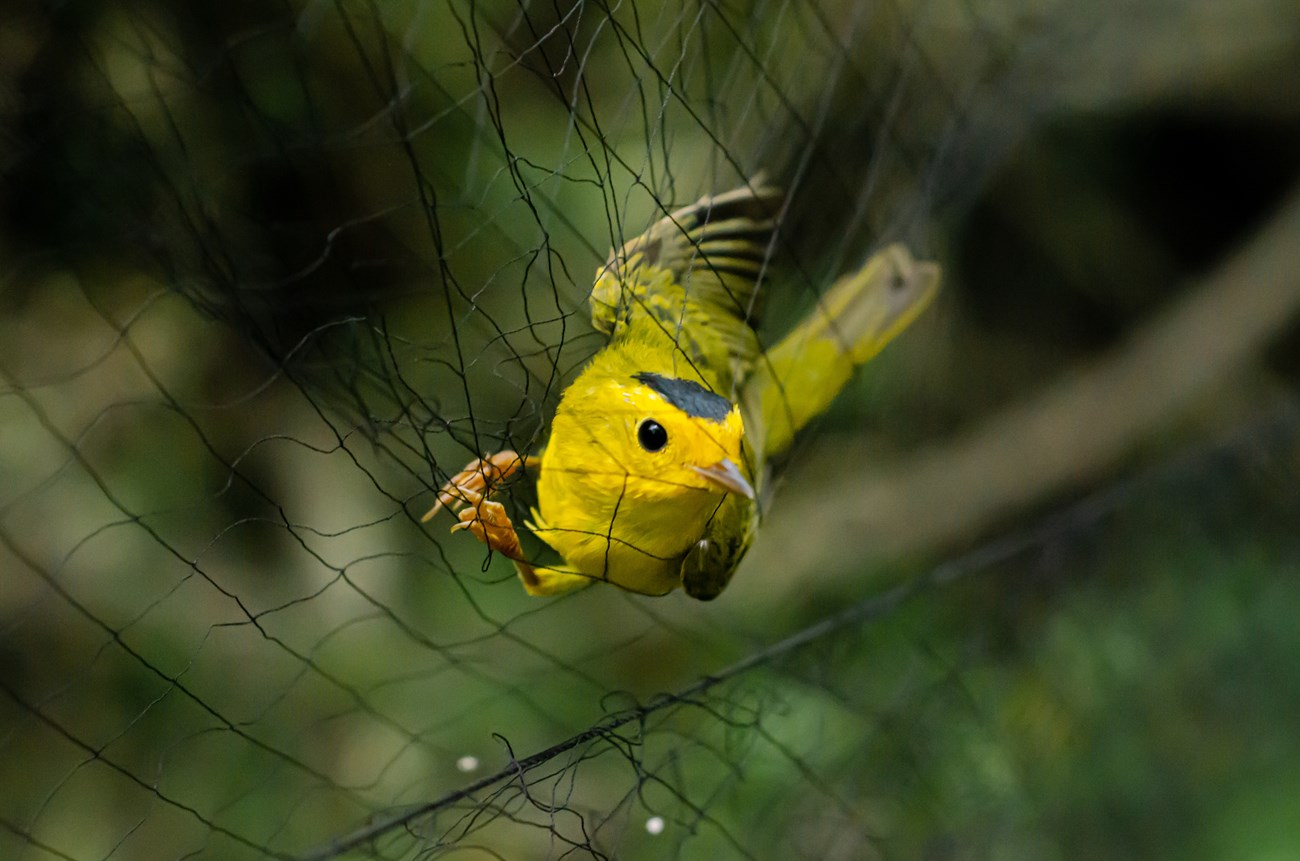
A Wilson’s warbler, caught in a soft mist net and awaiting extraction by a trained bird bander, after which it was given a unique metal leg band, had data collected to teach biologists about this individual bird and the overall population, and released safely back into the wild. NPS / Environment for the Americas / Jailyn Hoskins
The second day, I got to see what a busy day looked like. Every net run that we went on there was a bird. Or more than one! I was only there for an hour and got to see a dozen birds and five different species. My favorite bird of the day was the Wilson’s warbler, which seemed to be especially yellow in the green riparian area that we were in.
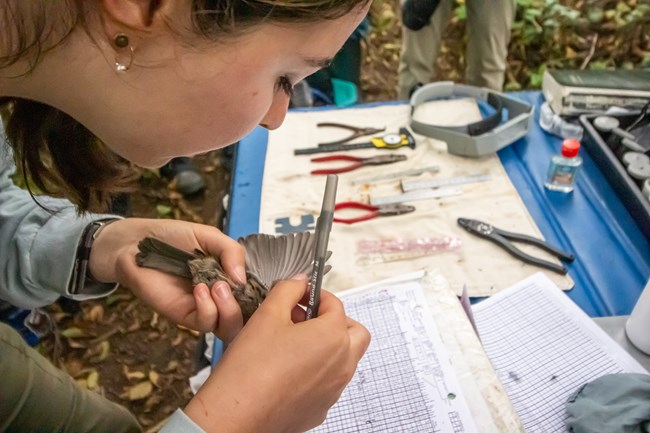
Examining the feathers of this song sparrow and looking at which ones are new or old helps the banders get a better sense of the bird's age. NPS / Environment for the Americas / Jailyn Hoskins
Watching the team handle the birds and record data—sometimes at the same time—was a great way to see complicated data collection in action. Mist-netting is just one part of the monitoring that Point Blue does at their study sites in the Point Reyes area. The organization also conducts annual point-count surveys to study breeding birds, nest searches and territory mapping, and tagging birds to determine where they migrate, while also monitoring the weather and changing vegetation. These collectively allow researchers to better understand birds’ relationships to ecosystems over time.
Adding other data sets to the mix allows Point Blue scientists to take their research even further. For example, they recently used data from the North American Breeding Bird Survey (BBS), a large-scale volunteer effort founded in 1966—the same year that the Palomarin Field Station was founded—by the U.S. Geological Survey. Comparing the trends of bird species from data collected by Point Blue in San Francisco Bay Area parks to BBS data from much larger regions, Point Blue was able to determine that most birds, like the bright yellow Wilson’s warbler I saw, were doing better inside protected areas.
With issues like climate change and loss or degradation of habitat, researchers aren’t certain what the future of bird populations will look like. But they and land managers like the National Park Service know that collecting this data to study how populations are doing is important for ensuring a future full of birds for generations to come.
For more information
- Point Blue Conservation Science Keystone Data Sets
- San Francisco Bay Area Network Landbird Monitoring
- Pacific Coast Science & Learning Center Landbirds webpage
San Francisco Bay Area Landbirds Blog
See more from the Bay Area Nature & Science Blog
Where this belongs
- Golden Gate National Recreation Area
- Point Reyes National Seashore
Where this page came from
This page was imported from National Park Service. Produced by the U.S. National Park Service and, as a work of the United States government, in the public domain.
Nobody has written it yet — it is the source material at a new address, which is why search engines are asked to skip it and why no one earns from it. It is up for grabs: take it on, and it is yours to rewrite and to earn from.
In diesen SammlungenGolden Gate National Recreation AreaPoint Reyes National Seashore
Lizenz: CC0 1.0 (gemeinfrei) · Bearbeitet nach www.nps.gov
1
0
0
0

Kommentare
Weiterlesen


