
Willst du den Inhalt der Seite besser machen? Schlag eine Änderung vor.
Every spring, Acadia National Park closes some of its most popular trails — the Precipice Trail on Champlain Mountain, Jordan Cliffs, Valley Cove — so that peregrine falcons can raise their young on the cliffs undisturbed. At the foot of the Precipice, rangers set up spotting scopes and invite anyone to watch. This is the 2023 season, week by week, as kept by that year's raptor intern.

The Peregrine Falcon Watch at the Precipice Trail parking area.
Why the trails close
Peregrines nearly vanished from eastern North America in the 20th century. The cause was DDT, an insecticide in wide use from the mid-1900s. It built up the higher an animal sat in the food chain, and peregrines sit at the top. It did not kill the adults outright; it upset their calcium metabolism, so their eggs had shells too thin to survive incubation.
| Year | |
|---|---|
| 1956 | the last successful nest on Champlain Mountain before the collapse |
| 1970 | peregrines protected as an endangered species |
| 1972 | Cornell University, with the Peregrine Fund, begins captive breeding and reintroduction |
Reintroduction used hacking: chicks hatched in captivity were placed in a protected "hack box" on a cliff and released from there. They were fed with a puppet or through tubes, so they would not link food with people. Young falcons imprint on the place they are raised — the hope was that they would come back to nest on Acadia's historic cliffs. They did.
The Peregrine Falcon Watch exists to show visitors that recovery up close, and to build support for protecting and reintroducing native species generally. The park hires a raptor intern each year through the Student Conservation Association to help run it; in 2023 that was Logan Witt, a new environmental science graduate from Iowa State.
The season
| Week | At the Precipice |
|---|---|
| June 5 | the watch opens; the trail closures explained |
| June 12 | three chicks, like balls of cotton, peer out of the nest; the parents hunt, ferry food and chase everything out of their territory. Park wildlife staff band the chicks: two females and a male |
| June 19 | the white down is almost gone; the chicks flap at the edge of the scrape |
| June 26 | liftoff — the chicks fledge. Parents and young share a meal on a ledge; a fledgling helps chase off a juvenile bald eagle. Only two of the three have been seen since |
| July 3 | three weeks of fog and rain; the scopes are useless in wet weather |
| July 10 | sun again; the young are seen more than their parents, who are out hunting for the family |
| July 17 | the last week of the watch: the parents are weaning the young, who still beg for food |

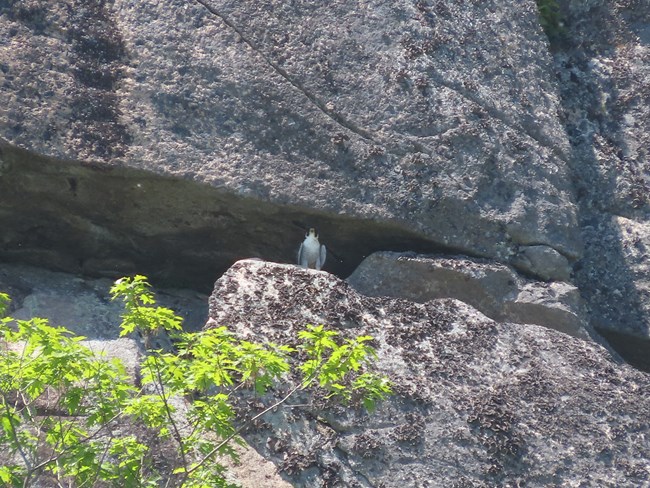
Where the nest is. NPS photo by Logan Witt
Banding a chick
Bands on a bird's leg tell researchers, over its life, how far it travels, where it winters, how long it lives and how young it starts to breed; together, those numbers estimate how many young survive and how many nests a region needs to hold its population.
There is a narrow window: chicks are banded at 21–25 days old. Any younger and the band slips off; any older and they are frightened of people and hard to handle. The parents do not make it easy either — peregrines chase eagles and vultures from their nests, and they go after the banders too, who wear hard hats for it.

Descending the cliff to band the chicks. NPS photo by Molly Mays

Banding a chick. NPS photo
Peregrines, in brief
- A scrape, not a nest. They clear a patch of a cliff ledge of loose rock and gravel, and lay there.
- Most active at dawn and dusk in good weather, when they hunt; quieter on hot afternoons and in rain.
- Speed. In level flight they average around 65 mph; in a dive from height, a stoop, a peregrine can pass 200 mph — faster than any other animal.
- Bird hunters. About the size of a crow, they mostly take pigeons and songbirds, but have caught ducks and gulls. Females are noticeably bigger than males, and that is the easiest way to tell them apart.
- Growing up. A fledgling can make its first kill about two and a half weeks after leaving the nest, and still begs from its parents after that.
- Surviving. Only about one in four young peregrines lives to two; after that the odds improve. The oldest known wild peregrine was about 19.
- Winter. Most wander south to wherever food is reliable. Because eastern peregrines were largely rebuilt by reintroduction, they carry no inherited migration route — a chick banded at Acadia turned up in Cuba. The Precipice pair have sometimes stayed all winter.
NPS photo by Molly Mays
When the trails reopen
When the falcons have not been seen for a couple of days, the watch ends and the Precipice Trail reopens — until the falcons return the next March. Fog is the watch's great enemy; on days when the birds hide, the rangers bring replica eggs, a talon, a skull and a life-size wingspan to show instead.

NPS photo
Sources
Written from "View From the Aerie: Peregrine Falcon Watch in 2023," by Logan Witt, SCA Raptor Intern, Acadia National Park, National Park Service; a work of the United States government in the public domain.
In diesen SammlungenAcadia National Park
Lizenz: CC0 1.0 (gemeinfrei) · Bearbeitet nach www.nps.gov
1
0
0
0

Kommentare
Weiterlesen


