
Willst du den Inhalt der Seite besser machen? Schlag eine Änderung vor.
Celiast Smith, a Clatsop woman born at the mouth of the Columbia River, lived through nearly the whole 19th century and nearly every change it brought to the Pacific Northwest: from an Indigenous-run river trade, to the fur trade and its multiracial families, to the missionaries, officials and settlers of American expansion. Her life shows something often overlooked — how women's movements from place to place shaped the making of homes in the West. Three objects in National Park Service and family collections trace it.
A shellfish basket: girlhood on the Clatsop coast
Celiast was a young girl when the Lewis and Clark Expedition reached the Pacific; her father, the Clatsop leader Coboway, was given Fort Clatsop by the expedition when it left, in thanks for his hospitality. The Clatsop had already traded with Europeans, and the Americans were one more foreign power seeking a place in a vast Indigenous trading system built on gift-giving and accommodation.
In that uncertain world, family mattered, and Celiast stayed close to her sisters Kilakotah and Yiamist all her life. As girls they would have done traditional women's work such as gathering clams, weaving baskets of cedar bark, spruce root and grasses to carry shellfish from the beaches of today's Oregon coast — work that sustained their community and was an art in itself.
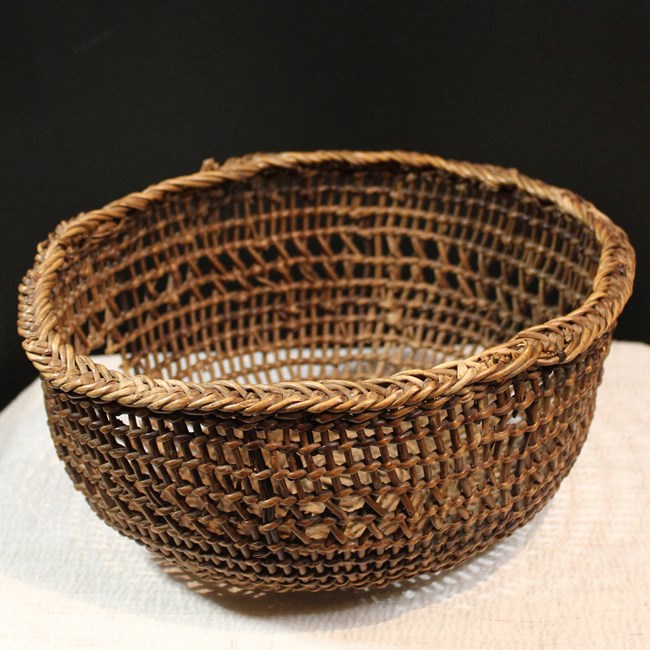
A shellfish basket woven by the Clatsop woman Tsin-is-tum in the 1890s from western redcedar and Sitka spruce roots. Credit: National Park Service, Lewis and Clark National Historical Park collection.
A pierced thimble: Fort Vancouver
In 1821, Celiast married Basile Poirier, a French-Canadian baker for the Hudson's Bay Company, and by 1825 they lived at the company's Fort Vancouver with their first child. Most women at the fort were Native or Métis and married to company men. Such marriages served both sides, linking knowledge of the land to a global fur market. The women were central: interpreters and cultural go-betweens, keys to trade networks, growers and cooks, processors of furs into goods for sale — and wives and mothers holding families steady amid rapid change.
According to one of her sons, Basile drank heavily and abused his family. Around 1833, Celiast met the fort's American schoolteacher, Solomon Smith. Accounts differ on what came next — whether the two left together, or whether Chief Factor John McLoughlin sent Basile away after learning he had a wife in Montreal — but her first marriage ended. Escaping danger meant leaving her three children behind. She moved with Solomon to the Willamette Valley, where her sisters lived; they opened a school and married in 1837.
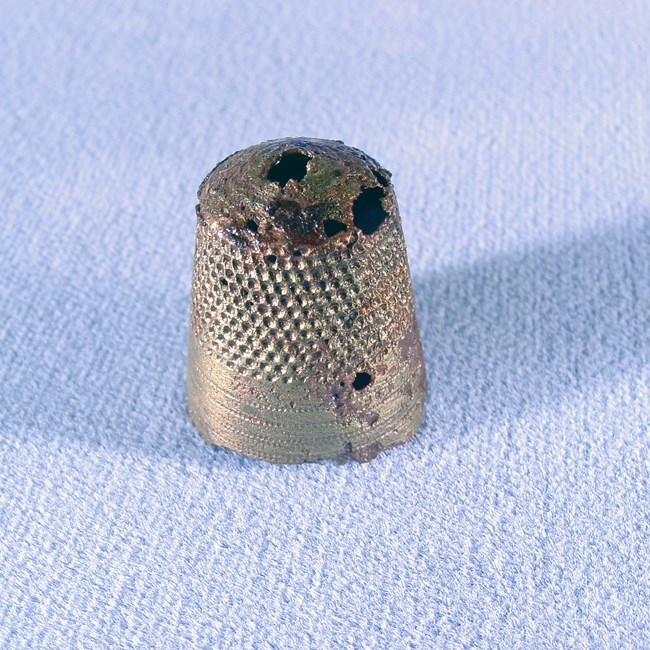
A perforated brass thimble, about 1825–1850, excavated at a house site in the Fort Vancouver village. Credit: National Park Service, Fort Vancouver National Historic Site collection.
The pierced thimble captures that kind of independence. Fort Vancouver was, for many Native and Métis women, not their home, and they pushed back in small ways — blending European and Indigenous dress, and reworking trade goods. Some punched holes in thimbles to wear them as jewelry; strung with beads and other metal, they jingled as the wearer walked.
A wedding plate: coming home
In 1840, Celiast and Solomon moved to the Clatsop Plains so she could live among and speak for her people. Her son Silas remembered people running into the water "waist deep on either side of the canoe" to carry her ashore.
There she became a peacemaker and negotiator between the Clatsop and settlers. She worked for a time with Methodist missionaries and several times intervened on settlers' behalf. For her own people, she added an "Indian room" to her house, where displaced neighbors could hear news of their homeland and receive traditional medicines and spiritual support, away from settlers' eyes. After Solomon died in 1876, her granddaughter recalled, she went back to speaking Clatsop.
McLoughlin had given the couple a dinnerware set, and one plate survives with their descendants — nearly two centuries in the family, a sign of a lasting marriage. By Solomon's death, though, the fur-trade world was gone, replaced by rigid racial lines: Oregon had banned marriages between whites and people "more than one-half Indian" for a decade, and local obituaries left out his marriage to Celiast and their six children. The plate remains as evidence of a life the record tried to erase.
A woman in motion
Celiast died in 1891. Her last decades brought epidemics and the loss of Clatsop land. Some Clatsop women kept traditions alive by adapting them — basketry, for instance, found a new market in coastal tourism. In 1900, the weaver Tsin-is-tum helped locate the cairn where Lewis and Clark's men had made salt, with Celiast's son Silas, who had learned Clatsop from his mother, interpreting. In that moment, the whole arc of Celiast's life — from the expedition of her girlhood to the adaptations of her old age — comes into view.
Sources
Based on "Celiast Smith," by Nicole Martin, PhD, part of the National Park Service's Home and Homelands exhibition; rewritten in hubnx's own words. The article draws on David Peterson-del Mar, "Intermarriage and Agency: A Chinookan Case Study" (1995), and Silas B. Smith's recollections.
In diesen SammlungenFort Vancouver National Historic SiteHome and Homelands Exhibition: WorkLewis and Clark National Historical Park
Lizenz: CC0 1.0 (gemeinfrei) · Bearbeitet nach www.nps.gov
1
0
0
0

Kommentare
Weiterlesen


