
Willst du den Inhalt der Seite besser machen? Schlag eine Änderung vor.
On This Page Navigation

Fenestrate bryozoan fossils. Grand Canyon-Parashant National Monument, Arizona.
Introduction
Bryozoans, a type of aquatic colonial animal, aren’t as widely familiar as some groups of invertebrates. However, they are an important part of fossil assemblages in many national parks, and are still around today. Even though they are colonial animals, bryozoan fossils are usually small: the individual animals were microscopic. The colonies themselves were often only a few centimeters or inches in size and often had easily broken structures. For example, many bryozoan colonies had the shapes of delicate lace (fenestrate bryozoans) or branching twigs.
Phylum Bryozoa
Bryozoans, informally known as “moss animals” based on the ancient Greek roots of their name, are filter-feeding colonial animals that live primarily in marine environments. They are also known as “sea mats” or “lace corals.” Bryozoans generally prefer warm, tropical waters but are known to occur worldwide. They first appeared in the fossil record in the Early Ordovician. Today there are both living mineralized and non-mineralized bryozoans, but the non-mineralized forms have a very poor fossil record.
Bryozoans may be confused with corals because both build colonies made of many small individual animals, but individual bryozoan animals (zooids) are much smaller than coral animals, anatomically more complex (they have a one-way digestive tract like us and unlike corals), and live by filter-feeding instead of capturing small prey and using symbiotic algae. Bryozoan colonies can take a wide variety of forms, including: simple mats and encrustations; mounds or domes; branching twigs; densely branched forms; and net-like or lacy forms. Figuring out what genus or species a fossil bryozoan belongs to is usually not easy, because many species produced similar-looking colonies, and were quite variable. It often requires microscopic techniques to tell species apart.
Bryozoan Fossils in National Parks

Bryozoan fossil from the Mississippian Redwall Limestone. Grand Canyon National Park, Arizona.

Bryozoan fossils from the Ordovician Decorah Shale, showing a variety of shapes. Mississippi National River and Recreation Area, Minnesota.
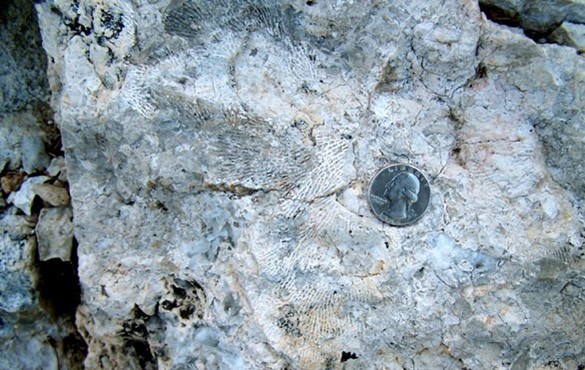
Permian fenestrate bryozoans from Guadalupe Mountains National Park, Texas.
Identification Guide to the Fossils of the Guadalupe Mountains by Mary Carol Coleman and Cameron Coleman.

Branching twig-stye bryozoans. Pakoon Limestone. Grand Canyon-Parashant National Monument.
NPS/2020 Field Inventory.
NPS photo.

Lyre-like bryozoans. A lyre is a musical instrument with strings between a fixed crossbar. Mammoth Cave National Park. NPS photo.
Bryozoan fossils are known from at least 64 units of the National Park System, mostly in parks with exposures of Paleozoic marine rocks. Together with brachiopods and crinoids, bryozoans are significant components of many shallow marine assemblages from the Paleozoic. Because of their small size and fragmentary fossils, they are usually more of an “accessory” type of fossil than the center of attention, but a few parks have particularly good records.
Many different kinds of small bryozoan colonies are known from the Ordovician rocks of **Mississippi National River and Recreation Area **in Minnesota. Bryozoans were also an important part of the Permian reef of Carlsbad Caverns National Park in New Mexico and **Guadalupe Mountains National Park **in Texas. Several parks in Arizona and Nevada, including Grand Canyon National Park, Grand Canyon-Parashant National Monument, and Lake Mead National Recreation Area, have extensive records of bryozoans from the Mississippian, Pennsylvanian, and Permian. Bryozoan fossils among the fossils in the Kaibab Formation on the rim of Grand Canyon .
One of the most famous kinds of bryozoan is the screw-like Archimedes from the middle to late Paleozoic. The screw-like fossils represent a central axis that supported a spiraling lacy frond that is rarely found attached. Fossils of Archimedes have been found at several parks, such as Mammoth Cave National Park in Kentucky. Mammoth Cave also has examples of another kind of showy bryozoan, lyre-like bryozoans composed of a V-shaped base supporting a lacy colony.
Featured Parks
Carlsbad Caverns National Park (CAVE), New Mexico—[CAVE Geodiversity Atlas] [CAVE Park Home] [CAVE npshistory.com]
Grand Canyon National Park (GRCA), Arizona—[GRCA Geodiversity Atlas] [GRCA Park Home] [GRCA npshistory.com]
Grand Canyon-Parashant National Monument (PARA), Arizona—[PARA Geodiversity Atlas] [PARA Park Home] [PARA npshistory.com]
Great Basin National Park (GRBA), Nevada—[GRBA Geodiversity Atlas] [GRBA Park Home] [GRBA npshistory.com]
Guadalupe Mountains National Park (GUMO), Texas—[GUMO Geodiversity Atlas] [GUMO Park Home] [GUMO npshistory.com]
Lake Mead National Recreation Area (LAKE), Arizona and Nevada—[LAKE Geodiversity Atlas] [LAKE Park Home] [LAKE npshistory.com]
Mammoth Cave National Park (MACA), Kentucky—[MACA Geodiversity Atlas] [MACA Park Home] [MACA npshistory.com]
Mississippi National River and Recreation Area (MISS), Minnesota—[MISS Geodiversity Atlas] [MISS Park Home] [MISS npshistory.com]
Part of a series of articles titled
Invertebrate Fossils in National Parks.
Previous:
Fossil Cnidarians - Corals, Jellyfish, and Sea Anemones
Next:
Fossil Brachiopods
Where this page came from
This page was imported from National Park Service. Produced by the U.S. National Park Service and, as a work of the United States government, in the public domain.
Nobody has written it yet — it is the source material at a new address, which is why search engines are asked to skip it and why no one earns from it. It is up for grabs: take it on, and it is yours to rewrite and to earn from.
In diesen SammlungenInvertebrate Fossils in National Parks
Lizenz: CC0 1.0 (gemeinfrei) · Bearbeitet nach www.nps.gov
1
0
0
0

Kommentare
Weiterlesen


