
Willst du den Inhalt der Seite besser machen? Schlag eine Änderung vor.
In 1963, returning to Normandy to film a television special for D-Day's 20th anniversary, former President Dwight D. Eisenhower made a stop that was never broadcast. He stood at the grave of a private first class he had never met, beside flowers his wife, Mamie, had chosen, because the soldier's mother had asked him to.
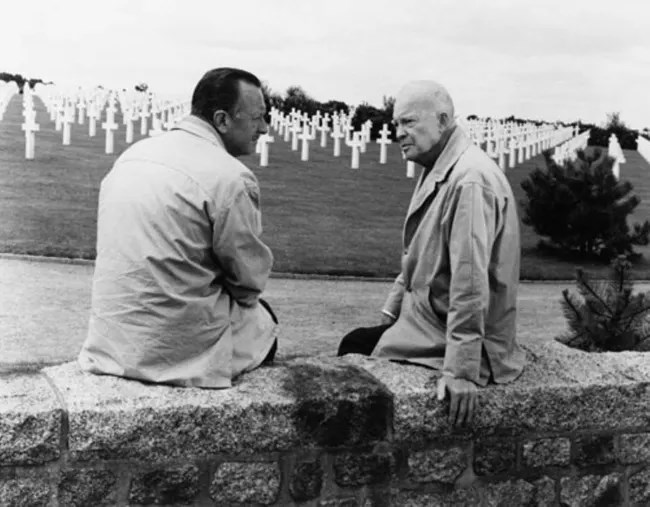
Eisenhower in Normandy in 1963, filming a television special with CBS News anchor Walter Cronkite. Credit: American Battle Monuments Commission.
Herbert Kaufman
Abe and Florence Kaufman of Terre Haute, Indiana, were a Jewish family; Abe had moved there in 1939 and ran the Fountain Theater. In late 1942 their elder son, Herbert, left college after a year to join the Army. He served in Company E, 2nd Battalion, 116th Infantry Regiment, 29th Infantry Division — one of two American divisions assigned to Omaha Beach on June 6, 1944.
Strong currents pushed Herbert's landing craft a mile east of its target. Near shore, a German artillery shell tore through the hull and exploded inside. Wounded in the leg and swept under the boat by a wave, Herbert was one of a small number of wounded who reached the sea wall. He died of his wounds the next day, June 7, 1944.
A father's answer
The Kaufmans learned of his death on July 23, 1944. Abe wrote letters seeking details — including to Lt. Edward Gorman Jr. of Herbert's company — and in time received his son's ring, bracelet, wallet and a leather case. In 1947, like hundreds of thousands of families, they were asked where their son should be buried; the United States had undertaken the unprecedented repatriation of its war dead. They chose to leave him in France with his comrades. On the form, Abe wrote that his son had given his life in the fight for "the decent things of life" and the protection of all minorities, and asked that the government make sure his death was not in vain.
A request to Gettysburg
In July 1963, reading that Eisenhower would travel to France for the anniversary, Florence — knowing she and Abe were unlikely ever to see the grave — wrote to him at his farm in Gettysburg. Would he stop at her son's grave and say a silent prayer? His secretary, Lillian Brown, replied that she could promise nothing, but would pass the request along.
More than a month later, a letter arrived from Gettysburg with a photograph: the former president standing at Herbert's Star of David headstone, a bouquet at its foot. The note said Mamie had chosen the flowers. It was not sent to the press or broadcast; it was taken and mailed privately, for two grieving parents. Florence wrote back that they would always treasure it.
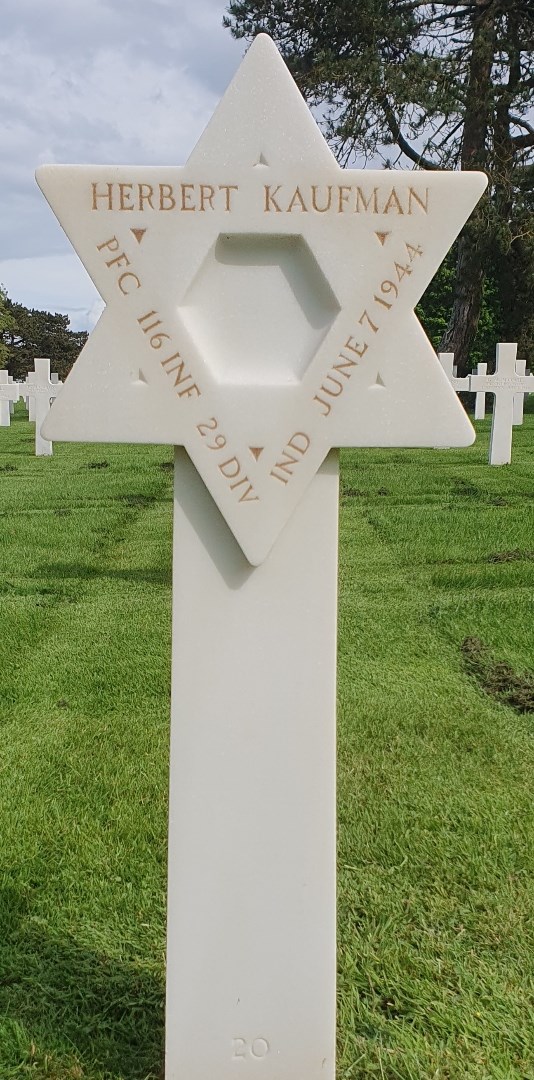
The grave of PFC Herbert Kaufman in the Normandy American Cemetery. Credit: American Battle Monuments Commission.
What remains
The Eisenhowers and the Kaufmans are gone. The Normandy American Cemetery holds nearly 10,000 white marble headstones, Latin crosses and Stars of David — among them Herbert Kaufman's, where a former president and first lady once paused, quietly, to honor a mother's wish.
Sources
Based on "'The Decent Things of Life': Eisenhower, Herbert Kaufman, and the Memory of D-Day" (May 2024) from the National Park Service (Dwight D. Eisenhower Memorial), a work of the United States government in the public domain. The Kaufman family's letters are summarized here, not reproduced.
In diesen SammlungenEisenhower National Historic SiteDwight D. Eisenhower MemorialWorld War II Memorial
Lizenz: CC0 1.0 (gemeinfrei) · Bearbeitet nach www.nps.gov
1
0
0
0

Kommentare


