Etwas zu verbessern? Schlag eine Änderung vor.
Diese Seite ist öffentlich.
| 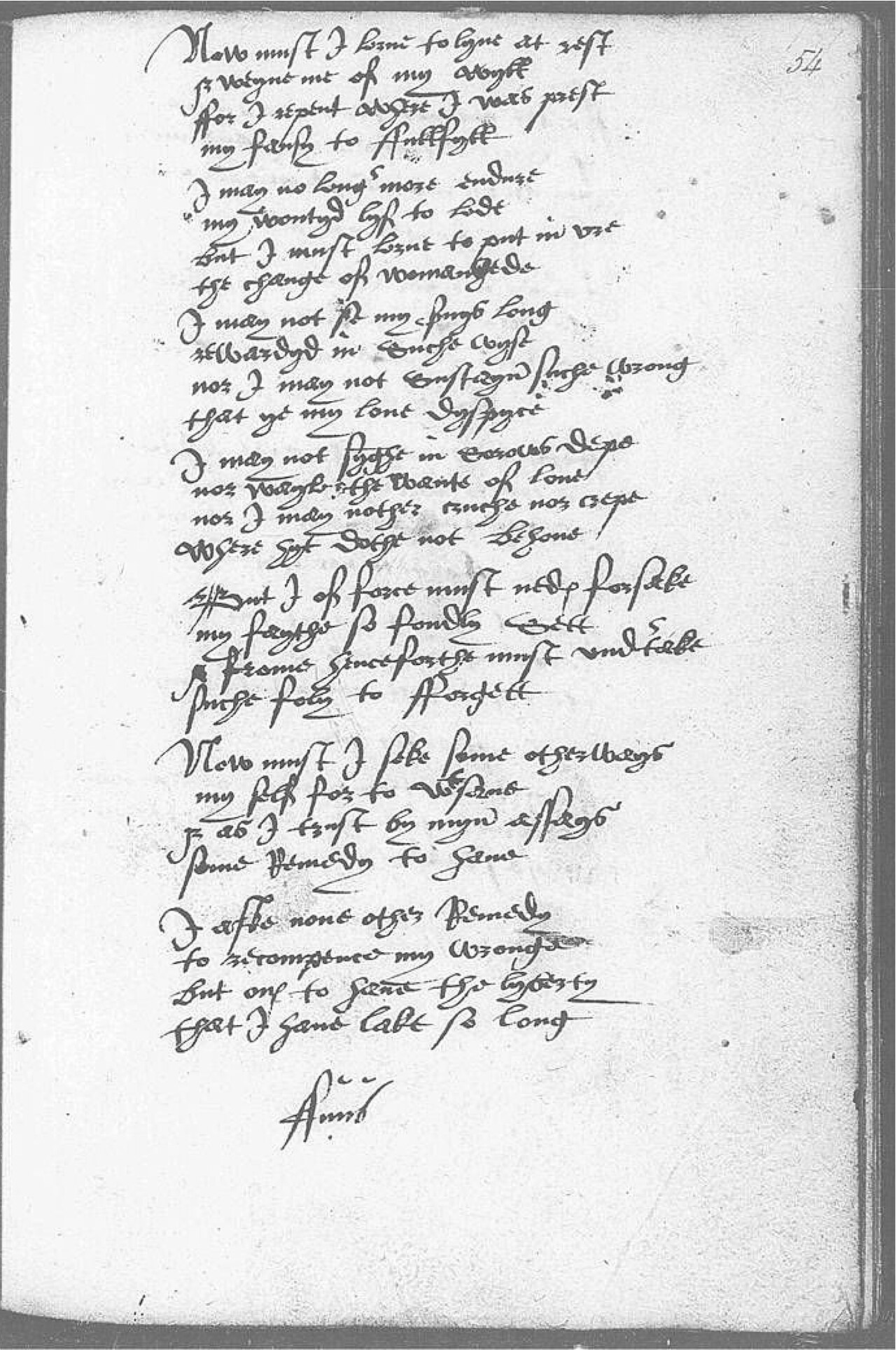
The Devonshire Manuscript facsimile 54r (Image: DMSEG, CC BY-SA 3.0) |
| --- |
|---|
f. [54r]
1 Now must I lerne to lyue at rest
2 & weyne me of my wyll
3 ffor I repent where I was prest
4 my fansy to ffullfyll
5 I may no longer{g'} more endure
6 my wontyd lyf to lede
7 but I must lerne to put in vre
8 the change of womanyede
9 I may not se my ser{{s}8}uys long
10 rewardyd in suche wyse
11 nor I may not sustayn suche wrong
12 that ye my loue dyspyce
13 I may not syghe in sorows depe
14 nor wayle the wante of loue
15 nor I may nother cruche nor crepe
16 where hyt dothe not behoue
17 But I of force must nedes{es} forsake
18 my faythe so fondly sett
19 & frome henceforthe must vnder{d'}take
20 suche foly to fforgett
21 Now must I seke some other ways
22 my self for to with{w+t+}saue
23 & as I trust by myn assays
24 some Remedy to haue
25 I aske none other Remedy
26 to recompence my wronge
27 but ones{es} to haue the lyberty
28 that I haue lakt so long
ffinis1
Notes & Glosses
- The dots on the letter is are scoops, as in "Syns loue ys suche that as ye wott" (52r), "Lo how I seke & sew to haue" (52v), "My loue ys lyke vnto theternall fyre" (53r), and "Yf in the worlde there be more woo" (53v).
Commentary
Attributed to Sir Thomas Wyatt,1] this poem was entered by [H6 and is unique to this manuscript. The speaker tries to exercise reason by forcing himself to forsake a love that is not returned. The power that holds him derives either from the lady’s beauty or his own fancy and will. Rebholz notes that the speaker's use of passive voice may indicate "a reluctance to acknowledge responsibility for falling in love."[2]
H6 seems fond of dotting the letter “i” with a scoop; see, for instance, "Syns loue ys suche that as ye wott" (52r), "Lo how I seke & sew to haue" (52v), "My loue ys lyke vnto theternall fyre" (53r), and "Yf in the worlde there be more woo" (53v).
Works Cited
- ↑ R.A. Rebholz, ed. Sir Thomas Wyatt: The Complete Poems. London: Penguin, 1978. 312-13.
- ↑ ibid., 536.
Where this page came from
This page was imported from Wikibooks. From “The Devonshire Manuscript” on Wikibooks, by its contributors, under CC BY-SA 4.0. Changed here: set as a page; navigation and edit links left out; each image under its own licence, credited in its caption.
Nobody has written it yet — it is the source material at a new address, which is why search engines are asked to skip it and why no one earns from it. It is up for grabs: take it on, and it is yours to rewrite and to earn from.
In diesen PublikationenThe Devonshire Manuscript
Lizenz: CC BY-SA 4.0 · Bearbeitet nach en.wikibooks.org
Kommentare