
Möchten Sie den Inhalt des Knotens verbessern? Versuchen Sie, eine Bearbeitungsanfrage zu stellen.
The defining technology narrative of May 11, 2026, is the emergence of a "Silicon Wall," a critical shortage of advanced semiconductor manufacturing and high-bandwidth memory (HBM) that has overtaken energy constraints as the immediate limiting factor for artificial intelligence expansion. **Reports from the Center for a New American Security (CNAS) and recent market analysis indicate that despite multi-billion dollar investments in domestic chip fabrication, the supply of logic chips and specialized memory cannot keep pace with hyperscale demand.**^^ BlackRock CEO Larry Fink corroborated this shift today, dismissing "AI bubble" concerns and characterizing the current market as a systemic supply deficit. This shortage is no longer confined to data centers; it is now driving price increases in consumer electronics, including smartphones and personal computers, as manufacturers compete for limited silicon wafers and advanced packaging slots. Consequently, "compute" is transitioning from a utility to a tradable commodity, with financial markets beginning to develop instruments for "compute futures" to hedge against procurement volatility.
State of the Global AI Infrastructure and the Shift to Hardware Constraints
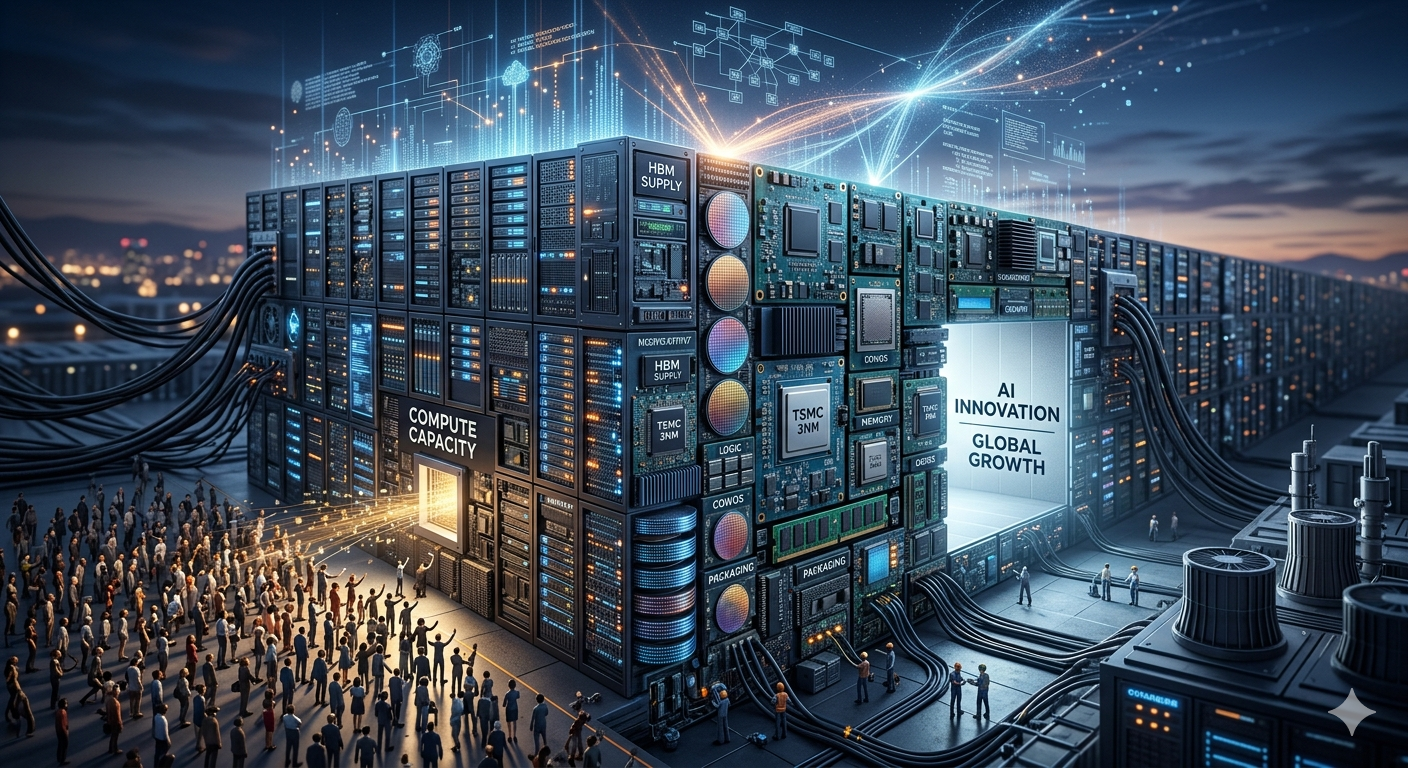
The global technology landscape in early 2026 has been defined by an insatiable appetite for compute power. For the past eighteen months, the primary concern for hyperscalers—Amazon, Google, Meta, and Microsoft—was the "power crunch." The industry struggled to secure enough gigawatts of electricity to fuel massive data center clusters, leading to a surge in nuclear energy deals and long-term power purchase agreements. However, as of May 11, 2026, the bottleneck has fundamentally shifted. While energy remains a long-term logistical hurdle, the "Silicon Wall" has become the immediate operational barrier.
The current crisis is a convergence of three distinct technical shortfalls: advanced logic fabrication, High-Bandwidth Memory (HBM) production, and CoWoS (Chip-on-Wafer-on-Substrate) packaging capacity. Logic chips, the "brains" of AI accelerators, require the most advanced process nodes (2nm and 3nm), which are currently operating at maximum capacity. Even as companies like TSMC and Samsung expand their facilities, the lead times for specialized lithography equipment have extended, preventing a rapid scale-up.
Simultaneously, HBM has emerged as a secondary but equally severe bottleneck. AI models require massive amounts of data to be moved quickly between memory and the processor. Current production from SK Hynix, Micron, and Samsung is reportedly sold out through 2027. This has created a "bidding war" environment where major tech firms are offering unprecedented capital infusions directly to chipmakers' production lines to secure future inventory.
This hardware scarcity is reshaping the global economy. BlackRock’s Larry Fink noted today that the demand for AI infrastructure is outpacing supply at a rate that suggests the industry is in a "shortage phase" rather than a "bubble phase." The financial implication is the birth of a new asset class: compute futures. Much like oil or wheat, the right to future computing cycles is becoming a liquid asset that companies can trade to manage risk.
The impact has also reached the consumer level. For the first time since the 2021 supply chain crisis, the cost of high-end consumer electronics is rising due to component shortages. Manufacturers of smartphones and gaming consoles are finding their margins squeezed by the rising cost of DRAM and NAND flash memory, which are being diverted to satisfy more profitable enterprise AI contracts.
From a geopolitical perspective, the "Silicon Wall" is intensifying export enforcement. The U.S. Department of Commerce has recently signaled a shift toward "hardware-level verification," mandating that AI chips include location-tracking features to ensure compliance with trade restrictions. As silicon becomes the most valuable resource on the planet, the friction between commercial expansion and national security continues to mount, making hardware availability the ultimate arbiter of tech leadership in 2026.
1
0
0
0

Kommentare