
Willst du den Inhalt der Seite besser machen? Schlag eine Änderung vor.
On a sunny day in April 2023, in the Kīpahulu District of Haleakalā National Park, a group of women gave a demonstration of kapa making. They are part of a modern revival of an art once thought lost.
What kapa is
Kapa is Hawaiian barkcloth — a Polynesian textile known elsewhere in the Pacific as tapa, and centuries old. Early Hawaiians made it a high art, adding fermentation, watermarks and bold natural dyes. Until cotton reached the islands in the nineteenth century, kapa was everywhere: it clothed the living, covered sleepers, wrapped the dead, and adorned the ceremonial dress of dancers and warriors. As the journalist Shannon Wianecki has noted, it also had a spiritual side, carrying the mana — the life force — of the plants it came from and of the people who made and wore it.
The women at the anvil
Two of the demonstrators, Didi Krause and Poha Kanakaʻole, are dancers (ʻōlapa) with Hālau o Nakaulakuhikuhi, under kumu hula Kauʻi Kanakaʻole, where they learned kapa making from the well-known contemporary practitioner Verna Takashima of Oʻahu. With them was their young student — a sign that the women reclaiming a lost art are also handing it on.
In a short video of the workshop, they strike wauke (paper mulberry bark) with iʻe kuku — wooden kapa beaters — on wooden anvils, making a pleasant, hollow beat. Watching, you notice their concentration, their strength and their calm: they seem at once to observe, reflect, listen, practise and share, inside the space the rhythm creates.
Women's work, and slow work
Kapa making was traditionally women's work, and hard work — a single piece can take months. Each maker's process differs in detail, but it generally runs:
- Grow the paper mulberry carefully for up to two years.
- Strip the bark.
- Beat and shape it through several stages over long stretches of time, with tools made mostly from native wood.
- Scent and dye the cloth, usually with Native Hawaiian and Polynesian plants.
The video shows an important beating stage after the bark has been soaked and fermented. For the final beating, one face of the iʻe kuku is carved with a pattern that presses a watermark into the cloth — making each piece personal, and reflecting the vision, experience and surroundings of the woman who made it.
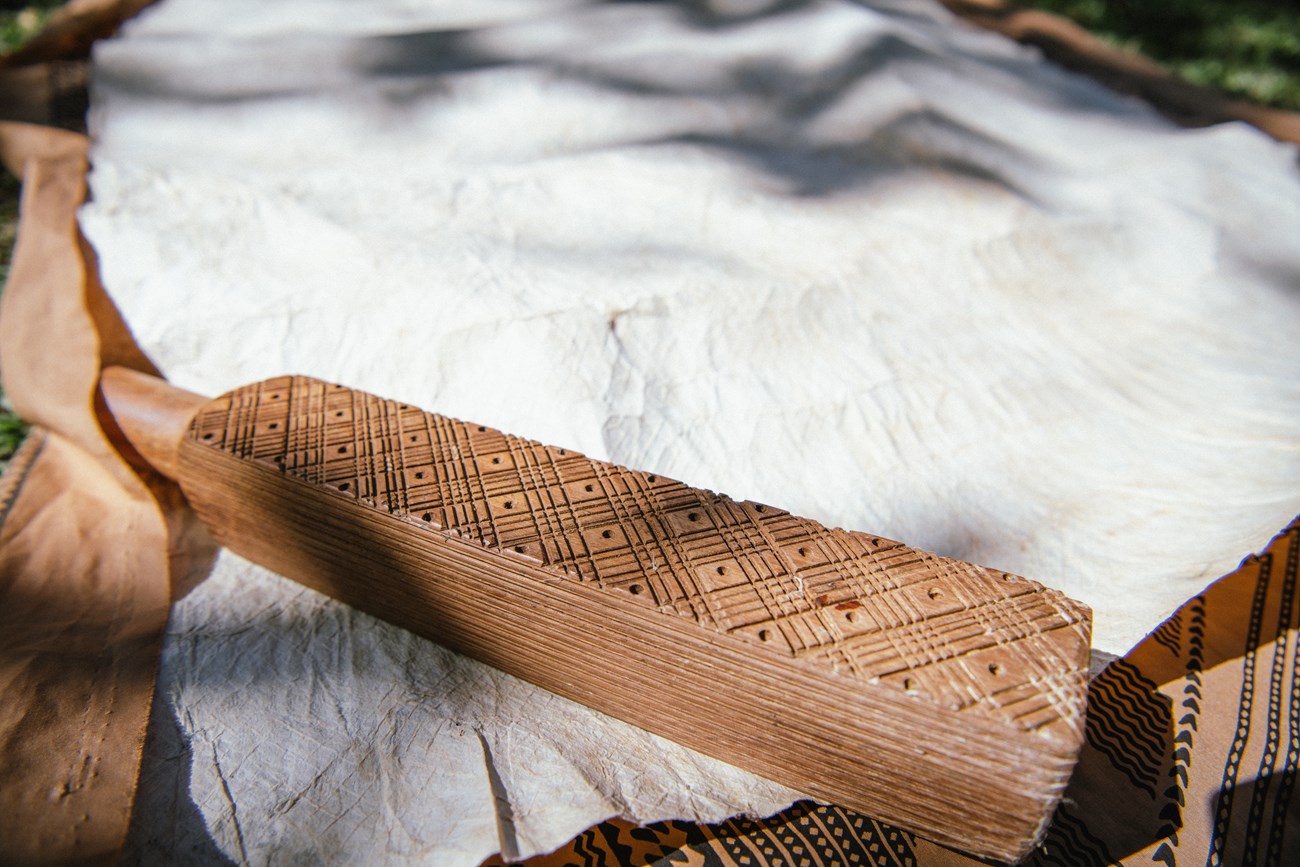
A contemporary iʻe kuku with an ʻupena (fishing net) watermark face. The art was almost entirely lost by the 1870s; the revival since the 1970s has produced beautiful new tools like this one. NPS / Jill Peters
The workshop shared a Hawaiian proverb (ʻŌlelo Noʻeau) about learning: E lawe i ke aʻo a mālama, a e ʻoi mau ka naʻauao — one who takes teachings and puts them to use keeps growing in knowledge.
The sound of home
Through it all runs the ʻouʻou — the sound of the beater striking the anvil, music and labor at once. Early Hawaiians may even have used the beating to send messages and news across an island. European and American colonization almost entirely wiped out that world of sound.
Sound is easy to overlook when we think about what makes a home or a homeland, but it can make us feel at home as much as a building, a landscape, an object or a tradition. The kapa revival, the article argues, is nothing less than the restoration of a lost soundscape: each beat recalls a homeland before colonization while making new sounds, and new visions of home, today.
For the women at the anvils, the steady pulse can carry them into the past. Sitting in one place for hours, they wonder how their foremothers made kapa and what they thought about as they worked — who called this place home before, and who will after. The hollow ʻouʻou ties together women past, present and future.
Sources
Based on "Iʻe kuku and Kapa Making Workshop," by Nicole Martin, PhD, part of the Home and Homelands exhibition, National Park Service, drawing on the Kapa Workshop at the Kīpahulu District of Haleakalā National Park, April 14, 2023 (with notes by Didi Krause), and on William Tufts Brigham's Ka Hana Kapa (1911); supported by a grant from the National Park Foundation. Shannon Wianecki's words are paraphrased. A Bishop Museum photograph of kapa is left out; rewritten in hubnx's own words.
In diesen SammlungenHome and Homelands Exhibition: WorkHaleakalā National Park
Lizenz: CC0 1.0 (gemeinfrei) · Bearbeitet nach www.nps.gov
1
0
0
0

Kommentare


