
Want to improve the page's content? Try to propose a change.
In 2021, a National Park Service employee found an antique glass perfume bottle half-buried on a ridge in City of Rocks National Reserve near Almo, Idaho. Sun had turned the glass purple. Embossed on it: WELLS PERSIAN PERFUME HACKMETACK LEROY, NY — a scent that S.C. Wells & Co. had introduced by the early 1880s alongside its popular "Shiloh's Family Remedies." How did a New York perfume reach this remote corner of the West? This account is from the Park Service's Home and Homelands exhibition, written by historian Nicole Martin.
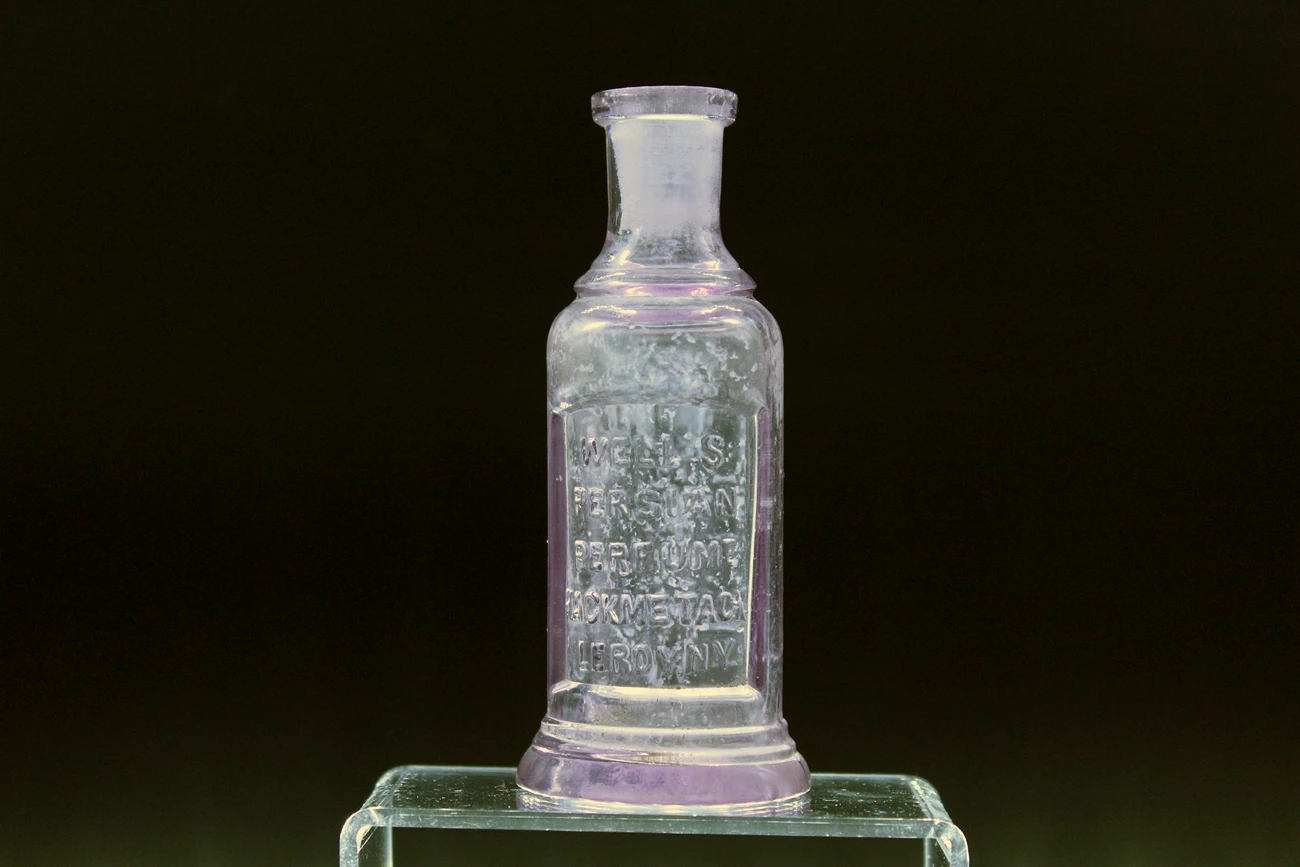
The perfume bottle, found near the likely site of Clara Campbell's house. NPS Collections, City of Rocks National Reserve.
Whose bottle?
Park staff concluded it probably belonged to Clara Campbell, because it lay near where her house is believed to have stood in the early 1900s. She filed one of only 29 homestead patents in the area between 1910 and 1919, and when she began the process in 1909 she was a divorced, single woman — tough enough to try farming in City of Rocks' dry, unforgiving land.
From New York to Idaho
| Year | |
|---|---|
| 1861 | Born in Orleans, New York |
| 1878 | Married Hezekiah Campbell, a farmer; they had eight children in New York |
| Early 1900s | Hezekiah left; Clara moved west with her three youngest children, possibly to be near her daughter Jennie Maude and son-in-law John Hull, who ranched at Almo |
| 1908 | A Utah judge granted her a divorce for non-support |
Almo was nothing like the small New York towns she knew. City of Rocks has long been homeland to the Shoshone and Bannock peoples, who gather pine nuts there in fall. In the mid-nineteenth century it became a crossroads — first where two overland trails met, later a stage station linking a Utah railroad to Boise's mining district. Even at the height of homesteading it stayed very rural, with few comforts.
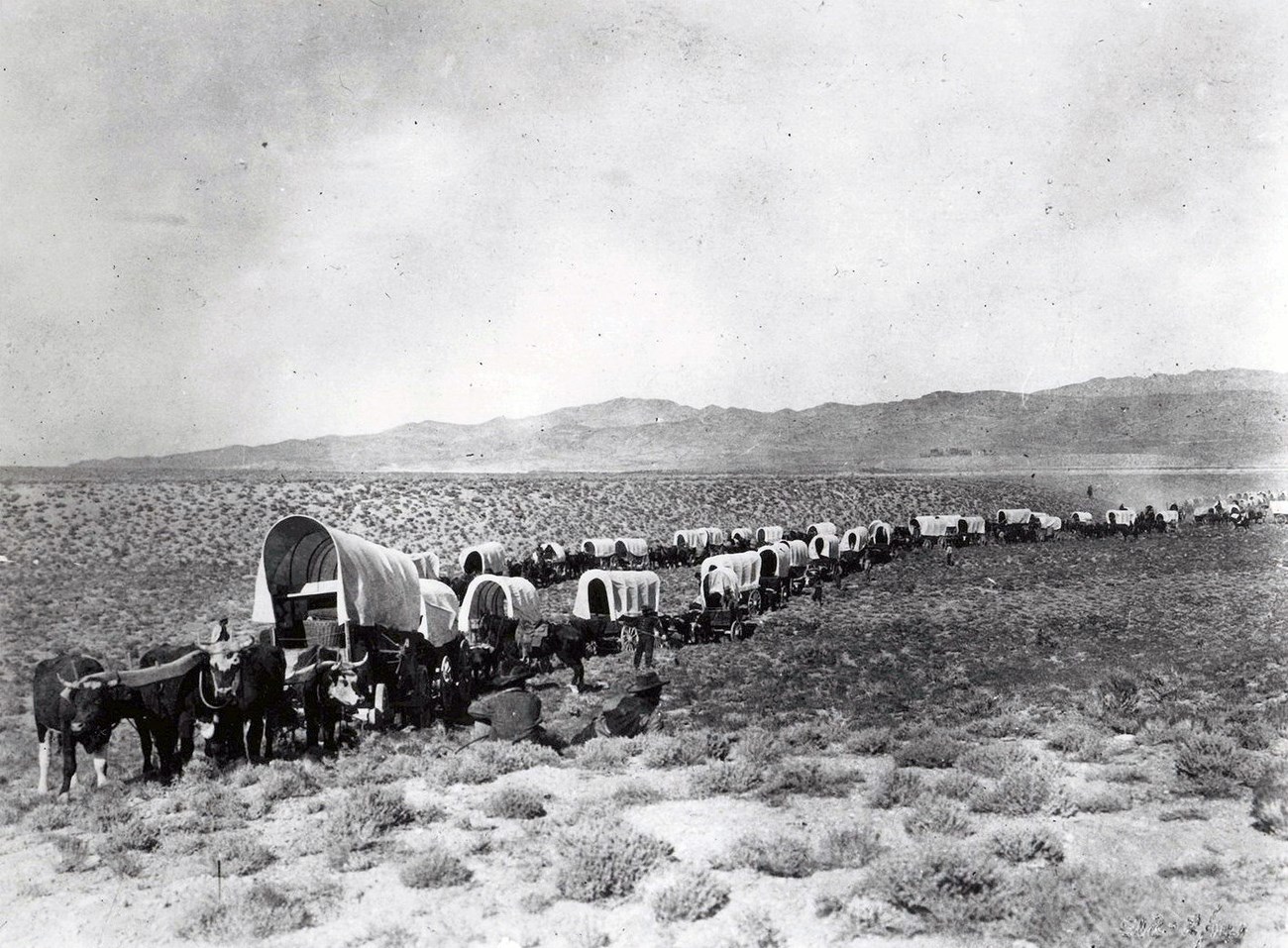
Wagons on the overland trails through dry desert country. Credit: National Park Service.
Proving up — with a touch of luxury
Under the Homestead Act of 1862, a claimant had to be head of a household — which included unmarried women like Clara — and live on and farm the land for five years to "prove up." Many settlers also brought the trappings of "civilized" home life, eager to show relatives back East that they were living well despite bare dwellings. Clara built a log house with a dirt roof and planted crops, some of which failed without irrigation. A perfume bottle was a luxury, perhaps a reminder of an easier life in New York, and a sign of how women homesteaders sought refinement in uncertain circumstances.
A divorced homesteader
Clara's story doesn't fit the familiar image of pioneer families. Divorce rose steadily after the Civil War, especially in the West, where many states made it relatively easy despite fears for the American home. Courts granted two-thirds of divorces to women, often for desertion or non-support, and homesteading offered a newly divorced woman a way to own property and earn a living.
Women's homestead claims peaked after 1900. Some sought independence and a break from traditional roles, but many homesteaded to add to family landholdings. Clara filed near her daughter, suggesting a family enterprise built on cooperation as much as independence.
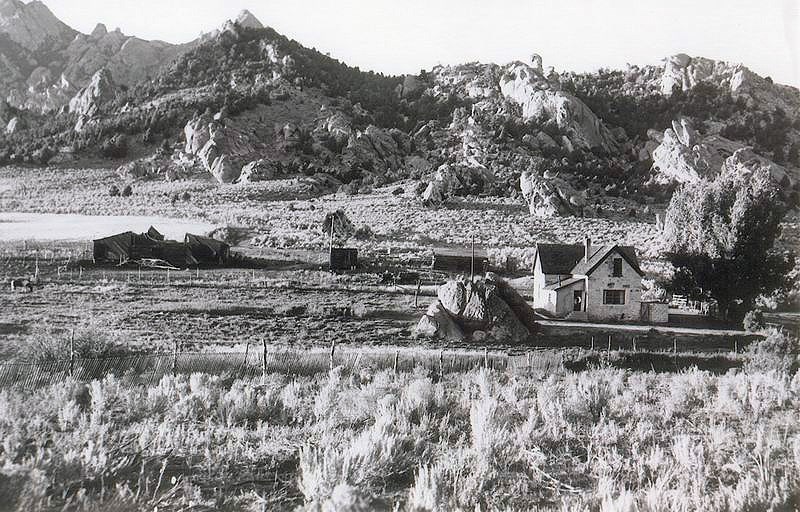
The stone Tracy Hull House, home of Clara's daughter from 1909 to 1916; Clara's own house stood nearby. Credit: National Park Service.
She remarried in 1910. When she went to complete her patent, witnesses said — correctly — that she was now married, making her ineligible. But after she swore an affidavit that she had been single while proving up, she received her final certificate in 1911. She was divorced and married, self-reliant and supported by family, boundary-breaking and domestic, all at once.
Moving on
Before 1919 Clara sold the homestead and moved with her new husband to Ogden, Utah, where she died in 1929. Like most homesteaders, she moved on. Her daughter and son-in-law did too, selling their ranch for a Ford Model T and heading to California. Farming City of Rocks was hard, and making a home in the West often meant giving up and trying again elsewhere. The half-buried bottle marks the brief moment one woman, left on her own, staked her claim.
Sources
Based on "Clara Campbell's Perfume Bottle," by Nicole Martin, PhD, Home and Homelands exhibition, supported in part by a grant from the National Park Foundation, published by the National Park Service; rewritten in hubnx's own words.
In these collectionsHome and Homelands Exhibition: WorkCity Of Rocks National Reserve
Licence: CC0 1.0 (public domain) · Adapted from www.nps.gov
1
0
0
0

Comments
Read next


