
Look down into the Grand Canyon and you are looking at three different chapters of Earth's history, stacked one on another. Ever since John Wesley Powell led the pioneering river expedition through the canyon in 1869, geologists have recognized three main packages of rock:
- The Vishnu Basement Rocks — the igneous and metamorphic rocks of the three Granite Gorges.
- The Grand Canyon Supergroup — tilted, mostly sedimentary rocks.
- The Layered Paleozoic Rocks — the flat-lying layers of the upper two-thirds of the canyon.
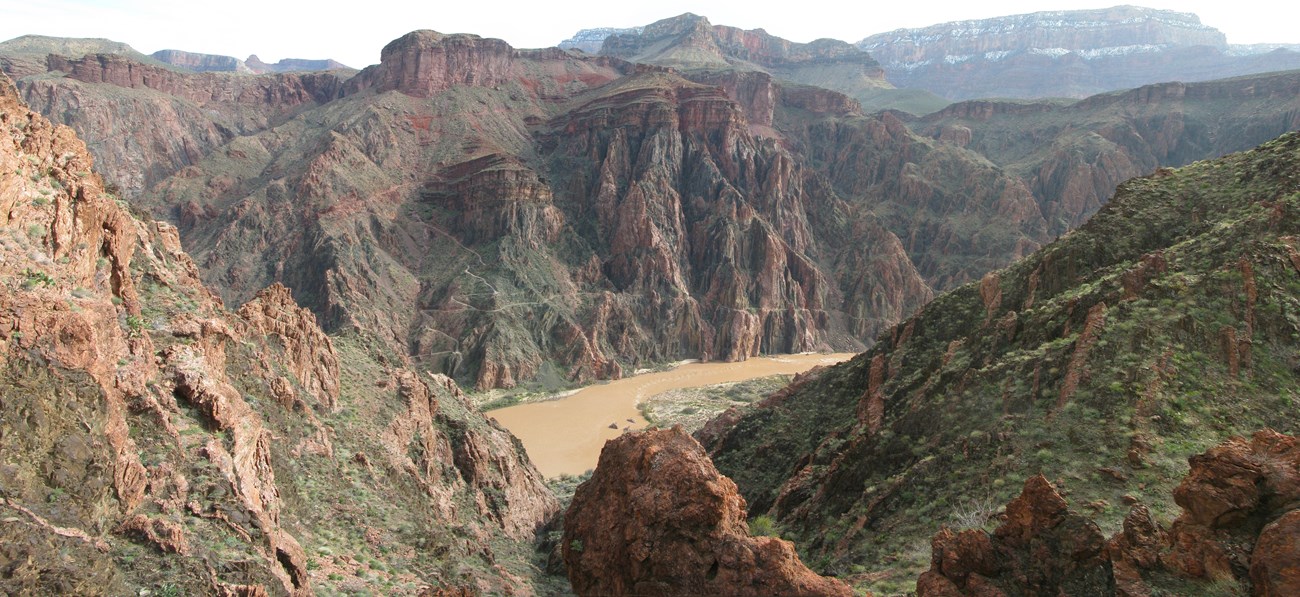
A view of the Grand Canyon showing all three sets of rocks. Credit: National Park Service.
What a "set" is
"Set" is an informal word for Powell's three packages. It is not part of the formal naming system of stratigraphy — supergroups, groups, formations and members — though it sits closest to the supergroup level, and it is a convenient, very visual way to describe the canyon. Within the three sets are six packages at the group level, 35 individual formations and at least 53 members. More than 180 rock units have been named in the park in all, including Paleozoic units exposed in places in the western canyon, Mesozoic rocks and Cenozoic deposits that fall outside the three sets.
The three sets
| Set | Rocks | Where they formed | Age (million years ago) |
|---|---|---|---|
| Layered Paleozoic Rocks | horizontal sedimentary layers | a low coastal plain and the shallow seas of the continental shelf along the proto-Pacific coast | Paleozoic Era, 270–530 |
| Grand Canyon Supergroup | tilted sedimentary and igneous layers | rivers and shallow seas far from the active plate margin, as the supercontinent Rodinia assembled (Unkar Group) and rifted apart (Chuar Group) | Meso- and Neoproterozoic Eras (Precambrian), 729–1,255 |
| Vishnu Basement Rocks | metamorphic and igneous rocks with vertical folds and foliation | volcanic island chains that collided with ancestral North America to form the southwestern United States, then were metamorphosed and invaded by magma deep in the crust | Paleo- and Mesoproterozoic Eras (Precambrian), 1,375–1,840 |
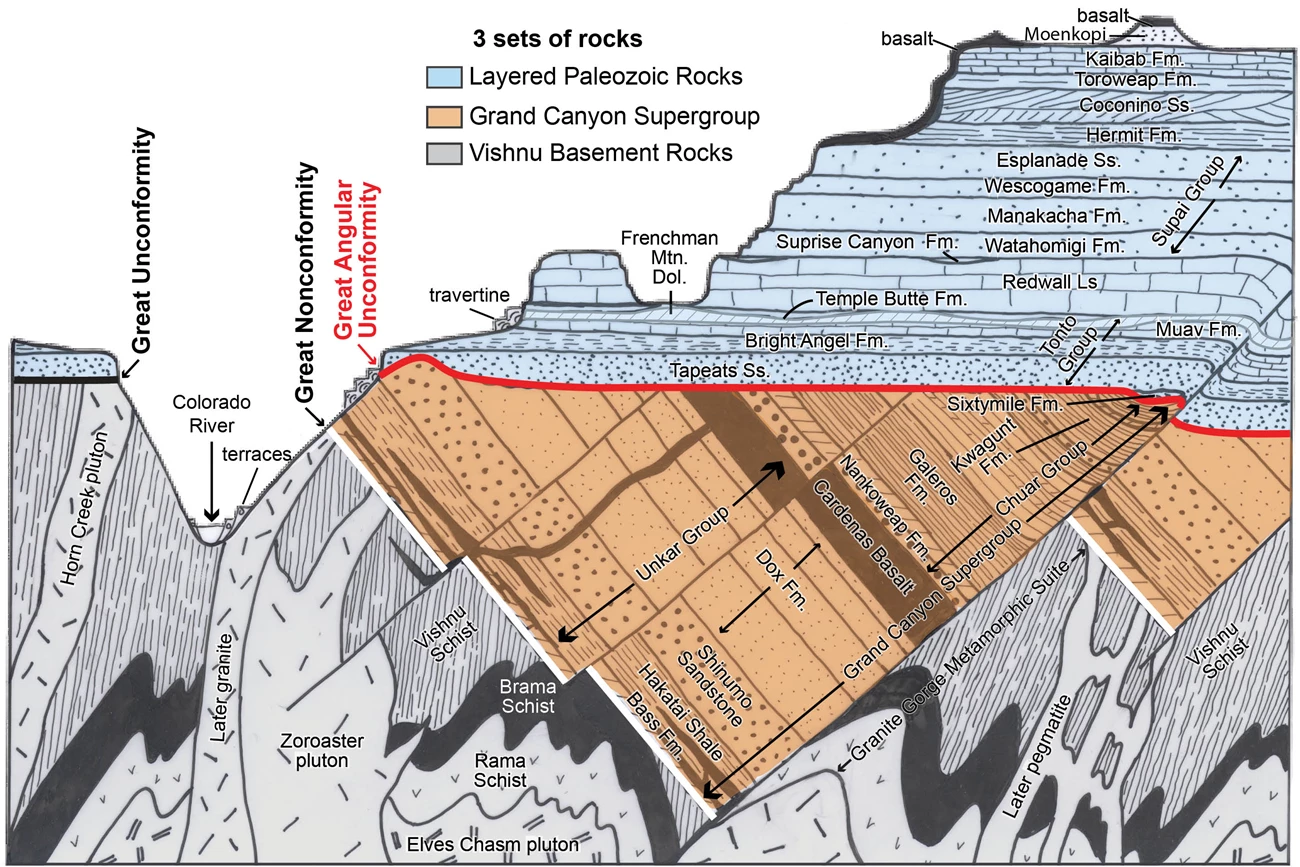
The rocks of the Grand Canyon region, showing the three sets and the major unconformities between them: the Great Nonconformity (white line), the Great Angular Unconformity (red) and the Great Unconformity (black). Credit: National Park Service, "Telling Time at Grand Canyon: 2020 Update."
Vishnu Basement Rocks
These are ancient metamorphic rocks that formed, and were intruded by igneous rocks, deep in the crust nearly 2 billion years ago. Their thickness is unknown: the original sedimentary layers were so intensely folded that what was horizontal now stands nearly vertical.
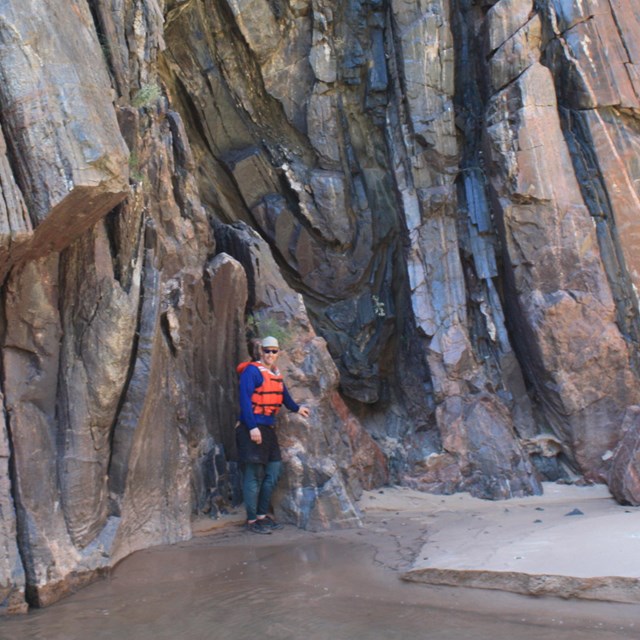
Tightly folded Vishnu Basement Rocks. Credit: National Park Service.
Grand Canyon Supergroup
Exposed only in the eastern Grand Canyon, these late Precambrian sedimentary and volcanic rocks were laid down mostly in rift basins between about 729 and 1,255 million years ago. They are about 12,000 feet (3,600 m) thick.
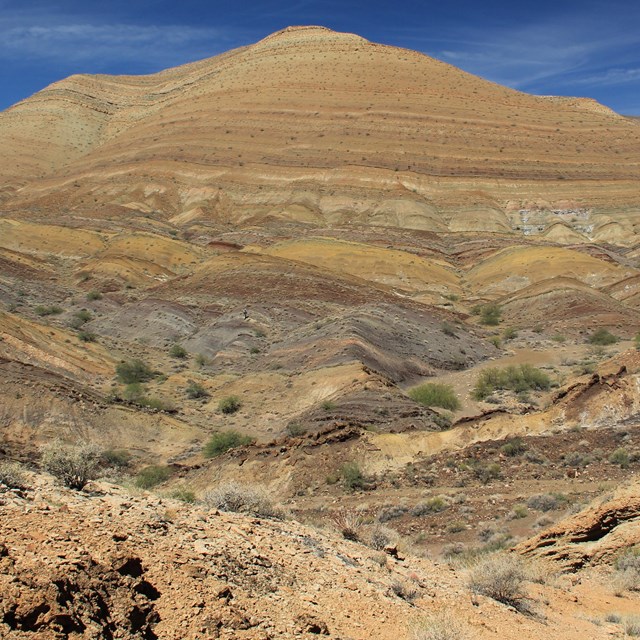
Grand Canyon Supergroup rocks. Credit: National Park Service.
Layered Paleozoic Rocks
These flat-lying sedimentary rocks form the "stair-step" upper walls throughout the canyon. They are 3,000–5,000 feet (900–1,500 m) thick, and they record many changing environments, from shallow oceans to vast fields of sand dunes, along with the history of life on Earth from about 530 to 270 million years ago.
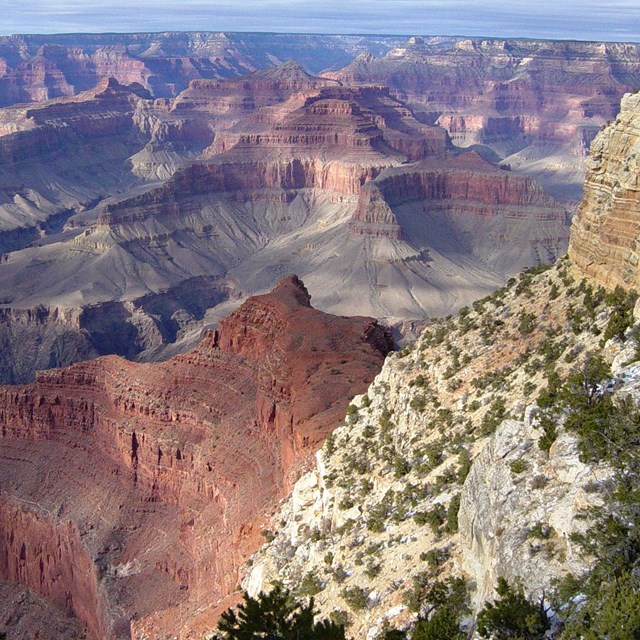
The Layered Paleozoic Rocks. Credit: National Park Service.
Three kinds of gap
Where one set meets another, part of the rock record is missing — an unconformity.
- Nonconformity: sedimentary layers lying directly on older, eroded igneous or metamorphic rock.
- Angular unconformity: horizontal layers deposited on tilted ones. At the Grand Canyon, the flat Layered Paleozoic Rocks lie on the tilted Grand Canyon Supergroup.
- Disconformity: a gap between two parallel sedimentary layers, caused by erosion or by nothing being deposited for a time.
Sources
Based on "Grand Canyon's Three Sets of Rocks," National Park Service, part of the series Telling Time at Grand Canyon National Park, adapted from K. Karlstrom, L. Crossey, A. Mathis and C. Bowman, Telling Time at Grand Canyon National Park: 2020 Update, Natural Resource Report NPS/GRCA/NRR—2021/2246 (National Park Service, 2021), doi:10.36967/nrr-2285173; a work of the United States government in the public domain. Karl Karlstrom and Laurie Crossey are geologists at the University of New Mexico; Allyson Mathis and Carl Bowman worked for the National Park Service at Grand Canyon National Park.
In these collectionsGrand Canyon National ParkTelling Time at Grand Canyon National Park
Licence: CC0 1.0 (public domain) · Adapted from www.nps.gov
1
0
0
0

Comments


