
Want to improve the page's content? Try to propose a change.

Paint sticks better to rougher surfaces, so crew members use wire pads, steel wool, and wire brushes to scuff up the old paint on the fence in preparation for a new coat. Student Conservation Association photo, A. Lueth
The Student Conservation Association Massachusetts Historic Preservation Corp (SCA HPC) has been restoring the wrought iron fence around the Bunker Hill Monument, applying a new coat of paint to bring it back to its original quality. The project began in 2023, with each subsequent year’s crew repainting one of the four sides of the fence. As of 2024, two sides have been painted, and the project is slated to be completed by 2026.
Site History
The Monument sits on Breed's Hill, the site of the Battle of Bunker Hill, one of the earliest battles of the Revolutionary War. Constructed from 1825 to 1842, the Bunker Hill Monument commemorates the soldiers who fought in the battle.[1] The park's iron fence was originally installed in 1843, followed by a new iron fence in 1870, the one that still stands today.[2]
Learn more about the Bunker Hill Monument and the efforts to preserve the Monument over the years.
Project Overview


Left image
One of the bottom portions of the fence BEFORE painting was completed.
Credit: Student Conservation Association photo, A. Lueth
Right image
One of the bottom portions of the fence AFTER painting was completed
Credit: Student Conservation Association photo, A. Lueth
Over time, the paint on the fence has started to deteriorate, leading to rusting and other damage. Each group of HPC crew members have begun this project by removing any paint that had begun to chip off. They use wire brushes and steel wool to scuff up the old paint, which allows the new coat of paint to stick to the fence better.

A crew member using a drill with a steel brush attachment to clean the fence and scuff up the old paint. Student Conservation Association photo, A. Lueth.
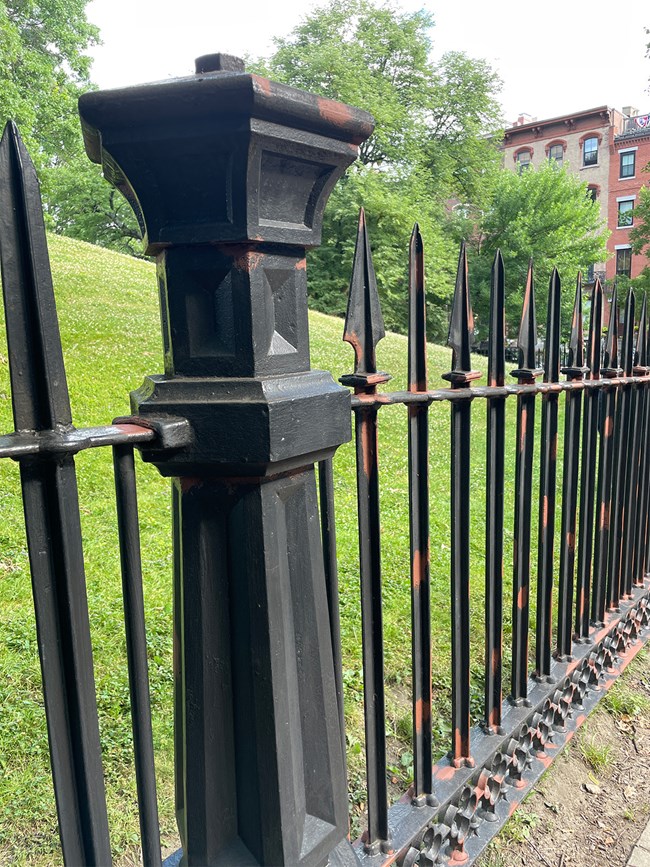
The primer (rust-colored) after being applied to the fence. It is applied just to exposed metal and rusting areasand prevents further rust from forming. Student Conservation Association photo, A. Lueth
The crew then washed the fence with TSP solution, a cleaning agent, to remove the buildup of grime and dirt.
To complete the project, the crew applied an anti-rusting primer to any exposed metal or rust to prevent further rusting, followed by a topcoat of thick, black paint.
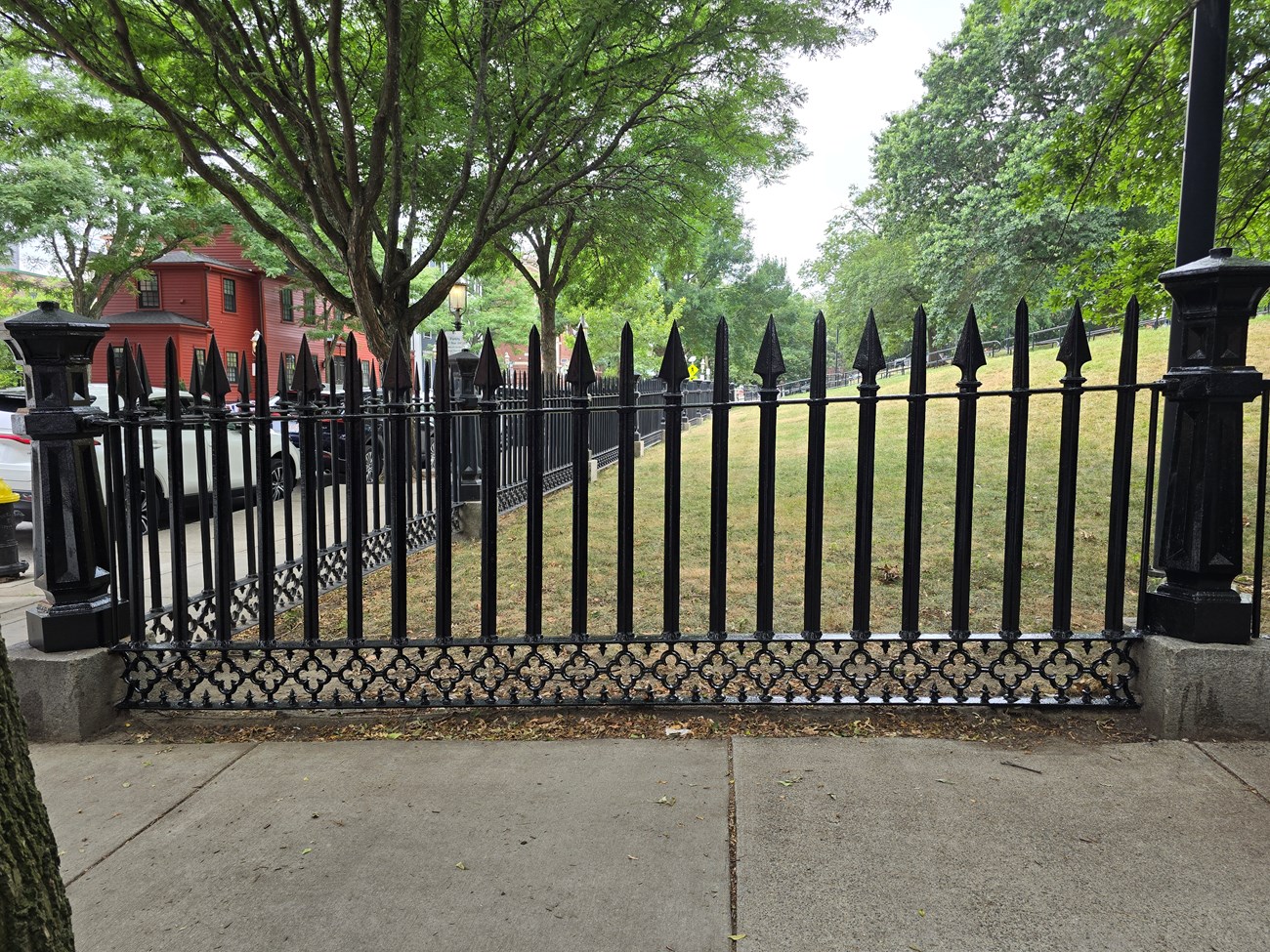
A section of fence after painting is completed. Student Conservation Association photo, A. Lueth.
Contributed by: Greg Bsales, SCA Historic Preservation Corps Crew Member
Footnotes
[1] Kristen Heitert, Archaeological Assessment and Overview: Bunker Hill Monument (Pawtucket, RI: PAL Publications, 2009), 38. NPS.gov.
[2] Kristen Heitert, Archaeological Assessment and Overview: Bunker Hill Monument (Pawtucket, RI: PAL Publications, 2009), 39. NPS.gov.
Where this belongs
- Boston National Historical Park
Where this page came from
This page was imported from National Park Service. Produced by the U.S. National Park Service and, as a work of the United States government, in the public domain.
Nobody has written it yet — it is the source material at a new address, which is why search engines are asked to skip it and why no one earns from it. It is up for grabs: take it on, and it is yours to rewrite and to earn from.
In these collectionsBoston National Historical Park
Licence: CC0 1.0 (public domain) · Adapted from www.nps.gov
1
0
0
0

Comments
Read next


