
Want to improve the page's content? Try to propose a change.

Eastern and Western Area (Alaska) Fire Management Ecology teams (minus photographer M. Perez) standing the southeast corner of the Biederman allotment fire break. Mariana Perez, NPS
In the heart of Yukon-Charley Rivers National Preserve, a few miles up the Yukon River from the confluence with the Charley River, the historic and privately owned Biederman allotment has been threatened by wildfire a remarkable three times in the last 16 years! Before that, this area burned in 1969 in a large, nearly 500,000-acre, fire. In 2014, the NPS Eastern Area Fire Management and Tanana Chiefs Conference fire crew created a shaded fuel break around the allotment to reduce the risk of damage by wildfire. Shaded fuel breaks are favored by the NPS over other types of fuels breaks as they reduce the risks of wildfire while causing the least disruption to ecological systems. To protect the allotment during the most recent wildfire event, however, firefighters initiated a backburn and cut the remaining trees in the fuel break creating an “unshaded” fuel break where it was once shaded.
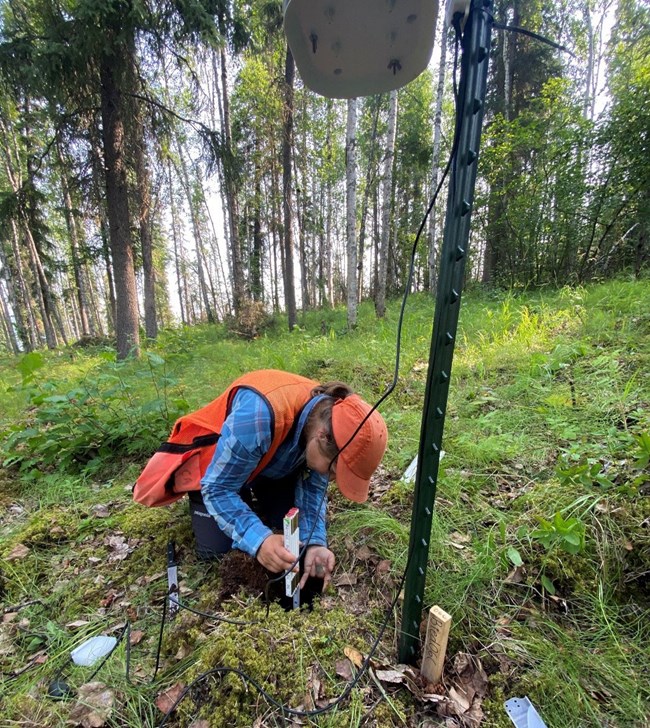
Eastern Area Fire Management team member installing temperature and moisture loggers. NPS
The area around the Biederman allotment is primarily black spruce forest underlain with mostly continuous permafrost. Active layer thickness, the layer of seasonally thawed soil above permafrost, is around 50 cm in this area. Near surface permafrost is the driving factor in what plant species grow and is a major control on tree growth rate. Permafrost forms the physical fountain on which these plant communities live and harbors large amounts of carbon in the organic rich soil horizons. As our climate warms, the soil temperatures in this area are at or near the thawing point and additional disturbance, such as an unshaded fuel break, is likely to accelerate this process.
The newly installed unshaded fuel break presented an opportunity to measure the ecological effects of this type of fuel break on plant species composition, active layer depth, and microclimate conditions. In their first year in operation, the NPS Eastern and Western Area Fire Management Ecology teams (photo to the right) installed paired monitoring plots around the Biederman allotment in the fuel break and surrounding natural forest. A small portion of shaded fuel break remained, and they were able to install one plot in this fuel break type.

Active layer thickness, or depth to permafrost, in the plots in natural forest (in green) and in the shaded (in blue) and unshaded (in orange) fuel breaks. Active layer thickness was significantly greater in the unshaded fuel break relative to the control due to thawing permafrost. NPS
The team also set up air and soil temperature as well as soil moisture loggers in the shaded and unshaded fuel breaks. While analyses of plant species composition are ongoing and microclimate loggers are still recording data, the team could immediately see a significant difference in active layer thickness between the two study areas (graphic to the right), with the depth to permafrost being about 30 cm deeper in the unshaded fuel break compared to the natural forest. The information gathered from these monitoring plots will help inform decisions about fuel break types as land managers balance the need for reducing wildfire risk to allotments with other park values.
Where this belongs
- Yukon - Charley Rivers National Preserve
Where this page came from
This page was imported from National Park Service. Produced by the U.S. National Park Service and, as a work of the United States government, in the public domain.
Nobody has written it yet — it is the source material at a new address, which is why search engines are asked to skip it and why no one earns from it. It is up for grabs: take it on, and it is yours to rewrite and to earn from.
In these collectionsYukon - Charley Rivers National Preserve
Licence: CC0 1.0 (public domain) · Adapted from www.nps.gov
1
0
0
0

Comments
Read next


