
Pearl Harbor was only one target. Within a few hours on December 7, 1941, Japan struck Hawai'i, Guam, Howland Island, Midway Island, Wake Island and the Philippines — all part of the American home front. The attacks hit not only military targets but sugar mills and the Honolulu airport in Hawai'i, the Pan Am hotels on Guam and Wake Island, and the settlement on Howland Island. Hundreds of civilians died that day, some as young as 3 months old. Among them were two colonists on Howland Island, doomed when the United States had refused to pick them up earlier in the year.
Occupation
American forces drove back the attackers in many places, but Japan quickly took control of Guam, the Philippines and Wake Island. Civilians there suffered greatly: they lost homes and family members and endured forced marches, forced labor, internment and incarceration, starvation, injury and execution. The United States eventually took these places back, but the damage done by both sides was often extreme.
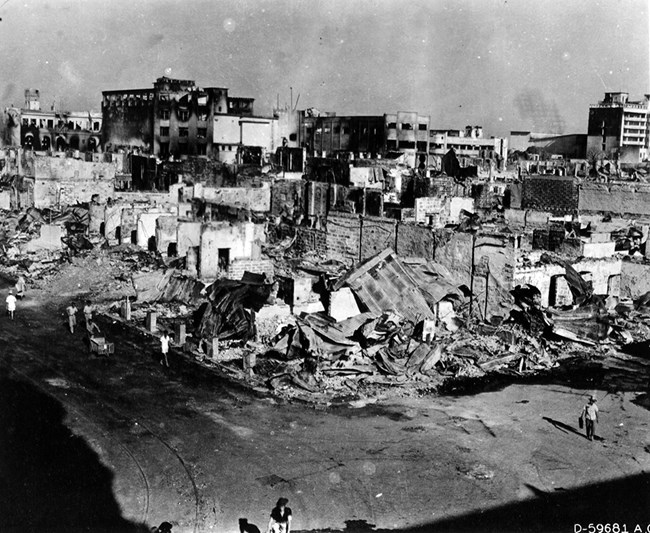
Bomb damage in downtown Manila, February 1945. The Japanese occupation caused considerable damage, but U.S. bombing during the recapture devastated the islands. Credit: National Archives and Records Administration (NAID 204952271).
"This is no joke. This is war!"
The attack on Pearl Harbor began at 7:50 a.m. Oahu time (12:50 p.m. Eastern) and ended at 10 a.m. News reached American homes almost at once:
- NBC radio broadcast the first report while the attack was still under way. As the Japanese withdrew from Pearl Harbor, word came that the Philippines had been bombed too, and a reporter in Honolulu told a live feed to New York, "This is no joke. This is war!"
- Eleanor Roosevelt learned of the attack as she prepared for her popular afternoon radio show. While the President met with his Cabinet, she told her listeners what had happened, then went on with her planned broadcast.
- In Manitowoc, Wisconsin, the local radio station stayed open around the clock so residents could come in for the latest news off the teletype.
- Less than three hours after the attack began, the War Department ordered 1.5 million draftees into uniform "by tomorrow," all Japanese people in Norfolk, Virginia, were arrested, and the Territory of Hawai'i was placed under martial law.
The next day, Franklin D. Roosevelt called December 7, 1941, "a date which will live in infamy." Citing the attacks on Hawai'i, Guam, the Philippines, Wake Island and Midway, he asked Congress to declare war on Japan. It did, with a single vote against — the pacifist Jeannette Rankin. Germany and Italy, Japan's allies, then declared war on the United States, and America was fighting a world war on several fronts.
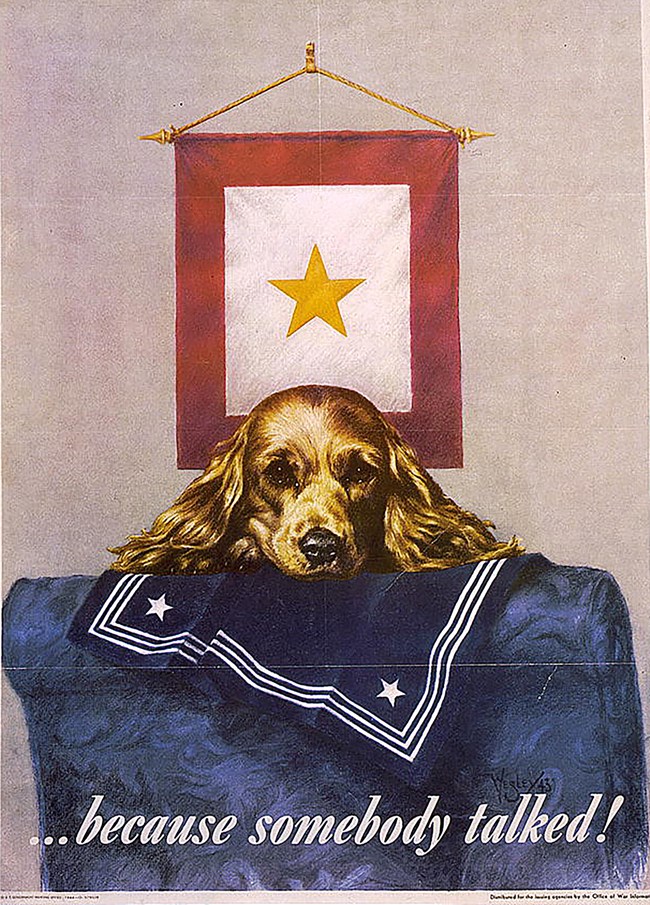
"…because somebody talked!" Office of War Information poster, 1944. A gold star meant a family member had died in the war; cocker spaniels were then America's most popular family dog. Credit: Library of Congress.
A new landscape
The country had already done much to prepare, but there was far more to do.
| Industry | New factories were built and old ones expanded and retooled. Millions moved to industrial areas for work, causing local housing shortages |
| Work | Women and enemy prisoners of war filled jobs left by men who went to war. Unemployment fell to 1.2% by 1944 |
| The draft | Everyone from 18 to their 65th birthday had to register, fathers lost their exemption, and African Americans began to be drafted in larger numbers than before |
| The Alaska Highway | Approved and begun early in 1942, to give the military access to settlements in Alaska |
The war was everywhere. Products vanished from stores. Towns near training camps and ports of embarkation filled with uniforms. Radio shows, Hollywood films and books for all ages took on patriotic themes, and posters, the government and celebrities urged people to buy war bonds, save scrap, plant victory gardens and be cautious. "Remember Pearl Harbor!" appeared on decals, pins, posters and jewelry.
It reached into homes, too. Families hung blue and gold stars in their windows. Rationing began; civilians collected and donated materials for the war effort and planted victory gardens, preserving what they grew; some turned to illicit markets for rationed goods. Many found themselves working and living in very different conditions. Some were interned or incarcerated, some lived under military rule, and some saw themselves, their homes and their businesses come under attack.
Places to remember
- Wake Island: sites and artifacts from World War II and the Pan Am era were designated a National Historic Landmark on September 16, 1985.
- The Alaska Highway: part of the original route, the Alaska-Canada Military Highway (Segment), was added to the National Register of Historic Places on July 31, 2013.
A note on words
The article follows Densho's guidance: "internment" properly describes the detention of "enemy aliens" in wartime — about 8,000 Issei (first-generation Japanese immigrants) were arrested and held in camps run by the Army or the Justice Department. For American citizens held by their own government — two-thirds of the Japanese Americans incarcerated during the war were citizens by birth — "incarceration" is the accurate word.
Sources
Based on "The American Home Front During World War II: A Date That Will Live in Infamy," written by Megan E. Springate, University of Maryland, for the National Park Service Cultural Resources Office of Interpretation and Education, part of the series The American Home Front and World War II; a work of the United States government in the public domain. The original cites, among others, Franklin D. Roosevelt's joint address to Congress (National Archives), Eleanor Roosevelt's radio address of December 7, 1941, and the live Honolulu broadcast preserved by History Matters.
Licence: CC0 1.0 (public domain) · Adapted from www.nps.gov
1
0
0
0

Comments


